


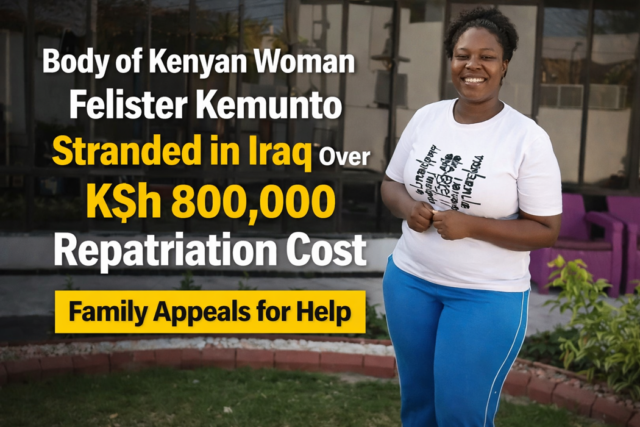
The body of Felister Kemunto, a 32-year-old Kenyan woman who died while working in Iraq, remains stranded in Baghdad as her family struggles to raise the KSh 800,000 required to repatriate her remains to Kenya.
Felister, who hailed from Kisii County, passed away in December 2025 after reportedly falling ill with suspected respiratory complications while working as a domestic worker in Iraq. Her family says she had recently extended her three-year employment contract. Subsequently, her health suddenly deteriorated.
According to her relatives, Felister was taken ill and later died in Baghdad. However, her body has remained in the custody of authorities and her employer. This is because her family cannot afford the high cost of transporting her remains back home.
So far, the family has only managed to raise KSh 50,000 through local fundraising efforts — far below the amount needed to cover embalming, documentation, air freight, and other logistical expenses.
Threat of Cremation Raises Alarm
In a development that has deeply distressed the family, Felister’s employer in Iraq has allegedly warned that her body may be cremated if the repatriation costs are not settled within two months. This practice goes against the family’s cultural and religious beliefs.
“We are devastated. We want our daughter brought home so we can bury her with dignity among her people,” a family member said.
The family says they have reached out to Kenyan government authorities for help but have not yet received any official assistance.
Appeal to Government and Well-Wishers
Felister’s relatives are now appealing to the Kenyan government, the Ministry of Foreign Affairs, the Kenyan Embassy in Iraq, and well-wishers. They seek help to raise the remaining funds and facilitate the repatriation process.
They say the financial burden is overwhelming for a rural family that depended heavily on Felister’s income. Moreover, they fear time is running out.
Human rights activists have also raised concerns about the treatment of Kenyan migrant workers in the Middle East. They are calling on the government to strengthen protections and emergency support mechanisms for citizens working abroad.
Growing Crisis for Kenyan Migrant Workers
Felister’s case highlights a growing pattern where Kenyan migrant workers die abroad. Consequently, families are left struggling with expensive repatriation costs that often run into hundreds of thousands of shillings.
Labor rights advocates are urging the government to establish a repatriation fund. Additionally, they call for stronger bilateral agreements to ensure Kenyan workers are protected. Families should not be left helpless in times of tragedy.
As the family continues to appeal for help, Felister’s body remains in Baghdad — her final journey home still uncertain.