

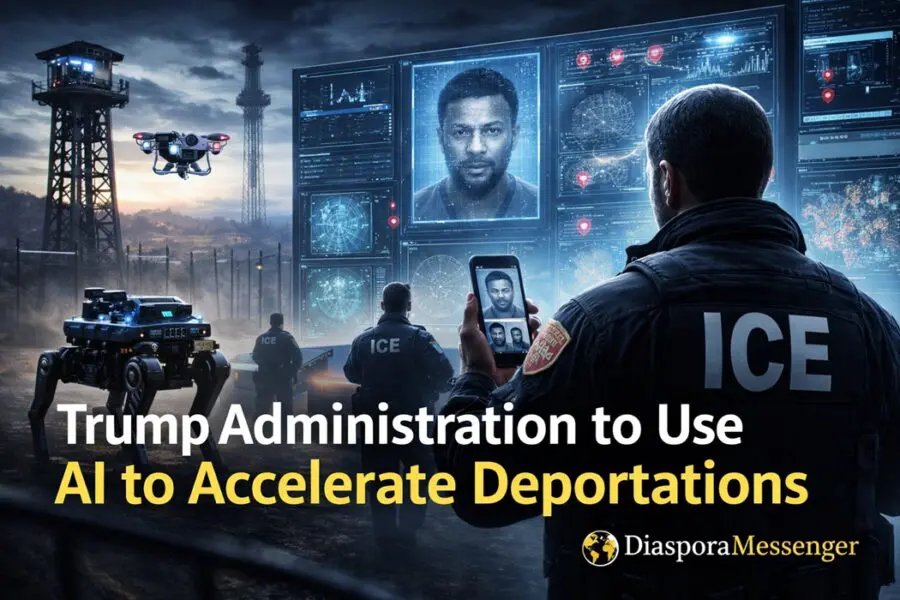
The use of artificial intelligence (AI) in immigration enforcement has entered a new phase, with the Trump administration significantly expanding digital tools to accelerate deportation processes across the United States.
This shift marks one of the most technologically driven approaches to immigration control in modern history—raising both operational efficiency and serious civil liberties concerns.
AI at the Center of U.S. Deportation Strategy
At the core of the administration’s strategy is a suite of AI-powered platforms designed to automate and streamline how immigration authorities identify, track, and deport noncitizens.
ImmigrationOS (Palantir)
One of the most critical tools is ImmigrationOS, developed by Palantir Technologies. This system integrates vast datasets—including immigration records, criminal histories, and alleged gang affiliations—to identify individuals considered “removable.”
Using AI-driven analytics, ImmigrationOS generates “actionable leads” for Immigration and Customs Enforcement (ICE), dramatically reducing the time required for case identification and prioritization.
ELITE: Generative AI for Data Extraction
Another powerful tool, ELITE, leverages generative AI to extract information from handwritten documents such as warrants and police reports. The system converts unstructured data into usable intelligence, identifying addresses and mapping potential targets.
It also assigns “confidence scores” based on data completeness—allowing agents to prioritize enforcement actions with higher probability of success.
Mobile Fortify: Facial Recognition in the Field
Field agents are increasingly equipped with Mobile Fortify, a facial recognition application that enables real-time identity verification. By scanning an individual’s face, the app compares it against government databases to confirm identity within seconds.
This technology has expanded ICE’s ability to conduct on-the-spot enforcement operations, particularly in high-traffic urban and border regions.
Babel Street: Social Media Surveillance
Through software developed by Babel Street, immigration authorities can monitor social media activity and open-source data. The system is used to verify traveler identities and flag individuals deemed potential risks.
This expansion into digital surveillance has significantly broadened the scope of immigration enforcement beyond physical borders.
Border Surveillance: Robots and Autonomous Systems
At the southern border, advanced surveillance technologies—including autonomous towers and robotic systems—are being deployed to predict and detect migration activity.
These tools rely on machine learning to analyze movement patterns and environmental data, enabling proactive border enforcement.
“Hurricane Score”: Predicting Compliance Risk
A controversial addition is the “Hurricane Score,” an AI-generated metric that assesses a detained migrant’s likelihood of evading supervision. This score influences whether individuals are detained or released pending immigration proceedings.
Critics argue that such predictive scoring systems risk embedding bias into critical legal decisions.
Legal Challenges and Operational Failures
Despite the rapid rollout of these technologies, the administration’s AI-driven approach has encountered significant legal and operational obstacles.
Federal courts, including the Supreme Court of the United States, have intervened to block or limit certain fast-track deportation measures. Notably, attempts to invoke the Alien Enemies Act of 1798 for expedited removals were curtailed, with courts emphasizing the need for due process—such as individualized notice and the opportunity to contest deportation.
In addition, AI implementation has not been without setbacks. An automated recruitment system used to hire new ICE officers reportedly misclassified thousands of applicants, labeling unqualified civilians as experienced law enforcement personnel. The result was a surge of under-trained recruits entering the field—raising concerns about safety and operational effectiveness.
Civil Liberties Concerns and Global Implications
Human rights organizations, including Freedom House, have warned that the expanding use of AI in immigration enforcement risks creating a “surveillance dragnet.”
Critics argue that:
- AI systems may produce biased or inaccurate results
- Individuals could be flagged or detained based on flawed data
- Due process protections may be undermined by automated decision-making
For immigrant communities—including the Kenyan diaspora in the United States—these developments carry significant implications. Increased surveillance and automated enforcement may heighten fears around privacy, profiling, and legal vulnerability.
A New Era of Immigration Enforcement
The integration of artificial intelligence into deportation systems represents a fundamental shift in how immigration enforcement is conducted. While proponents argue that these tools enhance efficiency and public safety, the growing reliance on AI also raises complex legal, ethical, and human rights questions.
As the debate continues, the balance between national security and individual rights remains at the center of America’s evolving immigration landscape.




 in immigration enforcement has entered)