


Kenya is quietly overhauling how young people and adults are trained for the workforce. At the heart of this transformation is CBET, or Competency-Based Education and Training—a model that prioritizes practical ability over paper qualifications.
If you’ve been hearing about CBET from training institutions, education forums, or even relatives back home, this article will break down what it really means, how it works, and why it’s a big deal for Kenya’s job market—and for diaspora Kenyans who want to stay connected or invest in local skills development.
What Is CBET?
CBET stands for Competency-Based Education and Training—an approach to training that equips learners to meet industry standards in real-life tasks. Rather than learning passively through lectures or textbooks, learners in a CBET program must demonstrate their ability to perform specific, job-related tasks.
Whether it’s repairing a motorbike, installing a solar panel, or preparing food in a commercial kitchen, success in a CBET program is measured by what the learner can actually do—not how long they sat in class.
This model is part of Kenya’s broader effort to modernize technical training and is overseen by key institutions like TVET CDACC and TVETA, which are responsible for curriculum development and regulation of vocational institutions across the country.
Why Kenya Adopted the CBET Model
Kenya’s former technical training systems were heavily academic and exam-driven. Students often graduated with diplomas and certificates, yet lacked the hands-on skills that employers were looking for. This created a frustrating disconnect between education and employment.
CBET was introduced to fix this disconnect and address several challenges:
-
The growing number of jobless graduates with limited work-ready experience
-
Industry’s need for competent, certified technicians and artisans
-
The rise of self-employment and informal work as viable career paths
CBET is not just a curriculum update; it’s a complete rethinking of what it means to be “qualified” in today’s economy.
Key Differences: CBET vs Traditional Training
Here’s how the CBET system compares to the older, more conventional models of vocational education:
| Element | Traditional Model | CBET Model |
|---|---|---|
| Curriculum | Linear and time-bound | Modular and flexible |
| Learning focus | Theory-heavy | Skills- and task-oriented |
| Assessment | Written exams | Performance-based (practical tasks, POE) |
| Learner progression | Based on time (e.g., 3-year programs) | Based on competence (learn at own pace) |
| Certification | One final certificate | Multiple modular certifications |
| Recognition | Limited for informal skills | Allows RPL (Recognition of Prior Learning) |
How CBET Actually Works in Practice
1. Training Based on Industry Needs
Each CBET program is designed around occupational standards—real-world expectations created with input from employers and industry experts. These standards outline exactly what a competent professional in a given field should be able to do.
For instance, an automotive student might be expected to:
-
Diagnose mechanical faults
-
Use diagnostic tools properly
-
Adhere to safety standards in repairs
2. Modular Course Structure
CBET breaks down courses into smaller units or modules, each covering a specific skill. This makes it easier for learners to:
3. Evidence-Based Assessment
Instead of relying solely on tests, CBET learners compile a Portfolio of Evidence (PoE) that documents their ability to carry out specific tasks. This portfolio is reviewed by certified assessors before a learner is approved for certification.
4. Recognition of Prior Learning (RPL)
CBET acknowledges that many Kenyans—especially in the informal sector or diaspora—already have valuable skills. With RPL, such individuals can earn formal recognition for those skills without repeating training they’ve already mastered.
Why CBET Matters—At Home and Abroad
It Improves Employability
CBET graduates leave institutions with relevant, hands-on experience that directly matches employer needs. Whether in hospitality, construction, agriculture, or ICT, they are far better prepared for real work environments than their traditionally trained counterparts.
It Supports Flexible Learning
Because of its modular and self-paced format, CBET is ideal for adult learners, workers looking to reskill, and people managing other responsibilities like parenting or business.
It Encourages Entrepreneurship
Many CBET-trained individuals go on to start their own businesses. With practical skills and strong training in areas like costing, customer service, and quality control, self-employment becomes a natural next step.
It Advances Kenya’s Development Goals
CBET is tightly aligned with Kenya’s Vision 2030 and the Big 4 Agenda, especially in creating a technically skilled workforce for critical sectors such as healthcare, housing, and manufacturing.
What’s Holding CBET Back?
Despite its potential, the rollout of CBET in Kenya has not been without obstacles:
-
Learn in phases
-
Rejoin training later if they take a break
-
Specialize in areas relevant to their goals
- Capacity gaps: Some trainers were trained in theory-heavy systems and are still adapting to the CBET methodology.
-
Equipment shortfalls: Several TVET institutions lack the modern tools needed for hands-on, industry-standard training.
-
Limited awareness: Many learners and parents still prioritize university degrees over technical skills, despite the job market realities.
-
Mixed systems: Some colleges run both CBET and old-style programs, leading to confusion about standards and certification.
Nonetheless, the Ministry of Education, development partners, and private institutions are continuing to invest in CBET infrastructure, trainer development, and public outreach.
What Does This Mean for You?
For Students:
CBET offers a faster, more relevant, and more empowering path to earning a living—whether you’re seeking formal employment or self-employment.
For Parents:
It provides a credible alternative to academic tracks, especially for children who are more practical-minded or who thrive in hands-on environments.
For Employers:
CBET ensures access to a growing pool of work-ready professionals who are trained on current tools, practices, and expectations.
For the Diaspora:
CBET creates powerful opportunities to:
-
Sponsor skills training back home
-
Mentor young people entering trades
-
Partner with institutions to offer internships or equipment
-
Support returnees through RPL certification
A Note on Institutions Leading the Way
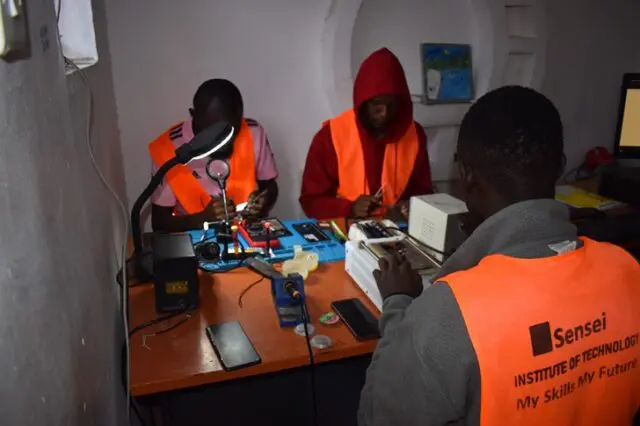
Institutions like Sensei Institute of Technology are playing a crucial role in making CBET a reality. With campuses across Kenya and a curriculum fully aligned to CBET standards, Sensei offers short modular programs in fields like plumbing, automotive, agribusiness, and ICT.
By focusing on performance-based training, entrepreneurship, and real-world application, Sensei and others are proving that CBET is more than a policy—it’s a transformative tool for economic mobility.
Final Word
CBET is helping Kenya rethink education from the ground up—placing value on ability, not just academic achievement. It recognizes the dignity of skilled work, the power of flexibility in learning, and the importance of aligning education with the modern economy.
As the system gains traction, it’s creating opportunities not only for learners and trainers, but for Kenya’s entire economy—including the diaspora, whose experience, resources, and voice can help shape the future of CBET for generations to come.