


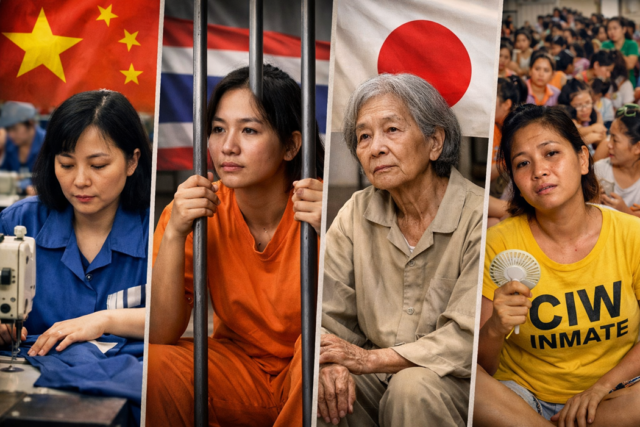
Across Asia, the number of female prisoners has been steadily rising, revealing deep social, economic, and legal challenges affecting women. From China’s vast prison system to Thailand’s drug-related incarcerations, women across the continent face unique realities behind bars. This article explores where Asian female prisoners are most concentrated, why incarceration rates are rising, and how international standards like the Bangkok Rules aim to protect women in detention.
China and Thailand Lead in Female Prison Populations in Asia
China and Thailand stand out as the Asian countries with the highest number of women prisoners.
- China has approximately 145,000 female inmates, making it the second-highest globally after the United States.
- Thailand follows with an estimated 33,000 women prisoners, one of the highest proportions of women in prison worldwide.
These figures highlight how criminal justice systems across Asia disproportionately affect women, particularly those from low-income and marginalized backgrounds.
Drug-Related Offenses Drive Female Incarceration in Asia
In many Asian countries, drug-related crimes are the leading cause of women’s imprisonment. Harsh drug laws, mandatory sentencing, and limited access to legal defense place women—often first-time or non-violent offenders—at high risk of incarceration.
Countries such as Thailand, the Philippines, and China enforce strict drug policies, and women are frequently imprisoned for low-level trafficking, possession, or acting under coercion from partners or criminal networks.
Overcrowding Crisis: The Philippines’ Women’s Prison System
In the Philippines, conditions for female inmates are particularly alarming. The Correctional Institution for Women (CIW) was designed to hold 1,000 inmates but currently houses over 3,300 women.
This extreme overcrowding affects:
- Access to healthcare
- Sanitation and hygiene
- Mental health services
- Safety and dignity
Overcrowded prisons also increase the risk of disease, violence, and human rights violations, especially for pregnant women and mothers with children.
Japan’s Aging Female Prison Population
Japan presents a unique case in Asia. A growing number of elderly women prisoners intentionally commit minor crimes such as shoplifting to be incarcerated.
For many older women, prison offers:
- Regular meals
- Stable housing
- Access to healthcare
- Social interaction
This trend exposes broader issues of elderly poverty, social isolation, and inadequate welfare support outside prison walls.
Rehabilitation in China: Labor and “Educational Reform”
In China, rehabilitation for female prisoners often includes compulsory labor and “educational reform.” These programs may involve:
- Factory or agricultural labor
- Political or moral education
- Traditional culture studies
- Psychological therapy
While officially framed as rehabilitation, human rights advocates have raised concerns about coercion, labor conditions, and the lack of voluntary participation.
The Bangkok Rules: Protecting Women Prisoners’ Rights
Recognizing that women have different needs in detention, the United Nations adopted the Bangkok Rules in 2010.
Formally known as the UN Rules for the Treatment of Women Prisoners and Non-Custodial Measures for Women Offenders, the Bangkok Rules address:
- Menstrual hygiene and sanitation
- Gender-specific healthcare
- Pregnancy and childbirth in prison
- Mental health support
- Maintaining contact with children
While widely endorsed, implementation across Asian prison systems remains inconsistent.
The Bigger Picture: Women, Poverty, and Justice in Asia
The rising number of Asian female prisoners reflects deeper structural problems:
- Poverty and lack of education
- Gender-based violence
- Unequal access to justice
- Harsh sentencing laws
Without gender-sensitive reforms, prisons will continue to serve as a last-resort safety net rather than a place of rehabilitation.
Conclusion
From China’s massive female prison population to Thailand’s drug-related incarcerations and Japan’s elderly women behind bars, the experiences of female prisoners in Asia reveal urgent human rights and social welfare challenges. Implementing the Bangkok Rules, reforming drug laws, and expanding community-based alternatives to incarceration are critical steps toward a more just and humane system.