


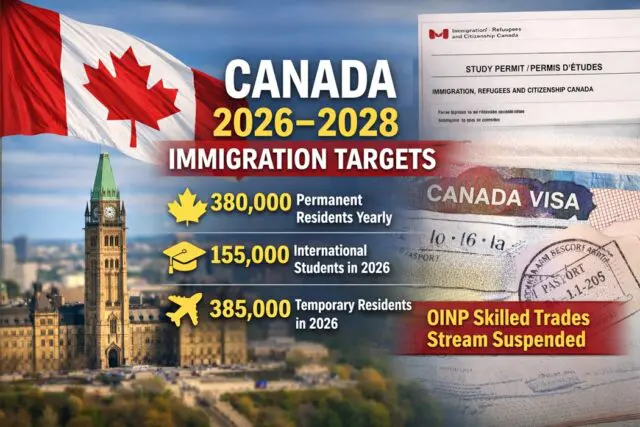
Canada has released its new 2026–2028 Immigration Levels Plan, outlining significant changes to how many people the country will admit and under what categories — marking one of the most consequential immigration policy shifts in recent years.
The plan, published by Immigration, Refugees and Citizenship Canada (IRCC), maintains permanent resident admissions at 380,000 per year through 2028, while sharply reducing the number of temporary residents, particularly international students and other short-term visa holders.
The changes reflect Ottawa’s effort to manage housing pressure, healthcare strain, infrastructure demand, and rising public concern over rapid population growth.
Permanent Residence Targets Remain Stable
Under the new plan, Canada will admit:
- 380,000 permanent residents annually in 2026, 2027, and 2028.
This stability signals that Canada remains committed to long-term immigration as a core driver of economic growth, workforce renewal, and demographic sustainability — particularly to address labor shortages and an aging population.
Temporary Resident Numbers to Be Reduced
The biggest structural shift is the sharp reduction in temporary resident inflows:
- 385,000 temporary residents in 2026
- 370,000 in 2027 and 2028
The federal government aims to lower Canada’s temporary resident population to below 5% of the total population by 2027, down from recent peaks driven largely by international students, temporary foreign workers, and humanitarian programs.
International Student Intake Cut Nearly in Half
The most dramatic impact is on international students.
According to the plan:
- International student permits are expected to fall from about 305,000 in 2025 to 155,000 in 2026
- This represents a 49% reduction in new student intakes
This move follows growing concern about:
- Housing shortages in major cities
- Exploitation by low-quality private colleges
- Fraud and abuse in student visa programs
- Pressure on healthcare and public services
The government has indicated it wants to prioritize quality over quantity, focusing on institutions with stronger oversight and students with clearer pathways to skilled employment or permanent residence.
Ontario Suspends OINP Skilled Trades Express Entry Stream
In a related development, the Ontario Immigrant Nominee Program (OINP) has suspended its Express Entry: Skilled Trades Stream.
The suspension followed a program review that uncovered:
- Systemic misrepresentation
- Compliance failures
- Difficulty verifying whether applicants met eligibility criteria
As a result, the OINP Director determined that the province could no longer reliably assess applications under that stream until safeguards and verification mechanisms are strengthened.
This decision affects thousands of skilled trades workers who had been relying on Ontario as a primary pathway to permanent residence.
What This Means for Immigrants and International Applicants
These changes mean:
- Fewer opportunities for international students seeking to study in Canada
- Tighter scrutiny of temporary visa pathways
- More emphasis on high-skill, high-integrity permanent migration
- Greater enforcement against fraud, misrepresentation, and program abuse
Applicants will now face:
- Higher competition for student permits and work visas
- Stricter documentation requirements
- Longer processing times in some categories
Canada Signals Shift Toward Controlled and Sustainable Immigration
The 2026–2028 plan marks a clear policy pivot: Canada is not closing its doors, but it is becoming more selective.
The federal government says the new approach is designed to balance immigration with housing capacity, service delivery, and economic integration — ensuring that immigration remains sustainable, trusted by the public, and beneficial to both newcomers and existing residents.
For prospective migrants, students, and workers, the message is clear: Canada remains open — but the bar is rising.
Conclusion
Canada’s 2026–2028 Immigration Levels Plan represents one of the most significant recalibrations in its modern immigration history. While permanent residence targets remain strong, the sharp cut in international student intake and the tightening of temporary pathways signal a new era of stricter controls and higher standards.
For anyone planning to study, work, or migrate to Canada, careful planning, accurate documentation, and early application will now be more important than ever.