

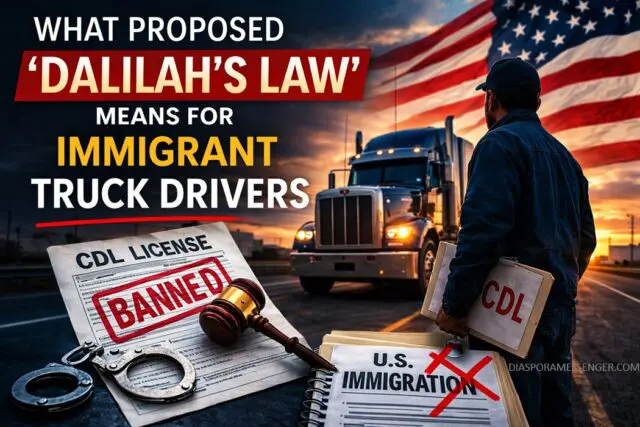
Proposed during Donald Trump’s 2026 State of the Union address, Dalilah’s Law is a sweeping federal proposal that could fundamentally reshape who is eligible to work as a commercial truck driver in the United States.
The legislation is named after Dalilah Coleman, a young girl who was severely injured in a 2024 traffic crash involving an undocumented truck driver. The Trump administration has framed the proposal as a road-safety measure aimed at closing regulatory gaps between states and enforcing stricter federal standards for Commercial Driver’s Licenses (CDLs).
For immigrant truck drivers—and the freight industry at large—the implications are significant.
What Is Dalilah’s Law?
At its core, Dalilah’s Law seeks to federalize and tighten CDL eligibility rules, removing discretion from individual states. Supporters argue that inconsistent state policies have allowed unqualified or undocumented drivers to operate commercial vehicles, putting public safety at risk.
Critics, however, warn the law could accelerate labor shortages in an industry already under pressure.
Key Provisions of the Proposed Law
1. Ban on Undocumented Immigrants Holding CDLs
Dalilah’s Law would explicitly prohibit states from issuing CDLs to individuals without lawful immigration status. Any existing state-level policies that allow undocumented immigrants to obtain commercial licenses would be overridden.
The administration describes this as closing a “dangerous loophole” in the national licensing system.
2. Mandatory English-Only CDL Testing
A central pillar of the proposal is strict English language proficiency enforcement.
Under the law:
- All CDL written and practical exams must be administered exclusively in English
- Drivers must demonstrate the ability to read road signs and communicate effectively with law enforcement and inspectors
Recent guidance from the Department of Transportation and the Federal Motor Carrier Safety Administration already moves in this direction, but Dalilah’s Law would make these standards mandatory nationwide.
3. Restricted CDL Eligibility for Non-Citizens
Even lawful immigrants would face tighter rules. CDL eligibility would be limited to specific visa categories, including:
- H-2A (temporary agricultural workers)
- H-2B (temporary non-agricultural workers)
- E-2 (treaty investors and employees)
Other temporary visa holders—and individuals with pending or transitional status—could lose eligibility under the new framework.
4. Immediate License Revocations
The proposal mandates automatic revocation of existing CDLs held by:
- Undocumented immigrants
- Drivers with temporary or non-qualifying immigration status
States would be required to conduct reviews and comply with federal enforcement timelines, leaving little room for appeals.
5. Increased Audits and Enforcement
The administration has already begun aggressive audits of state-issued CDLs, signaling how enforcement would unfold if the law passes.
Previous federal memos discouraging officers from sidelining drivers for limited English proficiency have been withdrawn, paving the way for stricter roadside enforcement and compliance checks.
Human rights organizations, including Refugees International, have raised concerns about due process, worker displacement, and unintended consequences for immigrant communities.
Impact on the Trucking Industry and Economy
Industry analysts warn that Dalilah’s Law could remove thousands of immigrant drivers from the workforce, worsening an already critical driver shortage.
Potential ripple effects include:
- Higher shipping and freight costs
- Delays in supply chains
- Increased pressure on domestic recruitment and training programs
- Reduced capacity for long-haul and cross-border freight
Supporters counter that safety and uniform standards outweigh economic concerns, arguing that stricter licensing will ultimately protect both drivers and the public.
What This Means for Immigrant Truck Drivers
For immigrant drivers—especially those in the Kenyan and broader African diaspora—the proposal introduces major uncertainty. Drivers currently working under state-issued CDLs may face sudden job loss, while aspiring drivers could find the pathway into trucking effectively closed.
Legal experts advise affected drivers to:
- Review immigration status carefully
- Seek qualified legal counsel
- Monitor federal rulemaking closely as the proposal moves through Congress
The Bigger Picture
Dalilah’s Law fits squarely within the Trump administration’s broader immigration and enforcement agenda, blending public safety arguments with stricter immigration controls. Whether it becomes law or is modified through legislative debate, its introduction alone has already begun reshaping conversations across the trucking industry.
For immigrant truck drivers, the message is clear: the regulatory landscape is shifting fast—and the stakes are high.