

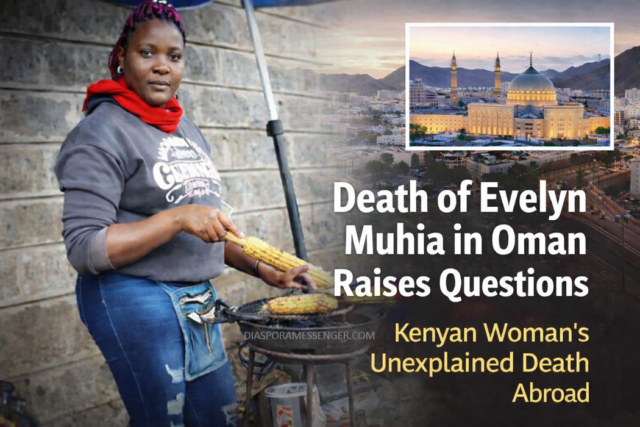
The death of Evelyn Muhia, a Kenyan woman who had recently traveled to Oman in search of better opportunities, has sparked concern, grief, and difficult questions within the Kenyan diaspora community.
Evelyn’s passing in February 2026 under unclear circumstances has renewed debate about the safety of Kenyan domestic workers in the Gulf region and the urgent need for stronger government oversight and safe migration pathways.
From Gitanga Road to the Gulf
Before traveling abroad, Evelyn Muhia was known to many in Nairobi’s Lavington area as a hardworking vendor selling roasted maize (mahindi choma) along Gitanga Road. Friends describe her as resilient and determined to improve her circumstances.
Like many Kenyans facing economic hardship, she made the decision to seek employment in the Middle East — a move thousands undertake each year in hopes of earning better wages and supporting families back home.
Reports indicate that she traveled to Oman without informing some members of her family about her plans. Shortly after her arrival, she began working, but her stay was brief.
Health Concerns and Employment Dispute
According to friends in Oman, Evelyn had been experiencing persistent leg and foot pain. The pain was allegedly linked to a prior accident she had been involved in while still in Kenya.
After approximately one month at her initial workplace, she reportedly left her employer — a practice commonly referred to among migrant workers as “kemboing,” where a domestic worker leaves their assigned employer, often due to disputes, harsh conditions, or unmet expectations.
Shortly thereafter, she was found dead in a different area under circumstances that remain unclear.
Her body was repatriated to Kenya in late February 2026 for burial, bringing closure to her family but leaving many questions unanswered.
Rising Concerns Over Kenyan Domestic Workers in the Gulf
Evelyn Muhia’s death has reignited ongoing conversations about:
- Working conditions for Kenyan domestic workers in Oman and other Gulf states
- Recruitment agency oversight and accountability
- The risks associated with irregular job transitions (“kemboing”)
- Access to medical care for migrant workers
- Government response mechanisms when tragedies occur
Kenya has in recent years signed bilateral labor agreements with several Gulf countries aimed at protecting migrant workers. However, advocacy groups and diaspora leaders argue that enforcement gaps remain.
Many Kenyans working in the Middle East are employed in domestic roles where labor protections may be limited compared to other sectors. Isolation, passport confiscation, contract substitution, medical neglect, and limited mobility are among the challenges often cited by worker rights organizations.
Calls for Safer Migration Channels
Evelyn’s story has intensified calls for:
- Stricter vetting of recruitment agencies
- Mandatory pre-departure health screenings and insurance coverage
- Stronger embassy monitoring and welfare checks
- Emergency hotlines for distressed workers
- Clear reporting channels for labor disputes
Diaspora leaders are also urging families to maintain open communication with loved ones traveling abroad and to ensure all migration processes are documented and legally compliant.
A Broader Conversation for the Kenyan Diaspora
For many in the Kenyan diaspora community, Evelyn Muhia’s death is not just an isolated tragedy — it reflects the vulnerability of low-income migrant workers navigating unfamiliar legal systems and cultural environments.
Her journey from selling roasted maize in Nairobi to seeking opportunity in Oman underscores the economic pressures driving migration — and the risks some workers face once abroad.
As her family lays her to rest in Kenya, the larger questions remain: How can Kenya strengthen protections for its migrant workers? Are current bilateral agreements enough? And what more can be done to prevent similar tragedies in the future?
Evelyn Muhia’s story has become a sobering reminder that behind every labor migration statistic is a human life, a family, and a community deeply affected.