


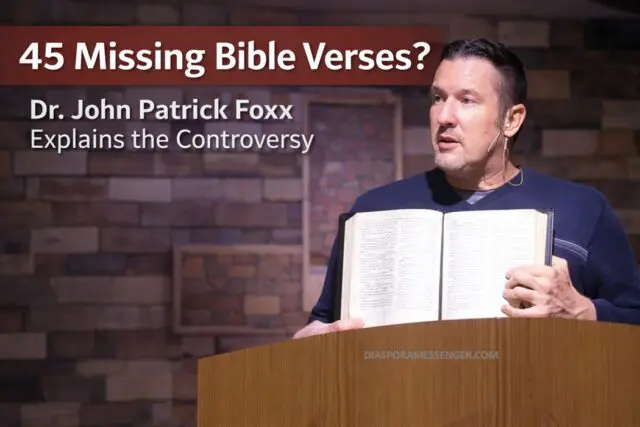
A growing online debate—now widely shared across diaspora Christian communities—claims that modern Bible translations have removed up to 45 verses and over 120 divine titles. One of the most vocal proponents of this view is Dr. John Patrick Foxx, often referred to as Doc Foxx.
For many Kenyan diaspora believers in the United States, Canada, the UK, and beyond, this discussion raises critical questions:
- Are modern Bibles like the NIV or ESV incomplete?
- Were verses intentionally removed?
- Which Bible translation should Christians trust?
This article provides a balanced, SEO-optimized explanation to help readers understand both perspectives.
Who Is Dr. John Patrick Foxx?
Dr. John Patrick Foxx is a Bible teacher known for his strong stance on Bible preservation and textual purity.
He argues that:
- Modern translations such as the New International Version (NIV), English Standard Version (ESV), and New Living Translation (NLT) are “mutilated”.
- Around 45 verses and over 120 divine names/titles of Jesus are missing.
- These omissions are based on reliance on “corrupt Alexandrian manuscripts.”
He promotes the Doc Foxx Translation of the Holy Bible, which he claims restores:
- Missing verses
- The name YHWH
- Original divine titles of Jesus Messiah
To restore the missing verses, Dr. John Patrick Foxx has written his own translation—the Doc Foxx Translation (DFT)—aimed at balancing accuracy, completeness, and readability.
Examples of “Missing Verses”
Some commonly cited verses include:
- Matthew 17:21
- Matthew 18:11
- Acts 8:37
In older translations like the King James Version (KJV), these verses appear fully in the text.
In many modern translations, they are either:
Placed in footnotes, or
Omitted from the main body
What Mainstream Biblical Scholars Say
Most biblical scholars and theologians strongly disagree with the idea that verses were maliciously removed. Their explanations include:
1. Older and More Reliable Manuscripts
Modern translations rely on ancient manuscripts such as:
- Codex Vaticanus
- Codex Sinaiticus
These manuscripts are older than those used for the KJV and often do not contain the disputed verses.
2. Scribal Additions Over Time
Scholars believe that some verses were:
- Added later by scribes
- Intended to clarify teachings or harmonize Gospel accounts
This means modern translations aim to reflect what is believed to be the earliest original text.
3. Transparency Through Footnotes
Most modern Bibles do not hide these verses. Instead, they:
- Include them in footnotes or brackets
- Clearly explain manuscript differences
This allows readers to see both textual traditions.
Alexandrian vs Byzantine Manuscripts: The Core Debate
At the heart of the issue is textual tradition:
Alexandrian Manuscripts
- Older (closer to original writings)
- Used by most modern translations
- Considered highly reliable by scholars
Byzantine Manuscripts
- Later copies
- More widely circulated historically
- Form the basis of the King James Version (KJV)
Doc Foxx supports the Byzantine tradition, believing it reflects divine preservation.
Why This Matters for the Kenyan Diaspora
For Kenyan Christians living abroad, this debate is more than academic—it touches on:
- Faith and doctrine
- Church teachings across denominations
- Personal Bible study choices
Many diaspora churches use different translations depending on:
- Pastoral preference
- Theological training
- Accessibility and readability
Key Takeaways
- The claim of “45 missing verses” is real in terms of textual differences, but interpretation varies.
- Doc Foxx views this as corruption, while scholars see it as textual refinement.
- Modern translations prioritize earlier manuscripts, not removal of truth.
- Most verses are not erased, but relocated to footnotes for transparency.
- The Doc Foxx Translation (DFT) represents one effort to restore and present what he believes is the complete biblical text.
Final Thought
Rather than dividing believers, this discussion can encourage deeper Bible study. Whether one prefers the KJV or modern translations like the NIV, ESV, or NLT, the central message of the Gospel remains unchanged:
Faith in God, salvation through Jesus Christ, and a life guided by Scripture.