

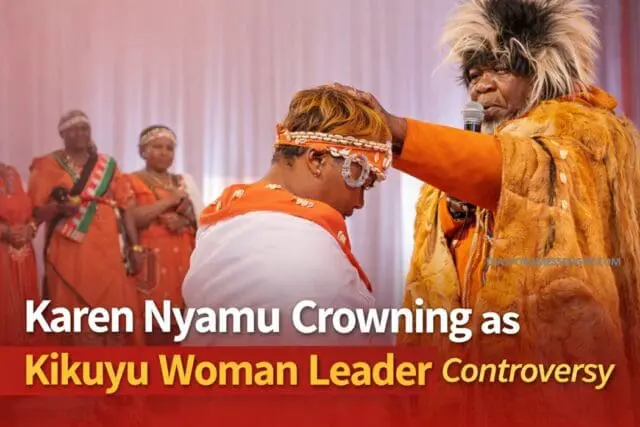
The recent crowning of Kenyan politician Karen Nyamu as a Kikuyu woman leader—commonly associated with the respected “Nyakinyua” status—has ignited widespread debate both in Kenya and across the Kenyan diaspora. While some have celebrated the moment as a sign of evolving cultural identity, others have raised concerns over whether traditional customs were upheld.
For many Kenyans living abroad, the controversy has opened deeper conversations about how culture should be preserved, interpreted, and adapted in a rapidly changing world.
What Is the “Nyakinyua” Title?
In Kikuyu tradition, the title “Nyakinyua” is not merely ceremonial—it carries deep cultural significance. It is typically reserved for senior women who have attained a certain status in society, often including:
- Having married children
- Being recognized as a moral and cultural guide
- Playing a leadership role among women in the community
The title symbolizes wisdom, maturity, and authority within Kikuyu cultural structures.
Why Karen Nyamu’s Coronation Sparked Controversy
1. Questions Over Cultural Qualifications
A major point of contention has been whether Karen Nyamu meets the traditional criteria for the title. Critics argue that the role is historically reserved for elder women whose children are already married—raising questions about adherence to long-standing customs.
2. Marital Status Debate
Traditionalists have also pointed to marital expectations. In many Kikuyu cultural settings, elder women leaders are expected to be married. The absence of a husband during the ceremony fueled online debate, with some questioning whether key cultural benchmarks were overlooked.
3. Ceremony Location and Ritual Practices
The ceremony, reportedly held at the Kenyatta International Convention Centre (KICC), drew criticism for taking place in a modern urban setting rather than a traditional environment.
Additionally, some observers noted deviations from customary rituals, such as elders praying with their eyes closed instead of facing Mount Kenya—a symbolic spiritual direction in Kikuyu culture.
4. Allegations Against Elders
Another controversial aspect has been public skepticism about the elders who officiated the ceremony. Some social media users alleged that financial incentives may have influenced the process, questioning the authenticity and integrity of the coronation.
While these claims remain unverified, they have contributed to the broader public discourse.
5. Public Image and Leadership Expectations
Karen Nyamu’s past public controversies have also shaped public perception. Critics argue that her personality and previous actions may not align with the dignity traditionally associated with the Nyakinyua role.
Supporters, however, counter that leadership should not be confined to outdated expectations and that modern leaders can still represent cultural values in evolving ways.
Diaspora Perspective: Culture vs. Modern Identity
Among Kenyans in the diaspora—particularly in countries like the United States, United Kingdom, Canada, and Australia—the debate has taken on additional meaning.
Many diaspora communities face similar questions:
- Should cultural traditions remain rigid, or adapt to modern realities?
- Who has the authority to define authenticity?
- Can cultural titles evolve alongside societal change?
For younger generations born or raised abroad, such debates often highlight the tension between preserving heritage and embracing contemporary identity.
A Reflection of a Changing Society
Karen Nyamu’s crowning has become more than a single event—it reflects a broader societal shift. Kenya, like many nations, is navigating the delicate balance between tradition and modernization.
While some see the coronation as a dilution of cultural values, others view it as a natural evolution of leadership roles in a modern, globalized society.
Conclusion
The controversy surrounding Karen Nyamu’s coronation as a Kikuyu woman leader underscores the complexities of cultural identity in today’s world. For the Kenyan diaspora, it serves as a reminder that culture is not static—it is continuously shaped by people, context, and time.
As discussions continue, one thing remains clear: conversations about culture, leadership, and identity are far from over.