

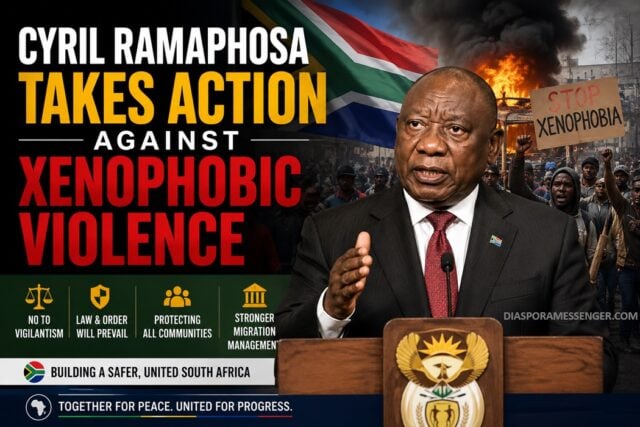
South African President Cyril Ramaphosa has announced a sweeping nationwide crackdown on xenophobic violence, vigilante groups, and individuals illegally targeting foreign nationals, following a surge in deadly anti-immigrant attacks across the country.
In a televised national address on June 7, 2026, President Ramaphosa strongly condemned recent incidents of violence against migrants, warning that unlawful civilian actions threaten South Africa’s constitutional democracy, economic stability, and international reputation.
The announcement comes after escalating unrest in major cities including Johannesburg, Pretoria, and Durban, where anti-immigrant protests have resulted in violent clashes, looting of migrant-owned businesses, and attacks on foreign-operated trucks.
The violence has already claimed the lives of at least five Mozambican citizens, prompting neighboring countries to organize emergency evacuations and repatriation efforts for their nationals.
Ramaphosa Condemns Xenophobic Violence
President Ramaphosa made it clear that South Africa will not tolerate vigilantism or xenophobia.
He emphasized that no citizen has the legal authority to stop people on the streets, demand proof of nationality, or conduct immigration enforcement.
According to the President, only legally authorized government officials may enforce immigration laws, labor regulations, and municipal by-laws.
He warned that those encouraging unlawful identity checks or inciting violence against foreign nationals would face the full force of the law.
“South Africa is governed by the Constitution and the rule of law—not by mob justice,” Ramaphosa emphasized during his address.
Government Targets Political Exploitation
Ramaphosa acknowledged that many South Africans are frustrated by rising unemployment, increasing pressure on public services, and concerns surrounding illegal immigration.
However, he cautioned that these genuine economic concerns should not be manipulated by political groups or criminal organizations seeking to fuel violence and division.
The government pledged to investigate and prosecute individuals or organizations exploiting public frustrations for political gain or criminal activity.
New Migration Management Strategy Introduced
To address immigration challenges while maintaining public order, the South African Cabinet has adopted a Comprehensive Approach for Migration Management.
The strategy introduces several major reforms aimed at strengthening immigration enforcement without encouraging unlawful vigilantism.
1. Dedicated Immigration Courts
The government will establish specialized immigration courts designed to process immigration-related cases more quickly and reduce legal backlogs.
The goal is to ensure faster deportation proceedings where appropriate while protecting constitutional rights.
2. Biometric Digital Identity System
South Africa will replace its aging paper-based “green book” identity documents with secure biometric digital ID cards.
Officials say the move will significantly reduce identity fraud, document forgery, and abuse of the immigration system.
3. Increased Workplace Inspections
Authorities will intensify inspections of businesses suspected of employing undocumented migrants.
Employers found violating labor and immigration laws will face tougher financial penalties and possible criminal prosecution.
4. Stronger Border Security
The government plans to strengthen physical border infrastructure through the Border Management Authority.
Refugee reception centers will gradually be relocated closer to border entry points to improve migration management and reduce administrative delays.
5. Regional Cooperation Across Africa
Recognizing that migration is a regional challenge, South Africa will deepen cooperation with the African Union (AU) and the Southern African Development Community (SADC).
The government hopes collaborative regional initiatives will address the root causes of migration, including conflict, poverty, unemployment, and climate-related displacement.
Regional Impact of the Violence
The recent unrest has affected citizens from several African countries living and working in South Africa.
Governments including Mozambique, Malawi, Ghana, and Nigeria have initiated emergency measures to assist citizens caught in the violence.
Several migrant-owned businesses have reportedly been looted, while foreign truck drivers have become frequent targets of attacks on major transport routes.
Human rights organizations continue to express concern over the safety of migrants and refugees living in South Africa.
Balancing Immigration Enforcement with Human Rights
President Ramaphosa stressed that South Africa remains committed to enforcing its immigration laws while protecting human rights and upholding constitutional principles.
He acknowledged that illegal immigration remains a legitimate policy concern but insisted that solutions must come through lawful government action rather than violence or mob justice.
The administration says the new migration strategy seeks to balance national security, economic stability, public confidence, and South Africa’s international obligations.
What This Means for African Diaspora Communities
The developments are being closely monitored by African diaspora communities across the world, particularly families with relatives living or working in South Africa.
Many foreign workers from neighboring African countries contribute significantly to South Africa’s economy through construction, transport, retail, mining, agriculture, and domestic work.
As the government intensifies immigration enforcement while cracking down on xenophobic violence, migrants are being encouraged to remain informed about their legal status and cooperate with lawful authorities rather than engage with vigilante groups.
Conclusion
President Cyril Ramaphosa’s latest announcement signals one of the strongest government responses yet to South Africa’s recurring xenophobic violence.
By combining tougher immigration enforcement with firm action against vigilantism, the government hopes to restore public confidence, protect vulnerable communities, and preserve South Africa’s constitutional values.
The coming months will determine whether these reforms succeed in reducing violence while addressing longstanding concerns over illegal immigration and public security