

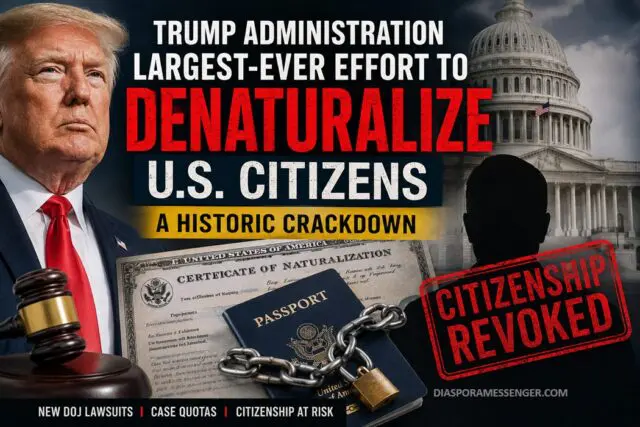
The Trump administration has unveiled what officials describe as the largest denaturalization initiative in modern American history, signaling a dramatic expansion of immigration enforcement efforts aimed at naturalized U.S. citizens.
The latest phase of the campaign was announced on June 8, 2026, when the U.S. Department of Justice (DOJ) filed civil lawsuits seeking to revoke the citizenship of 17 foreign-born individuals accused of immigration fraud, identity deception, or serious criminal offenses.
The move marks a significant shift in federal immigration policy, transforming denaturalization—a legal process historically used only in rare circumstances—into a major enforcement tool.
For millions of immigrants, including thousands of Kenyans and other Africans who have become U.S. citizens through naturalization, the development has sparked widespread debate, concern, and questions about the long-term security of citizenship status.
What Is Denaturalization?
Denaturalization is the legal process through which the U.S. government revokes a person’s citizenship after it has been granted.
Under the Immigration and Nationality Act (INA), citizenship can be revoked if it was:
- Illegally procured
- Obtained through willful misrepresentation
- Secured through fraud or concealment of material facts
Unlike deportation proceedings involving non-citizens, the government cannot simply strip citizenship through executive action. Instead, federal prosecutors must file a lawsuit in federal court and convince a judge that citizenship was unlawfully obtained.
If the government wins, the individual loses all rights associated with U.S. citizenship and may become subject to removal proceedings.
DOJ Targets 17 Naturalized Citizens
The newest round of enforcement involves 17 naturalized Americans accused of various forms of immigration fraud and criminal conduct.
According to federal officials, the cases involve allegations such as:
- Using false identities during immigration proceedings
- Concealing criminal histories
- Providing fraudulent information on immigration applications
- Committing serious offenses, including sexual abuse of minors
The administration argues that citizenship obtained through deception is invalid and should be revoked regardless of how much time has passed since naturalization.
Officials say the initiative reflects a “zero-tolerance” approach toward immigration fraud.
USCIS Reportedly Given Monthly Case Quotas
One of the most controversial aspects of the initiative is the reported use of denaturalization targets.
According to internal USCIS guidance cited by multiple reports, field offices have allegedly been instructed to identify and refer between 100 and 200 potential denaturalization cases every month to the DOJ’s Office of Immigration Litigation.
If fully implemented, the policy could produce thousands of investigations annually, representing an unprecedented expansion of denaturalization efforts.
Critics argue that citizenship revocation cases should be evaluated individually based on evidence rather than numerical targets.
Previous Enforcement Wave in May 2026
The June lawsuits follow another major enforcement operation launched in May 2026.
During that action, the DOJ reportedly filed 12 simultaneous denaturalization lawsuits against individuals accused of:
- Concealing involvement in war crimes
- Supporting terrorist organizations
- Participating in human trafficking operations
- Committing immigration-related fraud
The back-to-back enforcement actions suggest the administration intends to make denaturalization a permanent component of its broader immigration strategy.
Historic Increase Compared to Previous Decades
The scale of the current campaign is unprecedented when compared to historical trends.
Government records indicate that between 1990 and 2017, the United States averaged approximately 11 denaturalization cases per year.
By contrast, the current administration has already filed more denaturalization actions in a matter of months than many previous administrations pursued over multiple years.
Immigration analysts note that denaturalization was traditionally reserved for extraordinary cases involving national security threats, war crimes, or clear evidence of intentional fraud.
The current approach significantly broadens the scope of enforcement.
Administration Defends “Zero-Tolerance” Policy
According to Acting Attorney General Todd Blanche and Homeland Security Secretary Markwayne Mullin, the administration believes citizenship should not protect individuals who allegedly lied during the immigration process.
Federal officials argue that citizenship is a privilege earned through lawful conduct and honesty.
Their position is that individuals who concealed criminal activity or provided false information during immigration proceedings forfeited their eligibility for naturalization from the beginning.
Supporters of the initiative contend that enforcing these standards strengthens the integrity of the U.S. immigration system.
Civil Rights Groups Raise Concerns
The policy has drawn strong criticism from immigration advocates and civil rights organizations.
Groups such as the Democracy Forward and the Brennan Center for Justice warn that aggressive denaturalization quotas could create unintended consequences.
Critics argue that:
- Minor paperwork mistakes from decades ago could be reexamined.
- Naturalized citizens may begin to feel their citizenship is less secure than that of native-born Americans.
- Large-scale case referrals could overwhelm legal review processes.
- Fear within immigrant communities could increase substantially.
Advocates stress that denaturalization should remain an exceptional remedy reserved for proven fraud rather than becoming a routine enforcement mechanism.
What Happens After Citizenship Is Revoked?
If a federal judge grants a denaturalization request, the consequences can be severe.
An individual who loses citizenship may:
- Lose the right to vote.
- Lose eligibility for a U.S. passport.
- Lose protection from deportation.
- Lose access to certain federal benefits.
- Face immigration removal proceedings.
In some cases, a person may revert to lawful permanent resident status. In others, they may become removable from the United States altogether.
The outcome depends on their immigration history and the basis for the court’s ruling.
What This Means for the Kenyan Diaspora
The United States is home to a rapidly growing Kenyan diaspora community, with many obtaining citizenship through employment-based immigration, family sponsorship, asylum pathways, and diversity visa programs.
Immigration experts emphasize that lawfully naturalized citizens who provided accurate information during their immigration journey have little reason to fear denaturalization proceedings.
However, the administration’s aggressive enforcement strategy has created anxiety among some immigrants who worry about old application errors, missing records, or past immigration complications.
Legal professionals recommend that naturalized citizens maintain copies of their immigration documents and seek qualified legal advice if concerns arise regarding past filings.
Looking Ahead
The Trump administration’s denaturalization initiative represents one of the most significant shifts in immigration enforcement policy in recent decades.
Supporters view the campaign as a necessary effort to protect the integrity of American citizenship and hold fraudulent applicants accountable.
Critics see it as a potentially dangerous expansion of government power that could create uncertainty for millions of naturalized Americans.
As the lawsuits move through federal courts, the outcomes will likely shape future debates over immigration enforcement, citizenship rights, and the legal protections afforded to America’s immigrant communities.