


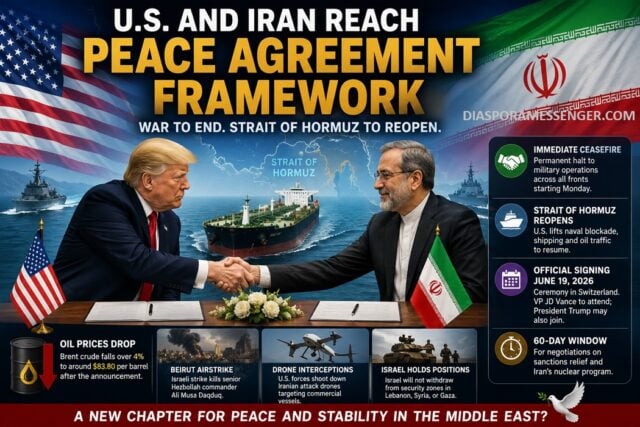
U.S. and Iran Reach Historic Peace Framework, Ending War and Reopening Strait of Hormuz
In a major diplomatic breakthrough, the United States and Iran have agreed on a peace agreement framework aimed at ending months of military confrontation, restoring international shipping through the Strait of Hormuz, and opening the door for broader negotiations on sanctions and Iran’s nuclear program.
The agreement, confirmed by U.S. President Donald Trump and senior Iranian officials, marks one of the most significant geopolitical developments in the Middle East in recent years. While many technical issues remain unresolved, both governments have finalized the text of a Memorandum of Understanding (MoU), which is expected to be formally signed on Friday, June 19, 2026, in Switzerland. Reports indicate that U.S. Vice President JD Vance will attend the ceremony, while President Trump may also participate.
Immediate Ceasefire to Take Effect
According to officials from both countries, the framework provides for an immediate and permanent halt to military operations across multiple fronts beginning Monday.
The ceasefire is intended to reduce tensions that have disrupted regional stability, threatened global energy supplies, and raised fears of a wider Middle East conflict.
Although the framework represents a major diplomatic milestone, several critical issues—including Iran’s nuclear program and long-term sanctions relief—will be negotiated separately during a 60-day diplomatic window following the signing of the agreement.
Strait of Hormuz Set to Reopen
One of the agreement’s most significant outcomes is the reopening of the Strait of Hormuz, one of the world’s most strategically important shipping routes.
President Trump announced that the United States would remove its naval blockade, allowing commercial shipping and oil tankers to resume normal operations.
The Strait of Hormuz carries a significant portion of the world’s oil exports, making its reopening welcome news for global markets.
Financial markets reacted immediately to the announcement, with Brent crude oil prices falling by more than 4 percent to approximately $83.80 per barrel, easing concerns about prolonged disruptions in global energy supplies.
60-Day Negotiation Period Begins
The signing of the memorandum will launch a 60-day period of intensive negotiations between Washington and Tehran.
These talks are expected to focus on:
- U.S. sanctions relief
- Iran’s nuclear program
- Release of frozen Iranian assets
- Long-term regional security arrangements
- Maritime security in the Persian Gulf
Officials emphasized that the nuclear issue was intentionally excluded from the initial peace framework to increase the chances of reaching an immediate ceasefire before addressing more complex disagreements.
Regional Tensions Continue Despite Breakthrough
Despite the agreement between Washington and Tehran, security concerns remain across the Middle East.
Israel Maintains Military Positions
Israel has stated that it is not a party to the agreement.
Israeli Defense Minister Israel Katz announced that Israeli forces will continue operating in security zones across Lebanon, Syria, and Gaza, stressing that Israel reserves the right to take independent action against any perceived Iranian nuclear threat.
Beirut Airstrike
Only hours before the peace announcement, Israeli forces carried out an airstrike in southern Beirut that reportedly killed senior Hezbollah commander Ali Musa Daqduq.
The strike underscored the fragile security situation in the region despite ongoing diplomatic efforts.
U.S. Military Activity Continues
The U.S. Central Command (CENTCOM) also confirmed intercepting several Iranian one-way attack drones that were reportedly targeting commercial vessels in the Strait of Hormuz shortly before the peace framework was finalized.
Why This Matters to the Kenyan Diaspora
The agreement carries significant implications for Kenyans living and working abroad.
Lower Fuel Prices
A reopening of the Strait of Hormuz could help stabilize global oil supplies, potentially reducing fuel prices and transportation costs worldwide.
Reduced Inflation
Lower energy prices may ease inflation, benefiting families through lower costs for food, shipping, and essential goods.
Improved Global Trade
Businesses involved in international trade—including Kenyan exporters and importers—could benefit from fewer disruptions in maritime shipping.
Better Economic Stability
Global financial markets generally respond positively to reduced geopolitical tensions, which can improve investment confidence and employment opportunities for professionals working abroad.
Looking Ahead
The upcoming signing ceremony in Switzerland represents only the first phase of a much larger diplomatic process.
If successful, the next two months could determine whether Washington and Tehran can achieve a broader and more lasting agreement covering sanctions, nuclear oversight, and long-term regional security.
Although major challenges remain, the peace framework is widely viewed as an important step toward reducing conflict in one of the world’s most strategically significant regions.
For millions around the globe—including the Kenyan diaspora—greater stability in the Middle East could translate into improved economic conditions, safer international trade routes, and a more predictable global economy.