


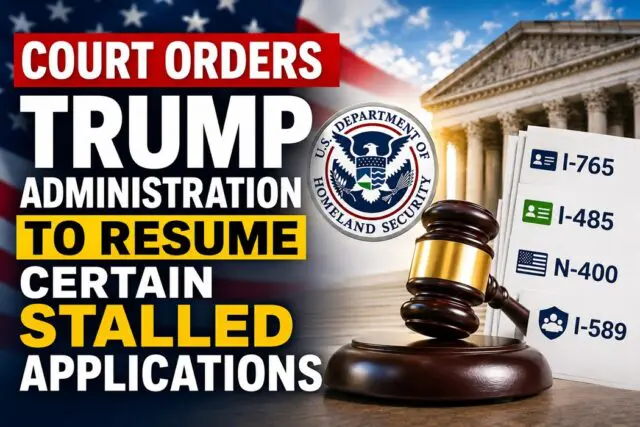
Court Orders Trump Administration to Resume Stalled USCIS Immigration Applications
A major federal court ruling has delivered significant relief to immigrants whose applications had been delayed under restrictive U.S. immigration policies. A U.S. District Court has ordered the Trump administration to immediately resume processing hundreds of thousands of immigration benefit applications that had been placed on hold by U.S. Citizenship and Immigration Services (USCIS).
The decision is expected to benefit thousands of immigrants nationwide, including many Kenyans living in the United States who have experienced prolonged delays in obtaining work permits, green cards, asylum decisions, and U.S. citizenship.
Federal Court Blocks USCIS Immigration Freeze
On July 6, 2026, U.S. District Judge Algenon L. Marbley issued a preliminary injunction requiring USCIS to restart processing immigration applications that had been suspended under internal agency directives.
The ruling comes just weeks after another landmark decision on June 5, 2026, when Chief Judge John J. McConnell Jr. vacated the USCIS Adjudication Pause Tracker Framework in the federal case Dorcas International Institute of Rhode Island v. USCIS.
Combined, the two decisions dismantle several immigration policies introduced between late 2025 and early 2026 that critics argued unfairly delayed lawful immigration benefits.
USCIS Policies Struck Down
The federal court rulings invalidate several controversial USCIS measures, including:
- Country-specific freezes affecting applicants from 39 designated “high-risk” countries.
- A nationwide pause on asylum and withholding of removal applications.
- Policies requiring immigration officers to consider an applicant’s nationality as a negative discretionary factor.
- Mandatory re-evaluation of immigration benefits that had already been approved for individuals from targeted countries.
The court found that these policies significantly disrupted lawful immigration processing and created extensive backlogs affecting eligible applicants.
USCIS Must Resume Processing These Immigration Forms
Following the court order, USCIS must resume normal adjudication of several major immigration benefits, including:
Form I-765
Employment Authorization Document (Work Permit)
Form I-485
Adjustment of Status (Green Card)
Form N-400
Application for U.S. Citizenship (Naturalization)
Form I-589
Application for Asylum and Withholding of Removal
Applicants whose cases were placed on hold may now begin receiving updates as USCIS resumes normal processing.
What This Means for the Kenyan Diaspora
For the Kenyan diaspora in the United States, the ruling could have far-reaching consequences.
Many Kenyan immigrants rely on timely USCIS decisions to maintain employment authorization, secure permanent residency, reunite with family members, or become U.S. citizens. Delays in processing often affect:
- Employment opportunities
- Healthcare coverage tied to work authorization
- Family reunification
- Mortgage approvals
- Educational opportunities
- International travel
Community organizations have repeatedly expressed concern over lengthy immigration delays, noting that uncertainty creates financial and emotional hardship for immigrant families.
Although Kenya was not among the countries reportedly targeted by the country-specific hold policy, Kenyan applicants whose asylum or immigration benefits were delayed under broader adjudication pauses may also benefit from the court’s decision.
Immigration Implications
The ruling reinforces an important legal principle that immigration agencies must follow existing immigration laws and cannot indefinitely suspend lawful applications without proper legal authority.
Immigration attorneys expect USCIS to begin clearing significant backlogs over the coming months, although processing times may still vary depending on staffing levels and case complexity.
Applicants are encouraged to:
- Regularly check their USCIS online case status.
- Respond promptly to Requests for Evidence (RFEs).
- Keep mailing addresses updated with USCIS.
- Consult qualified immigration attorneys regarding individual cases.
Expert Opinion
Immigration attorneys say the decision represents one of the most significant judicial interventions in immigration processing this year.
According to immigration law experts, restoring normal adjudications helps reinforce due process protections while ensuring that immigration benefits are decided based on federal law rather than internal administrative directives.
Legal analysts also note that the ruling may influence future challenges involving immigration policy changes implemented through agency guidance instead of formal rulemaking.
Immigration Statistics
USCIS continues to process millions of immigration applications annually, making it one of the largest federal benefits agencies in the United States.
Recent federal data show:
- USCIS receives several million immigration benefit applications every year.
- Employment Authorization Documents remain among the agency’s most frequently filed forms.
- Naturalization applications have increased steadily as more lawful permanent residents become eligible for U.S. citizenship.
- Immigration processing backlogs have affected millions of pending cases across multiple benefit categories in recent years.
The latest court rulings are expected to help reduce those backlogs by requiring USCIS to resume adjudicating previously frozen applications.
What Applicants Should Do Next
Individuals whose immigration applications were delayed should monitor their USCIS accounts closely for updates. While the court order requires processing to resume, applicants should understand that timelines may still vary depending on workload and available resources.
Those with urgent employment or travel needs may wish to seek legal advice regarding available options if delays continue.
Conclusion
The federal court’s order represents a major victory for immigrants awaiting immigration decisions across the United States. By requiring USCIS to resume processing work permits, green cards, asylum applications, and citizenship requests, the ruling restores normal legal procedures and offers renewed hope to thousands of families.
For the Kenyan diaspora, the decision provides reassurance that lawful immigration applications should once again move forward under established legal standards rather than broad administrative freezes.
As USCIS implements the court’s directive, many applicants may finally begin seeing long-awaited progress toward achieving their American immigration goals.