

Kenya Referendum Proposal: Eric Omondi Leads Campaign to Reduce 47 Counties to 8
A new constitutional reform campaign spearheaded by Kenyan comedian and activist Eric Omondi is igniting nationwide debate over the future of devolution, government spending, and political representation.
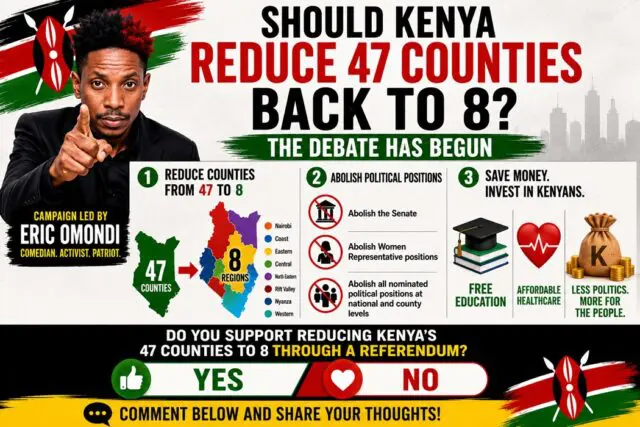
The movement seeks to collect public support for a constitutional referendum that would dramatically restructure Kenya’s system of governance by reducing the current 47 county governments to the country’s former eight administrative regions.
Supporters argue the proposal would significantly reduce the country’s ballooning wage bill and free up billions of shillings for critical public services such as education and healthcare. Critics, however, warn that the plan could weaken devolution and reduce local representation.
The proposal has already generated widespread discussion among Kenyans at home and across the diaspora, many of whom continue to contribute significantly to Kenya’s economy through remittances.
What the Campaign Proposes
According to the campaign, Kenya would replace its current 47 counties with the following eight regional administrations:
- Nairobi
- Coast
- Central
- Eastern
- North Eastern
- Rift Valley
- Nyanza
- Western
The initiative also proposes eliminating several elected and nominated political positions, including:
- The Senate
- Women Representative seats
- All nominated positions in Parliament
- All nominated positions in County Assemblies
Campaign organizers argue that reducing duplication in government would create a leaner and more efficient public administration.
Redirecting Billions to Public Services
One of the campaign’s central arguments is that Kenya spends billions of shillings every year maintaining political offices and administrative structures.
Supporters believe those savings could instead finance:
- Free education from primary school through university
- Affordable and accessible healthcare
- Improved public infrastructure
- Youth employment initiatives
- Better social welfare programs
The campaign frames the proposal as shifting national priorities from politics to public services.
Why the Proposal Is Sparking Debate
The proposal touches on one of Kenya’s most significant constitutional changes since the adoption of the 2010 Constitution, which introduced devolved government to promote equitable development and bring services closer to citizens.
Supporters argue that:
- Government has become too expensive.
- Political positions have multiplied beyond necessity.
- Public funds should prioritize service delivery instead of administration.
- A leaner government could improve efficiency.
Opponents counter that:
- Counties have improved access to services in previously marginalized regions.
- Devolution has increased local participation in decision-making.
- Reducing counties could recentralize power in Nairobi.
- Constitutional changes of this magnitude require broad national consensus.
The debate is expected to continue as more Kenyans examine the potential economic, political, and social implications of the proposal.
Why This Matters to Kenyans in the Diaspora
The proposal is also attracting attention among Kenyans living abroad.
Every year, Kenyans in the diaspora send home billions of shillings in remittances, making them one of the country’s largest sources of foreign exchange. Many diaspora members closely follow discussions on government accountability, public spending, and constitutional reforms because these policies influence investment opportunities, economic growth, and service delivery back home.
A more efficient government could potentially improve investor confidence and create a stronger environment for diaspora investments. However, many also recognize the importance of preserving equitable regional development achieved through devolution.
Could the Proposal Become a Referendum?
For constitutional amendments of this nature to move forward, they would need to follow the procedures outlined in Kenya’s Constitution.
Major constitutional amendments affecting devolved government require significant public participation and would ultimately need approval through a national referendum before taking effect.
Whether the initiative gathers enough political and public support remains to be seen, but it has already succeeded in reigniting a national conversation about the cost of governance and the future of devolution in Kenya.
The Bigger Conversation
The campaign goes beyond reducing the number of counties. It raises broader questions about how Kenya can balance efficient governance, fiscal responsibility, equitable development, and effective representation.
As discussions continue, Kenyans both at home and abroad are likely to play an important role in shaping public opinion on one of the country’s most ambitious governance reform proposals in recent years.
Do you support reducing Kenya’s 47 counties to 8 through a referendum?
👍 Yes – Cut government spending.
❤️ No – Protect devolution and local representation.
Share your thoughts in the comments below. Let’s have a respectful discussion.