


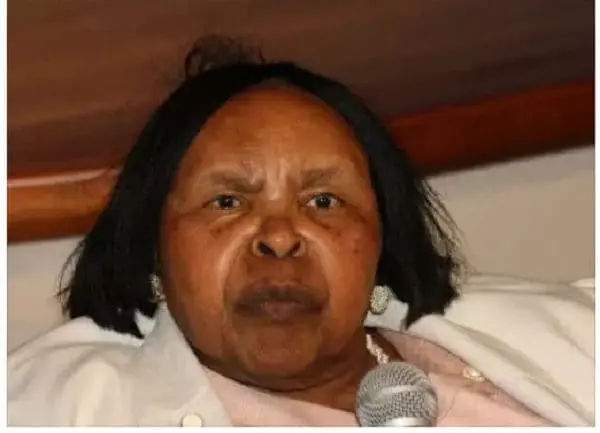
Friends and family of the late Wambui Otieno gathered at the P.C.E.A St. Andrews church to pay their tributes to the fallen former freedom fighter.
And it was timely relief for family after Prime Minster Raila Odinga announced that the Luo Council of Elders had intervened in the dispute over her final resting place giving way for her peaceful burial this Thursday at her Upper Matasia home.
The Umira Kager clan which had earlier demanded that the late Wambui be buried next to her late husband S.M. Otieno’s grave in Nyanza says it will respect Wambui’s wishes to be buried in Matasya. Sally Mbilu reports.
A Tribute to Wambui Otieno (1936–2011)
Wambui Otieno was a woman who defied the limits of her time—fierce in resistance, bold in voice, and unshaken in her convictions. A daughter of Kenya, her life was one of unrelenting struggle—for justice, for freedom, for the right of women to define their own destinies.
Born into the colonial Kenya of 1936, Wambui grew up witnessing the injustices that plagued her people under British rule. But she did more than observe—she rose. As a teenager, she joined the Mau Mau movement, becoming one of the few women to take an active role in the armed resistance. It was a dangerous path, but Wambui never flinched from danger when it stood in the way of dignity and liberty.
After independence, her battlefronts shifted—but not her fire. As a political activist and feminist, she fought for land rights, women’s rights, and against the silencing of women’s voices in the traditional patriarchal order. Her most public struggle came after the death of her husband, SM Otieno, in 1986, when she waged a landmark legal battle for the right to bury him. The case was not just about burial—it was a national debate on customary law vs. civil rights, and it cemented her place in Kenya’s legal and cultural history.
Wambui was a writer, a leader, and a relentless advocate for justice. Her memoir, Mau Mau’s Daughter, is not just a personal story—it is a piece of Kenya’s collective memory, a testimony of resistance, and a call to courage for generations to come.
She lived on her own terms, loved fiercely, and fought with a spirit that could not be domesticated. Her marriage in her seventies to a man decades younger raised eyebrows—but for Wambui, it was another declaration of autonomy. She was unapologetically herself.
Wambui Otieno leaves behind a legacy of resilience, rebellion, and radical love. She showed that womanhood is not a limitation—but a powerful force for change.
Rest in power, Wambui. Your voice still echoes in the winds of our liberation.