


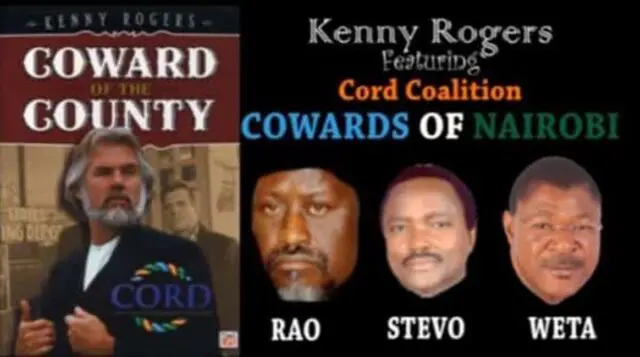
Cowards of Nairobi’ by Kenny Rogers: Apparently, CORD principals Raila Odinga, Kalonzo Musyoka and Moses Wetangula are the cowards of Nairobi. When they rallied their supporters in their last anti-IEBC protests, the leaders hid in their big SUVs as their supporters engaged anti riot officers in running battles. This incident sparked widespread criticism and gave rise to the viral video that humorously encapsulates the scenario, emphasizing the disconnect between political leaders and their followers during critical moments of civic engagement. Furthermore, the societal implications of such actions raise questions about accountability and the responsibilities of leaders in times of unrest.
Cowards of Nairobi’ by Kenny Rogers
A video showing the moment the principals disappeared into their vehicles has been made into a song dubbed ‘Cowards of Nairobi.’ It is basically a refix of Kenny Rogers’ 1979 hit ‘Coward of the county.’ The clever adaptation of this classic song resonates with many, as it humorously portrays the absurdity of political leadership that fails to engage in the struggles of their constituents. The juxtaposition of a well-known song with contemporary political satire serves to amplify its message, making it memorable and shareable across various platforms.
- nairobiwire.com
More Details
The phrase “Cowards of Nairobi” refers to a satirical video that humorously critiques the leaders of the Coalition for Reforms and Democracy (CORD) in Kenya—Raila Odinga, Kalonzo Musyoka, and Moses Wetangula. This video encapsulates the sentiments of many Kenyans who feel disillusioned by the actions of their leaders during pivotal protests. The clever use of satire in the video not only highlights the hypocrisy of political figures but also serves as a cultural reflection on the challenges of civic engagement in a democratic society.
The video, a parody of Kenny Rogers’ 1979 song “Coward of the County,” depicts the trio as fleeing into their SUVs during anti-Independent Electoral and Boundaries Commission (IEBC) protests, leaving their supporters to face police repression alone. This stark imagery effectively communicates the feelings of betrayal experienced by those who believed in their leaders. By utilizing humor, the video encourages viewers to reflect critically on the actions of their leaders and the broader implications of political cowardice in the face of civil unrest.
This portrayal resonated with many Kenyans who felt that the CORD leadership often encouraged public demonstrations but failed to stand with their supporters during confrontations with authorities. A significant number of citizens view such behavior as a clear indication of a larger pattern of neglect towards the very people who support them. The disconnect between rhetoric and action exemplifies a critical issue in political accountability, making the video not just a humorous take, but a poignant commentary on the current state of Kenyan politics.
ctivist Boniface Mwangi criticized CORD for “betraying” Kenyans by abandoning them during protests, highlighting instances where the leadership was absent when their calls for mass action led to arrests and police brutality. This commentary echoes the sentiments of many grassroots activists who feel that their leaders must bear the weight of the struggles they incite. The implications of such leadership failures extend beyond the immediate protest; they risk eroding public trust in political institutions and disenfranchising citizens who deserve better representation.
The “Cowards of Nairobi” video became a viral symbol of public disillusionment with political leaders who, according to critics, incited protests without facing the consequences themselves. Its impact can be seen in how it has sparked conversations about political integrity and responsibility, inviting a wider audience to engage with the pressing issues of governance and representation in Kenya. The video serves as a reminder that humor can be a powerful tool for social critique, encouraging citizens to remain vigilant and demand accountability from those in power.