


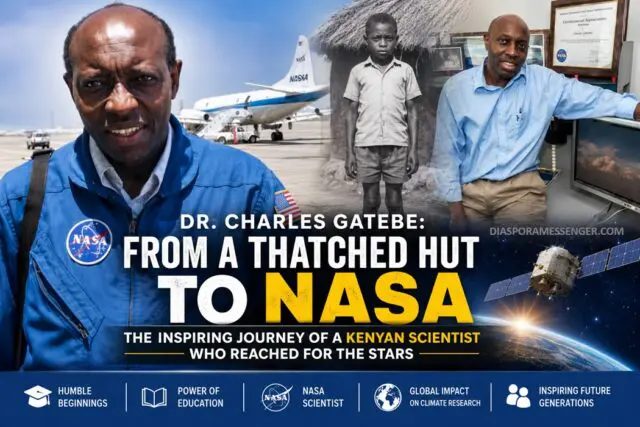
Dr. Charles Gatebe: The Inspiring Journey of a Kenyan NASA Scientist From a Thatched Hut to Global Recognition
For many young people growing up in rural Africa, dreams of working for one of the world’s most prestigious scientific organizations may seem impossible. However, the remarkable story of Dr. Charles Gatebe proves that determination, resilience, and education can overcome even the most challenging circumstances.
Born and raised in a humble family of nine children in rural Kenya, Dr. Charles Gatebe has risen from a childhood marked by poverty and hardship to become one of the most respected African scientists at NASA. Today, he serves as the Chief of the Atmospheric Science Branch at NASA’s Ames Research Center in the United States, leading groundbreaking climate and atmospheric research that impacts the world.
His extraordinary journey continues to inspire countless young Africans, especially those in the Kenyan diaspora, who dream of achieving global success despite humble beginnings.
Growing Up in Poverty Near Mt. Kenya
Dr. Gatebe’s childhood was far from easy. Raised in a modest village near Mt. Kenya, Africa’s second-highest mountain, he frequently faced financial challenges that threatened to derail his education.
School fees were a constant struggle for his family, and he was often sent home because his parents could not afford to pay. Like many children from low-income households, he experienced the pain and embarrassment of being unable to continue attending classes due to financial constraints.
Yet amid these hardships, one person played a crucial role in shaping his future—his mother.
Whenever young Charles felt discouraged, his mother reminded him that wealth did not determine a person’s worth. She often told him that children from rich families entered the world the same way he did and that he was no less valuable than anyone else.
Those powerful words became the foundation of the confidence and resilience that would later propel him to international success.
A Curiosity Sparked by Nature
Growing up in the shadow of the majestic Mt. Kenya sparked an early fascination with the natural world.
The snow-capped peaks, changing weather patterns, and mysteries surrounding the mountain fueled Dr. Gatebe’s curiosity about climate, weather, and environmental science.
What began as childhood wonder eventually evolved into a lifelong passion for understanding Earth’s atmosphere and climate systems.
This curiosity would ultimately guide him toward a career that would place him among the world’s leading atmospheric scientists.
Academic Excellence Opens Doors
Dr. Gatebe’s passion for science continued to grow during his years at the University of Nairobi.
While studying in Kenya’s capital city, he noticed something unusual: Nairobi’s skies often appeared gray even on bright sunny days. The observation raised important questions about pollution, atmospheric conditions, and environmental change.
Determined to find answers, he pursued studies in meteorology, mathematics, and physics before earning a master’s degree in meteorology.
His academic journey did not stop there.
He later moved to South Africa, where he earned a doctorate in atmospheric physics. His doctoral research made history by establishing the first climatology of air pollution corridors in Eastern Africa, significantly advancing scientific understanding of environmental pollution in the region.
Joining NASA and Making History
In 1999, Dr. Gatebe’s expertise attracted the attention of NASA.
He was recruited to participate in a major climate research campaign in Southern Africa, a milestone that would launch his distinguished career with the U.S. space agency.
During the mission, he operated NASA’s sophisticated Cloud Absorption Radiometer aboard a research aircraft. His work involved collecting reflectance measurements over clouds, oceans, forests, savannas, and smoke produced by biomass burning.
The data gathered helped scientists improve the accuracy of satellite observations and deepen understanding of Earth’s climate systems.
Over the years, his contributions have earned him recognition as one of NASA’s leading atmospheric researchers.
Leading Climate Research at NASA
Today, Dr. Gatebe serves as Chief of the Atmospheric Science Branch at NASA Ames Research Center.
His research focuses on studying reflected sunlight and how it interacts with Earth’s atmosphere, land surfaces, and oceans.
By analyzing reflected sunlight, scientists can better understand:
- Climate change trends
- Greenhouse gas concentrations
- Cloud behavior
- Aerosol distribution
- Vegetation health
- Ocean ecosystems
- Air quality and pollution levels
His work involves conducting complex airborne scientific experiments around the world and validating data collected by satellites monitoring Earth’s changing climate.
These studies play a critical role in improving climate models and helping policymakers understand environmental changes affecting communities worldwide.
A Powerful Message for Young Africans
Dr. Gatebe’s story carries a powerful message for young people across Africa and the diaspora.
His journey demonstrates that circumstances at birth do not determine one’s future.
From being sent home over unpaid school fees to leading scientific research at NASA, his life is proof that perseverance, education, and self-belief can break barriers and create opportunities beyond imagination.
For many Kenyan students aspiring to careers in science, technology, engineering, and mathematics (STEM), Dr. Gatebe represents what is possible when talent meets determination.
Inspiring the Next Generation
As climate change becomes one of the most significant global challenges of our time, scientists like Dr. Charles Gatebe continue to play a vital role in shaping solutions.
His rise from a thatched hut in rural Kenya to one of NASA’s top scientific leadership positions serves as an inspiration not only to Kenyans but also to Africans worldwide.
His achievements remind us that greatness can emerge from the most humble beginnings and that the next generation of world-changing innovators may currently be sitting in classrooms across Africa, dreaming of a better future.
Conclusion
Dr. Charles Gatebe’s remarkable journey from a rural Kenyan village to NASA’s leadership ranks is a testament to the transformative power of education, resilience, and ambition. Despite growing up in poverty and facing countless obstacles, he refused to allow circumstances to define his destiny.
Today, his groundbreaking work in atmospheric science is helping humanity better understand climate change and protect the planet. More importantly, his story continues to inspire millions of young Africans and diaspora communities around the world to dream bigger, work harder, and believe that no goal is beyond reach.
His life stands as proof that even from a thatched hut in rural Kenya, one can reach the stars.