


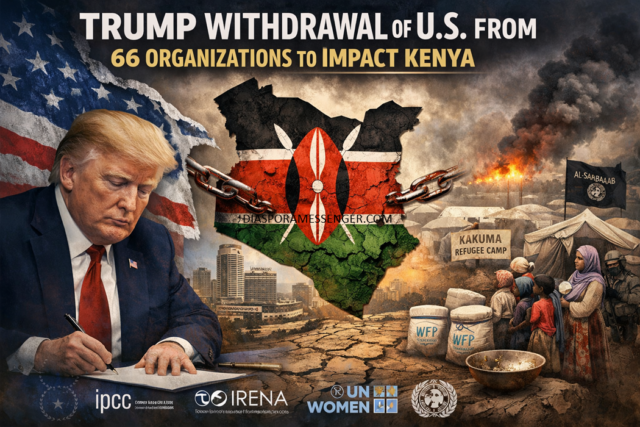
Kenya is bracing for wide-ranging economic, security and humanitarian consequences after U.S. President Donald Trump signed a directive on January 7, 2026, ordering the United States to withdraw from 66 international and United Nations-affiliated organizations.
The decision — part of a broader “America First” reorientation of U.S. foreign policy — directly affects agencies that fund and support major development, climate, security, and humanitarian programs in Kenya.
Kenyan officials, civil society groups, and international partners warn that the move could weaken climate resilience efforts. It could also slow renewable energy investments. Furthermore, it could disrupt counterterrorism cooperation and worsen already strained humanitarian conditions in refugee settlements.
UN-Habitat and Nairobi’s Global Standing at Risk
One of the most symbolic impacts is on UN-Habitat, the United Nations Human Settlements Programme headquartered in Nairobi — the only UN agency with its global headquarters in Africa.
Although the agency itself is not being closed, U.S. withdrawal from several UN bodies reduces both funding flows and diplomatic backing. These supports are crucial for UN-Habitat’s urban development, housing, and sustainable cities programs across Kenya and the region.
Experts say the move could undermine Nairobi’s status as a global diplomatic and development hub.
“Any reduction in multilateral engagement weakens Nairobi’s position as Africa’s diplomatic capital,” said a senior Kenyan diplomat who requested anonymity.
Climate Change and Renewable Energy Programs Hit
The U.S. is withdrawing from the UN Framework Convention on Climate Change (UNFCCC) and the Intergovernmental Panel on Climate Change (IPCC). These bodies provide Kenya with climate data, research, adaptation planning tools, and funding frameworks.
Kenya, which faces increasing droughts, floods and climate-related food insecurity, relies heavily on these institutions for policy guidance and international climate financing.
Additionally, U.S. exit from the International Renewable Energy Agency (IRENA) and the Renewable Energy Policy Network for the 21st Century (REN21) threatens momentum in Kenya’s clean energy transition. This includes sectors such as geothermal, wind, and solar.
Energy experts warn this could slow private investment and technical cooperation in renewable energy projects.
Security Cooperation and Counterterrorism Affected
The U.S. withdrawal from the Global Counterterrorism Forum (GCTF) is expected to weaken Kenya’s regional security partnerships, especially efforts targeting Al-Shabaab militants operating across Kenya and Somalia.
Kenya has been a frontline state in regional counterterrorism operations, relying on intelligence sharing, training and multilateral coordination. Much of this coordination is linked to U.S.-backed frameworks.
Security analysts say reduced engagement could embolden extremist groups. It may also strain Kenya’s security budget.
Women’s Rights and Population Programs Face Funding Cuts
The withdrawal from UN Women and the UN Population Fund (UNFPA) threatens programs addressing maternal health, family planning, girls’ education and gender-based violence prevention in Kenya.
Civil society organizations warn that funding gaps could reverse gains made in reproductive health, teenage pregnancy reduction, and women’s economic empowerment.
Humanitarian Crisis Deepens in Refugee Camps
Perhaps the most immediate impact is being felt in Kenya’s refugee camps. This is especially true in Kakuma and Dadaab, which host over 300,000 refugees from South Sudan, Somalia, Ethiopia, and the Democratic Republic of Congo.
Cuts to the World Food Programme (WFP) and the UN High Commissioner for Refugees (UNHCR) will result in food ration reductions. Additionally, there will be healthcare shortages and cuts to education and sanitation services.
Humanitarian agencies warn that further funding losses could push vulnerable populations into malnutrition, disease outbreaks, and social instability.
A Global Shift With Local Consequences
While the U.S. move is driven by domestic political considerations, its ripple effects will be felt far beyond American borders. Kenya is among the countries most exposed due to its central role in diplomacy, development, climate policy and regional security.
As Washington pulls back, Kenya now faces the challenge of navigating a changing global order. It must protect its most vulnerable citizens and safeguard long-term development goals.