


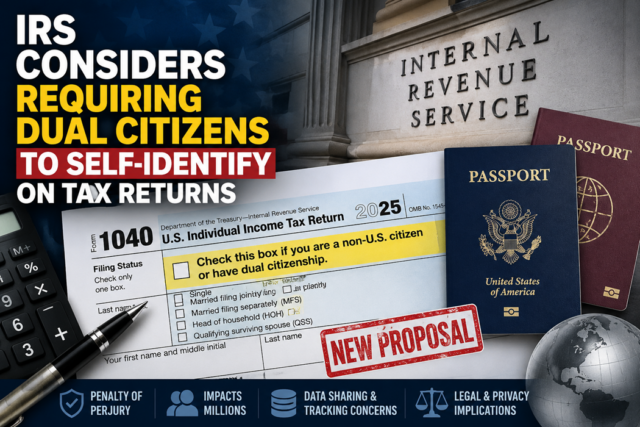
IRS Considers Requiring Dual Citizens to Self-Identify on U.S. Tax Returns
A proposed change by the Internal Revenue Service (IRS) is drawing significant attention among Americans living abroad, dual citizens, immigrants, and tax professionals. The agency is reportedly considering adding a citizenship-status checkbox to Form 1040, the primary federal income tax return used by millions of taxpayers across the United States.
If implemented, the proposal would require individuals to disclose whether they are non-U.S. citizens or hold dual citizenship when filing their annual tax returns. The move could affect an estimated five million Americans who possess citizenship in another country through birth, descent, naturalization, marriage, or investment-based citizenship programs.
What Is the IRS Proposing?
According to draft discussions within the IRS, officials have prepared two versions of the next Form 1040. One version includes a new checkbox that would read:
“Check this box if you are a non-U.S. citizen or have dual citizenship.”
If approved, the change would mark the first time citizenship status is directly incorporated into the standard federal income tax return used by individual taxpayers.
Because Form 1040 is signed under penalty of perjury, any information provided—or omitted—could carry legal consequences.
Why the Proposal Matters
The United States is one of the few countries in the world that taxes its citizens based on citizenship rather than residence. This means U.S. citizens living abroad must generally report their worldwide income to the IRS, regardless of where they reside.
For many dual citizens, the proposed checkbox would create an additional layer of disclosure beyond existing reporting requirements such as:
- Foreign Bank Account Reports (FBAR)
- Foreign Account Tax Compliance Act (FATCA) reporting
- Foreign earned income exclusion filings
- Foreign tax credit claims
- International asset disclosure requirements
Tax experts note that while the IRS already collects substantial information about foreign income and assets, the new checkbox would create a direct self-reporting mechanism that could be integrated into federal compliance systems.
Impact on Americans Living Abroad
The proposal is generating particular interest among the American diaspora community, including millions of U.S. citizens residing in countries such as Canada, the United Kingdom, Australia, Germany, Kenya, South Africa, and the Middle East.
Many Americans abroad maintain dual citizenship due to:
- Birth in another country
- Family heritage and descent
- Marriage to foreign nationals
- Long-term residency leading to naturalization
- Citizenship-by-investment programs
For these individuals, the checkbox could become another administrative requirement when filing annual U.S. tax returns.
Connection to Broader Immigration and Data Policies
The proposal comes amid broader efforts by the federal government to strengthen identity verification, fraud prevention, and data-sharing initiatives across agencies.
The Trump administration has emphasized closer coordination between federal agencies responsible for immigration enforcement, tax administration, and financial oversight.
Recent discussions have included:
- Expanded identity verification measures
- Enhanced anti-fraud initiatives
- Greater inter-agency data integration
- Improved monitoring of foreign financial connections
The proposal also follows previous efforts by federal agencies to facilitate information-sharing between the Treasury Department and immigration authorities. Those initiatives faced legal challenges and were temporarily halted by a federal court.
Could the Checkbox Trigger Additional Scrutiny?
Tax compliance specialists suggest the proposed citizenship-status field could eventually become part of IRS risk assessment and identity verification systems.
In practice, the information may be used to:
- Improve taxpayer identity matching
- Reduce fraud and duplicate filings
- Verify foreign reporting compliance
- Enhance data accuracy across government databases
Some experts believe returns involving foreign income, overseas assets, or dual citizenship could receive closer review if the new data field becomes part of IRS analytical systems.
However, no official guidance has been released indicating that dual citizenship alone would trigger audits or enforcement actions.
Does Congress Need to Approve the Change?
One notable aspect of the proposal is that congressional approval may not be required.
The IRS possesses administrative authority to design and modify its tax forms. As a result, the agency could potentially implement the checkbox through its normal form revision process without passing new legislation.
The proposal remains under review, and no final decision has been announced.
What Dual Citizens Should Do
For now, dual citizens and Americans living abroad should continue complying with existing tax obligations and monitor developments from the IRS.
Taxpayers with international financial interests should ensure they remain current on:
- Annual U.S. tax filings
- FBAR reporting requirements
- FATCA disclosures
- Foreign income reporting
- Recordkeeping for overseas assets and accounts
As discussions continue, tax professionals and advocacy groups representing Americans abroad are expected to closely examine the proposal and its potential implications.
The Bottom Line
The IRS proposal to add a dual-citizenship disclosure checkbox to Form 1040 could represent a significant change in how citizenship information is collected through the U.S. tax system. While supporters may view the measure as a tool for improved compliance and fraud prevention, critics argue it raises questions about privacy, government tracking, and the treatment of dual citizens.
If adopted, the change would directly affect millions of Americans living overseas and individuals who maintain citizenship ties to more than one country, making it one of the most closely watched tax policy developments for the global American diaspora community.