



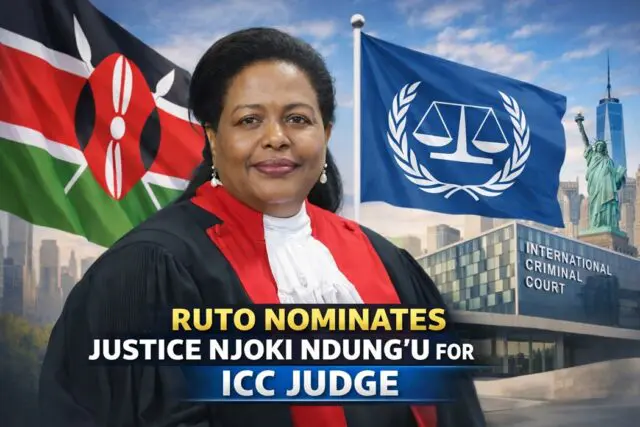
NAIROBI, Kenya — President William Samoei Ruto has officially nominated Njoki Ndung’u as Kenya’s candidate for election to the bench of the International Criminal Court (ICC), positioning the veteran jurist to compete for one of the court’s prestigious judicial seats.
The election will take place during the 25th session of the Assembly of States Parties, scheduled for December 7–17, 2026, in New York, where member states will vote to fill vacancies on the ICC bench.
If elected, Justice Ndung’u would join the world’s highest criminal court responsible for prosecuting individuals accused of genocide, crimes against humanity, war crimes, and the crime of aggression.
Kenya’s Candidate for a Global Judicial Role
Justice Njoki Ndung’u has served as a judge of the Supreme Court of Kenya since 2011, making her one of the country’s most experienced jurists. Over the past two decades, she has built a reputation as a leading voice in constitutional law, human rights, and gender justice.
Before joining the judiciary, Ndung’u was also a legislator and played a major role in advancing laws protecting women and vulnerable groups in Kenya.
Her nomination places her among seven candidates from different regions, including nominees from:
- Tanzania
- Uganda
- Ghana
- Switzerland
- Japan
- Colombia
Justice Ndung’u is competing under the African States category, which ensures geographic representation within the ICC’s judicial structure.
Potential Impact on Kenya’s Supreme Court
Legal analysts say the nomination could have significant implications for Kenya’s judiciary, particularly if Ndung’u wins the international post.
Her election to the ICC would create a vacancy at the Supreme Court of Kenya, forcing the government to initiate a new appointment process through the Judicial Service Commission (JSC).
Some political observers are already questioning whether the move could indirectly reshape the composition of the Supreme Court.
While the nomination has been widely praised as recognition of Ndung’u’s legal expertise, critics and analysts have raised questions about whether the decision could also open the door for new judicial appointments under President Ruto’s administration.
A Career Shaped by Constitutional Reform
Justice Njoki Ndung’u is widely recognized for her contributions to Kenya’s constitutional transformation and human rights advocacy.
Her legal career spans more than 20 years, during which she has served in several influential roles, including:
- Advocate of the High Court of Kenya
- Member of Parliament (2003–2007)
- Architect of landmark legislation on sexual offenses and gender rights
- Justice of the Supreme Court since 2011
Her jurisprudence has helped shape key constitutional decisions affecting governance, elections, and civil liberties in Kenya.
What Happens Next
The Assembly of States Parties to the ICC will review all nominated candidates ahead of the December elections.
Member states will then vote to select new judges who will serve nine-year terms at the court’s headquarters in The Hague, Netherlands.
If elected, Justice Njoki Ndung’u would join a small group of Kenyan legal professionals who have served at international judicial institutions, further elevating Kenya’s influence in global justice and international law.
Why This Matters to the Kenyan Diaspora
For Kenyans living abroad, especially those engaged in international law, governance, and global diplomacy, Ndung’u’s nomination represents a moment of national pride.
The appointment would place a Kenyan jurist at the heart of international justice, strengthening the country’s voice in global legal systems and human rights institutions.
It also highlights the growing role of African legal experts in shaping international criminal law and accountability mechanisms worldwide.





Somebody somewhere is looking outside the box for future favors as they likely face the ICC on genocide and many other charges..She may be the person to tilt the outcome in favour
If the NT fraud reduced to a single verse, how does that verse define the soul of the church to make ‘blood libel’ accusations that did not end with the shoah but continue with the Oct7th massacre on the last day of Chag Sukkot and UN ICJ and ICC blood libel slanders?
No evidence forgiveness works or is granted by belief. Promising forgiveness through belief alone undermines moral responsibility. Repentance has no connection with t’shuva. T’shuva directly affixed to the consequences of the Av tuma avoda zarah Golden Calf worshipped by the ערב רב שאין להם יראת שמים; Moshe forced HaShem to “remember” the oaths sworn to the Avot. Consequently on Yom Kippur HaShem made t’shuva and annulled the vow to make Moshe the father of the chosen Cohen people.
Mesechta Yoma rabbi Meir vs the sages who bring NaCH sources against the ודוי made by Moshe Rabbeinu in the Torah! How did the NaCH and even more so the majority of Tannaim sages rule against Moshe’s ודוי and the halacha follow their opinion? Answer – in all rabbinic matters the majority decides the halacha. Therefore the language of Moshe’s ודוי in the Torah – a rabbinic ודוי no different from the majority opinion of a different order of how to make a ודוי דרבנן. What then defines a ודוי דאורייתא? The dedication (מלכות) of Oral Torah middot (pronoun) רוח הקודש spirits within the Yatzir Ha’Tov within the heart. Hence the sages teach that tefillah ‘a matter of the heart’. The Oral Torah which Moshe heard on Yom Kippur defines the tohor middot: as ה’ ה’ אל רחום וחנון etc.
Xtian repentance in no wise remotely compares to t’shuva as defined by the Torah. Forgiveness, simply a pie in the sky feel good word substitute. No different than JeZeus is God or covenant means brit. ‘Believes in him’ and ‘forgiveness’ totally undefined terms of Xtian religious rhetoric. The definition of avoda zara perhaps best defined through theological belief systems. Torah defines faith as צדק צדק תרדוף. Justice requires objectivity. Belief – by definition subjective; it centers all around the Ego-I. Torah common law justice fundamentally NOT a belief system. Common law stands upon prior judicial courtroom precedents; not theological creed belief decrees like the Nicene Council. Acts 10:43 simply noise from the lower parts of the anatomy.
No evidence forgiveness works or is granted by belief. Promising forgiveness through belief alone undermines moral responsibility. Repentance has no connection with t’shuva. T’shuva directly affixed to the consequences of the Av tuma avoda zarah Golden Calf worshipped by the ערב רב שאין להם יראת שמים; Moshe forced HaShem to “remember” the oaths sworn to the Avot. Consequently on Yom Kippur HaShem made t’shuva and annulled the vow to make Moshe the father of the chosen Cohen people.
Mesechta Yoma rabbi Meir vs the sages who bring NaCH sources against the ודוי made by Moshe Rabbeinu in the Torah! How did the NaCH and even more so the majority of Tannaim sages rule against Moshe’s ודוי and the halacha follow their opinion? Answer – in all rabbinic matters the majority decides the halacha. Therefore the language of Moshe’s ודוי in the Torah – a rabbinic ודוי no different from the majority opinion of a different order of how to make a ודוי דרבנן. What then defines a ודוי דאורייתא? The dedication (מלכות) of Oral Torah middot (pronoun) רוח הקודש spirits within the Yatzir Ha’Tov within the heart. Hence the sages teach that tefillah ‘a matter of the heart’. The Oral Torah which Moshe heard on Yom Kippur defines the tohor middot: as ה’ ה’ אל רחום וחנון etc.
Xtian repentance in no wise remotely compares to t’shuva as defined by the Torah. Forgiveness, simply a pie in the sky feel good word substitute. No different than JeZeus is God or covenant means brit. ‘Believes in him’ and ‘forgiveness’ totally undefined terms of Xtian religious rhetoric. The definition of avoda zara perhaps best defined through theological belief systems. Torah defines faith as צדק צדק תרדוף. Justice requires objectivity. Belief – by definition subjective; it centers all around the Ego-I. Torah common law justice fundamentally NOT a belief system. Common law stands upon prior judicial courtroom precedents; not theological creed belief decrees like the Nicene Council. Acts 10:43 simply noise from the lower parts of the anatomy; if “all the prophets” really point to Jesus, then those who don’t accept that reading—Jews—can be cast as obstinate, blind, or guilty Christ-killers who bear the eternal mark of Cain. Acts 10:43 as the theological DNA that allows the church (and later, the mosque in its own way) to redefine Israel’s story, claim its prophets, and then accuse Israel of monstrous crimes when Jews refuse that redefinition.
Acts 10:43 defines the soul of the church, based upon how the Torah defines soul. The precedent – brit cut between the pieces wherein an oath alliance sworn between partners wherein the Torah defines the “soul of Avram” through all his future born chosen Cohen seed who eternally inherit the lands of Canaan. Soul does not refer to present tense because Avram at the time of that oath alliance brit – childless. Therefore it seems to me that Acts 10:43 defines the soul of the church and mosque abominations of av tuma avoda zarah because blood libels\לשון הרע define the behavior of the church in all generations.
This narrative involving Peter and Cornelius does not invoke the Avot in general or Avraham in particular. Its tumah soteriology theology, [“All the prophets testify about him” claims that the entire Tanakh in point of fact really all about Jesus. That’s a classic supersessionist move: Israel’s story is reinterpreted as prelude to the church.], completely and totally alien to the NaCH prophets. Hence its declaration utterly false on par with Muhammad another false prophet. Both abominations promote anti‑Jewish supersessionist theologies.
The Torah directly condemns false prophets, the gospel JeZeus converted by the Nicene Council into a God and unto a prophet by the Koran – both false books fail to define Prophet from the Torah. Neither Esav nor Yismael accept the revelation of the Torah at Sinai. Both employ “covenant” when that foreign term distorts brit as an oath alliance which requires שם ומלכות. The 1st commandment Sinai Name never once recognized not in the NT nor in the Koran. מלכות the code word for Oral Torah middot – which the church fathers throughout their history have publicly denied. Hence the confusion between t’shuva and repentance.
If brit is gutted, then t’shuva is gutted, and justice becomes secondary to belief. From there, it’s not a big leap to supersessionism: Esav and Yishmael claim the language of covenant while rejecting the actual revelation at Sinai and the Oral Torah that defines מלכות. Torah’s insistence on צדק צדק תרדוף and on t’shuva bound to brit – a direct challenge to any system that promises cheap grace while enabling deep injustice from generation to generation to generation.