


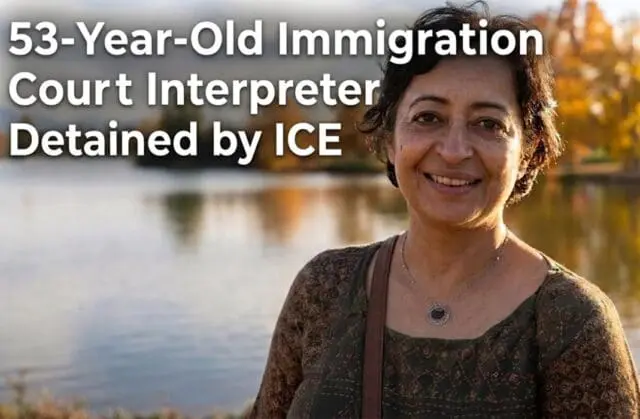
53-Year-Old Immigration Court Interpreter Detained by ICE in Texas Sparks National Debate
The detention of Meenu Batra, a 53-year-old immigration court interpreter based in South Texas, has ignited widespread concern across immigrant and legal communities in the United States. Her case highlights the complexities of U.S. immigration policy and the vulnerabilities faced by long-term residents who lack permanent legal status.
Batra, who has lived in the United States for over three decades, was detained by U.S. Immigration and Customs Enforcement (ICE) on March 17, 2026, at Harlingen International Airport while traveling to Milwaukee for a legal assignment.
A Respected Legal Professional Caught in the System
For more than 20 years, Meenu Batra has served as a highly skilled immigration court interpreter, assisting thousands of immigrants navigating complex legal proceedings. She is widely recognized as the only master-level licensed legal interpreter in Texas proficient in Hindi, Punjabi, and Urdu—languages critical to many South Asian diaspora communities.
Her role placed her at the center of the U.S. immigration system, helping individuals understand their rights and communicate effectively in court. Today, she finds herself on the other side of that same system.
Immigration Status: “Withholding of Removal”
Despite her long residence in the U.S., Batra does not hold permanent residency or citizenship. Instead, she was granted “withholding of removal” decades ago—a form of legal protection that prevents deportation to her home country, India, due to credible fears of persecution.
Batra fled India after her parents were killed during religious violence in the 1980s. While withholding of removal allowed her to remain in the U.S., it does not provide a pathway to a green card or full legal stability. This distinction has now become central to her detention.
Arrest at the Airport
Batra’s arrest has drawn particular attention due to the manner in which it occurred. According to reports, she was detained by plainclothes ICE agents at Harlingen International Airport as she prepared to travel for work.
The incident has raised concerns among immigration advocates about enforcement practices, especially when applied to individuals with longstanding ties to the country and professional contributions to the legal system.
Legal Battle Underway
As of April 16, 2026, Batra remains in custody at the El Valle Detention Center in Texas. Her legal team, led by attorney Deepak Ahluwalia, has filed a habeas corpus petition seeking her immediate release.
A government response to the petition is expected by April 21, 2026, a date that could prove pivotal in determining her immediate future.
Family and Community Impact
Batra is a single mother of four adult children, all of whom are U.S. citizens. Her detention has deeply affected her family, particularly her youngest son, Jasper, who recently enlisted in the U.S. Army.
In an effort to support his mother, Jasper has filed a parole application on her behalf—highlighting the personal toll of immigration enforcement on families with deep roots in the United States.
Broader Implications for the Diaspora
Batra’s case resonates strongly within diaspora communities, particularly among immigrants who have lived in the U.S. for decades under temporary or limited legal protections.
It raises critical questions:
- How secure is long-term residency without permanent status?
- Should individuals with significant community contributions be treated differently under immigration enforcement?
- What reforms are needed to address gaps in immigration pathways?
For many in the diaspora, her story is a stark reminder that legal vulnerability can persist even after decades of residence, work, and contribution.
Growing Calls for Reform
Immigration advocates and legal professionals are increasingly calling for policy reforms that provide clearer pathways to permanent residency for individuals under statuses like withholding of removal.
Batra’s detention has become a focal point in this ongoing debate, symbolizing the tension between enforcement and humanitarian considerations within U.S. immigration policy.
Conclusion
The detention of Meenu Batra underscores the complex realities faced by many immigrants in the United States—particularly those who have built lives and careers despite lacking permanent legal status.
As her legal case unfolds, it is likely to remain a significant touchpoint in national conversations about immigration reform, fairness, and the treatment of long-term residents within the system.