
The landscape of the Middle East changed dramatically following the military operations initiated in February 2026. As U.S. and allied forces engaged in a 40-day campaign involving over 13,000 strikes, the region saw a massive surge in retaliatory drone and missile attacks from Iran-backed militias. For Kenyan civilians working on U.S. bases in Iraq, Kuwait, Jordan, the UAE, and Qatar, the “front line” is no longer a distant concept—it is often the base where you live and work.
Following the tragic death of a Kenyan worker at the Erbil airbase on March 24, 2026, it is vital that you understand the legal protections that exist to safeguard your life, your health, and your family’s future.
1. Your Safety Rights During Regional Conflict
With thousands of drones and missiles targeting bases across at least nine Arab states in early 2026, Kenyan contractors have faced unprecedented pressure to remain on-site despite active threats. You must know your rights:
-
Evacuation vs. Retaliation: The U.S. government has recently pressured contractors like V2X to evacuate staff from high-risk zones in Iraq and Kuwait. If your employer threatens you with “voluntary resignation” or blacklisting for requesting evacuation during active shelling, they may be in violation of oversight standards.
- Advertisement - -
The “Zone of Danger” Rule: In a regional conflict where bases are being targeted by retaliatory strikes, you are protected by the Defense Base Act (DBA) 24 hours a day. Whether you are in a dining hall in Kuwait or a sleeping quarter in Erbil, any injury sustained during these attacks is considered work-related because the “danger” is a condition of your employment location.
-
Retaliation Protection: You have the right to report safety violations without fear of losing your legal standing for future compensation.
2. Financial Security: The Defense Base Act (DBA)
The DBA is a federal U.S. law that provides workers’ compensation to civilian contractors. It does not matter that you are a Kenyan citizen; if you work for a U.S. contractor, you are entitled to:
-
Medical Benefits: Full payment for medical care, including treatment for burns, shrapnel injuries, and long-term rehabilitation.
-
Disability Compensation: If an attack leaves you unable to work, you are entitled to roughly two-thirds of your average weekly wages.
-
Psychological Coverage: The 2026 conflict has led to a surge in PTSD and anxiety claims. The DBA covers psychological trauma caused by living under the constant threat of drone strikes, even if you were not physically hit.
-
Death Benefits: In the event of a fatality, the law provides for the surviving spouse and children, often through a “commuted” lump-sum payment that provides lasting security in Kenya.
3. Legal Advocacy: Ben Akech
Navigating the U.S. Department of Labor while managing family affairs in Kenya requires specialized expertise. Ben Akech is an attorney uniquely positioned to help, as he is licensed to practice in Kenya, Maryland, and New York. Mr. Akech provides a comprehensive bridge for Kenyan workers:
-
Medical Evaluation Network: He works with medical professionals who can evaluate both physical and psychological injuries to prepare the rigorous medical reports required for a successful DBA claim.
-
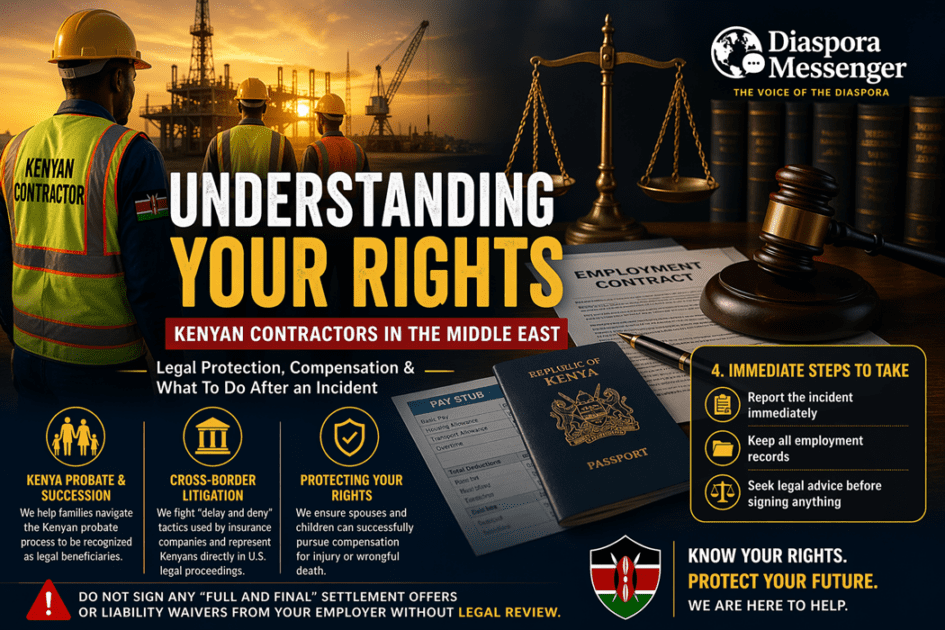
Kenya Probate and Succession: If a worker is killed, the family must navigate the Kenyan probate process to be recognized as legal beneficiaries. Mr. Akech handles these local legal hurdles, ensuring spouses and children can successfully pursue U.S. compensation.
-
Cross-Border Litigation: He fights “delay and deny” tactics used by insurance companies, representing Kenyans directly in U.S. legal proceedings.
4. Immediate Steps to Take
If you are involved in an attack or injured:
-
Report the Incident: Document the event and your injury to your supervisor immediately.
-
Keep Records: Save your contract, pay stubs, and any base clinic records.
-
Consult specialized Counsel: Do not sign any “full and final” settlement offers or liability waivers from your employer without legal review.
Summary of Regional Protection
| Base Location | Primary Threats (2026) | Your Coverage |
| Iraq / Erbil | Drone strikes, militia raids | Full DBA Medical & Disability |
| Kuwait / UAE / Qatar | Retaliatory missile barrages | “Zone of Danger” Protection |
| Jordan / Syria | Crossfire and drone activity | PTSD and Physical Injury claims |
The risks you take in the Middle East are significant, especially during periods of regional retaliation. Ensure you have the legal support necessary to protect the future you are working so hard to build.
Author Ben Akech is an attorney and founder of The Law Office of Ben Akech, LLC, based in Silver Spring, Maryland. There he provides dedicated legal services to individuals and families.