
Major USCIS Immigration Changes Could Affect Thousands of Kenyans Seeking Green Cards and U.S. Citizenship
The United States immigration system has entered another period of significant change following new policy updates from U.S. Citizenship and Immigration Services (USCIS). The changes affect how temporary visa holders pursue permanent residency, how citizenship applicants prepare for the naturalization test, and even how immigration fees are paid.
For thousands of Kenyans living in the United States on student visas, work visas, visitor visas, and other temporary immigration categories, these policy changes could reshape long-term immigration plans.
Immigration attorneys are encouraging applicants to understand the new requirements before filing any immigration benefit requests.
What Has Changed?
USCIS has announced several major updates affecting immigration benefits, including:
- Green Card applications through Adjustment of Status
- Naturalization (U.S. Citizenship)
- Electronic filing payments
- Asylum processing
The updates reflect the agency’s emphasis on stricter immigration procedures and increased administrative efficiency.
Green Card Applicants May Need to Leave the United States
Perhaps the biggest change affects individuals already living legally inside the United States on temporary visas.
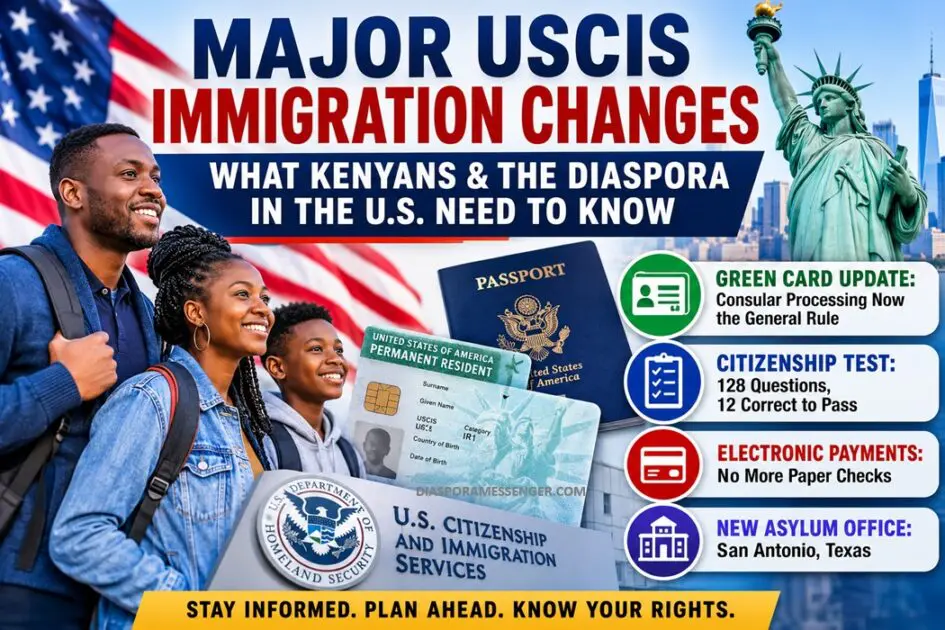
Under the updated USCIS policy guidance, foreign nationals seeking lawful permanent residence are generally expected to complete the immigrant visa process through a U.S. embassy or consulate overseas rather than adjusting status while remaining inside the United States.
USCIS states that adjustment of status should be treated as an extraordinary form of discretionary relief, meaning approvals inside the United States may become far less common outside exceptional circumstances.
What is Adjustment of Status?
Adjustment of Status (AOS) allows eligible immigrants already in the United States to become permanent residents without traveling abroad.
Historically, this process has been widely used by:
- Family-sponsored immigrants
- Employment-based immigrants
- Diversity Visa adjustment applicants (where eligible)
- Certain humanitarian applicants
The new policy signals that USCIS officers should place greater emphasis on consular processing abroad when exercising their discretion. Some immigration law experts note that dual-intent visa holders, such as many H-1B and L-1 workers, may still have stronger arguments for adjustment eligibility, but each case will be evaluated individually.
What This Means for Kenyans Living in America
Many Kenyans currently live in the U.S. under:
- F-1 Student Visas
- J-1 Exchange Visitor Visas
- B-1/B-2 Visitor Visas
- Temporary work visas
Some later become eligible for Green Cards through:
- Marriage to U.S. citizens
- Employment sponsorship
- Family petitions
- Other immigration categories
The updated policy means many applicants may need to carefully plan their immigration strategy and prepare for possible consular processing abroad, depending on their circumstances and how USCIS exercises its discretion.
Because immigration law is highly individualized, applicants should seek qualified legal advice before making travel or filing decisions.
Citizenship Test Becomes More Difficult
USCIS has also introduced a more rigorous civics examination for many naturalization applicants.
Applicants filing on or after October 20, 2025, must prepare using:
- 128 possible civics questions
- Officers ask 20 questions
- Applicants must answer at least 12 correctly to pass
This replaces the previous format, which drew from a smaller question bank and required fewer correct answers.
The updated test places greater emphasis on understanding constitutional principles, American history, and government rather than simple memorization.
Paper Checks Are Largely Being Eliminated
USCIS is also modernizing how applicants pay immigration fees.
Most benefit requests now require electronic payment methods, including:
- Credit cards
- Debit cards
- ACH bank transfers
Paper checks and money orders are being phased out for most applications as USCIS continues expanding digital processing. Applicants should verify accepted payment methods before submitting forms to avoid delays.
Additional Asylum Office Opens in Texas
To address growing workloads, USCIS has opened another asylum office in San Antonio, Texas.
The additional office is intended to help process increasing numbers of asylum interviews and improve case management across the immigration system. The expansion is expected to reduce pressure on existing asylum offices, although processing times will still vary depending on caseloads and individual circumstances.
Immigration Expert Opinion
Immigration attorneys caution that these changes represent one of the most significant shifts in USCIS policy in recent years.
Legal experts note that while adjustment of status remains authorized under U.S. immigration law, USCIS is signaling a preference for consular processing and reminding officers that adjustment is a discretionary benefit rather than an automatic entitlement. How the policy is implemented in practice may become the subject of future litigation and additional guidance.
Experts also recommend that applicants:
- Avoid relying on outdated immigration advice.
- Review the latest USCIS guidance before filing.
- Consult qualified immigration attorneys for case-specific advice.
- Keep immigration records organized.
- Prepare thoroughly for the updated citizenship examination.
Kenyan Diaspora Impact
The Kenyan diaspora in the United States numbers well over 150,000 Kenyan-born residents, according to recent U.S. Census estimates, with many more Americans claiming Kenyan ancestry. Every year, thousands of Kenyans apply for Green Cards, employment authorization, permanent residency, and eventually U.S. citizenship.
For this community, the latest USCIS changes could have far-reaching implications:
- Longer planning timelines for permanent residency.
- Greater importance of maintaining lawful immigration status.
- Increased need for professional legal guidance.
- More intensive preparation for the naturalization exam.
- Potential additional travel costs and family separation concerns for applicants required to complete consular processing abroad.
Despite these changes, immigration experts emphasize that lawful pathways to permanent residence and citizenship remain available for eligible applicants.
Immigration Statistics
- USCIS processes millions of immigration benefit applications each year, including family-based, employment-based, humanitarian, and naturalization cases.
- Hundreds of thousands of immigrants become lawful permanent residents annually through both adjustment of status and consular processing.
- Tens of thousands of people naturalize as U.S. citizens every month, making naturalization one of USCIS’s largest benefit programs.
Frequently Asked Questions (FAQ)
Can I still apply for a Green Card inside the United States?
Adjustment of Status remains available under U.S. law, but USCIS has emphasized that it is discretionary and has indicated a stronger preference for consular processing in many cases. Eligibility depends on individual circumstances.
Does this affect marriage-based Green Cards?
Marriage-based applicants should consult an immigration attorney, as eligibility depends on the petitioner’s status, the applicant’s immigration history, and current USCIS policy.
Has the citizenship test changed?
Yes. Applicants filing under the updated rules face a larger bank of 128 civics questions, will be asked 20 questions during the interview, and must answer at least 12 correctly.
Can I still pay USCIS using paper checks?
For most immigration benefit requests, USCIS now requires electronic payment methods, with paper checks and money orders largely phased out.
Should I speak with an immigration lawyer?
Yes. Immigration laws and USCIS policies change frequently, and obtaining professional legal advice before filing immigration applications is highly recommended.
Final Thoughts
The latest USCIS updates underscore the importance of careful immigration planning for Kenyans living in the United States. Whether pursuing a Green Card, preparing for U.S. citizenship, or navigating another immigration pathway, staying informed about changing policies is essential.
For the Kenyan diaspora, understanding these developments early can help reduce delays, avoid costly mistakes, and improve the chances of a successful immigration journey.
Sources: U.S. Citizenship and Immigration Services (USCIS), Department of Homeland Security policy guidance, and immigration law analysis.
Keywords: USCIS updates 2026, Green Card changes, Adjustment of Status, consular processing, Kenyan diaspora USA, immigration news, U.S. citizenship test, naturalization 2026, USCIS electronic payments, asylum office Texas, Green Card for Kenyans, U.S. immigration policy.

USCIS Updates 2026: Major Green Card Immigration Changes