


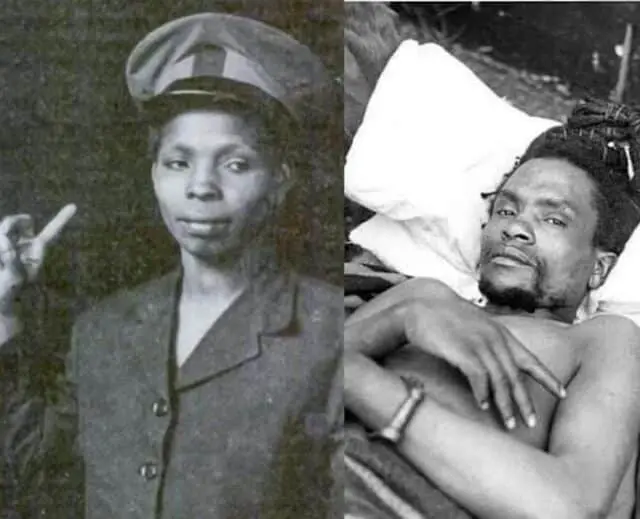
The late wife of Field Marshall Kimathi Wa Wachiuri, Mukami Kimathi was laid to rest on May 13th, 2023. She was also a Field Marshall and had fought alongside her husband Dedan Kimathi in the forest for the liberation of her people.
The Mau Mau movement was not solely about the liberation of a republic. Rather, it was a fight for the divine freedom of a people who had lived in harmony with nature, as they had been given by their Creator.
Before the colonialists set foot in what we now know as Kenya, different tribes lived in harmony with their environment. They had natural interactions with one another.
Natural relationships were formed through marriage, trade, and occasional fights. However, once the land of the Gîkûyû was taken from them, the Gîkûyû had to fight for their birthright. Though not a violent people, this resulted in the Mau Mau rebellion.
In the Gîkûyû culture, all genders and age groups worked in harmony for the collective good of the family and the tribe. Though women did not naturally go to war, the Gîkûyû people believed it was their higher calling to stand up and defend their birthright. This was demonstrated by the Kimathi couple fighting together.
This is a great lesson for today’s Gîkûyû family, which continues to struggle with gender roles. Also, it is debated over which gender child should be advocated for over the other. In the Gîkûyû nation, it shouldn’t be about gender empowerment. Rather, it should be about the sanctity of life and land through the integrity of the family.
Just like great technology without a moral fabric leads to destruction, strong individuals without a family grounding are dangerous.
Although Kimathi died in 1952, his wife spent the rest of her life advocating for his justice until her death. She might not have lived to see her wishes for the patriarch of her family accorded the respectful burial he deserved for his sacrifice for the land he died defending, but her children will live to see it come to pass.
This is a beautiful multi-generational story where one generation tells the history to the next. The next generation carries values to posterity. The Kimathi story resonates with the Martin Luther King story in Atlanta, Georgia. MLK was killed, but his wife spent the rest of her life cementing her family legacy.
Now, her children continue with the same legacy of building beloved communities and advancing civil rights. As a Gîkûyû people, if we are to heal and thrive, we must reflect on who we were before our communities were disrupted. By doing so, we can live up to our true calling.
We often go as far back as when Kenya was a colony, but that is not who we are. We are not subjects. We are a free, righteous society that lived in harmony with nature and had solutions to many external conflicts.
If we focus more on the success of the family than individual rights, our children will thrive anywhere in the world. Consequently, our freedom will grow.
The success of the Gîkûyû family is the success of the tribe. The tribe’s success is the success of the nation. World peace is achieved through the success of nations. It starts with the family, not political maneuvers.
By Kibiru Mugechi, Diaspora Messenger Contributor