



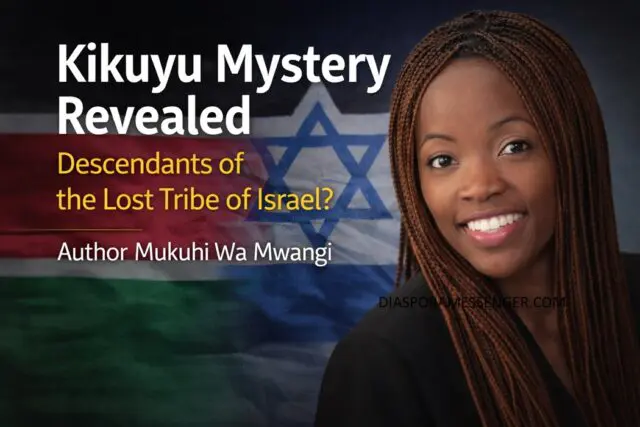
A growing body of literature exploring African-Israelite connections has reignited global interest in one of Kenya’s most fascinating cultural theories: that the Kikuyu people are descendants of one of the Ten Lost Tribes of Israel.
In her book Kikuyu Mystery Revealed: Descendants of Asher, a Lost Tribe of Israel, Kenyan author and researcher Mukuhi Wa Mwangi presents a compelling argument linking Kikuyu ancestry, rituals, and spiritual traditions to ancient Hebrew history.
The book, now available on Amazon, has sparked debate among scholars, theologians, and members of the African diaspora seeking to understand deeper spiritual and historical identities.
The Core Theory: Kikuyu as the Tribe of Asher
At the heart of Mwangi’s work is the claim that the Kikuyu people descend from the biblical Tribe of Asher, one of the ten tribes of Israel exiled after the fall of the Northern Kingdom of Israel in 722 BC.
According to the theory:
- The Tribe of Asher migrated “beyond the rivers of Ethiopia”, a phrase drawn from biblical prophecy.
- Over centuries of migration through Northeast Africa, they eventually settled in Central Kenya, becoming the Kikuyu people.
- Oral traditions, naming patterns, and spiritual practices preserved key elements of their Hebrew roots.
Mwangi argues that this migration narrative aligns with both biblical texts and Kikuyu oral history, which speaks of ancestral origins from the north.
Cultural Parallels Between Kikuyu and Ancient Hebrews
One of the strongest pillars of the book is the striking resemblance between traditional Kikuyu customs and Mosaic laws found in the Old Testament.
1. Sacrificial and Ceremonial Practices
Mwangi highlights similarities in:
- Animal sacrifices
- Purification rituals
- Community atonement ceremonies
- Blood symbolism in covenants
These traditions mirror practices described in Leviticus and Deuteronomy, suggesting a shared ancient spiritual framework.
The “Second Birth” Ceremony and Biblical Rebirth
Another key concept explored is the Kikuyu ritual known as “Second Birth”, where a child undergoes a symbolic rebirth through a lamb.
Mwangi connects this directly to the New Testament conversation between Jesus and Nicodemus, where Jesus teaches the necessity of being “born again” (John 3:3).
In both traditions:
- Rebirth represents spiritual renewal.
- A lamb symbolizes purity and redemption.
- The ritual marks a transition into divine covenant.
This parallel, Mwangi argues, points to a shared redemptive theology between Kikuyu spirituality and early Judeo-Christian teachings.
The Ituika Ceremony and Prophetic Leadership
The Ituika Ceremony, a sacred Kikuyu generational transition of leadership, is interpreted as a prophetic echo of Messianic succession.
In Kikuyu culture:
- Leadership transfers every generation.
- The ceremony marks renewal, judgment, and restoration.
- Elders symbolically hand authority to the next age.
Mwangi views this as reflecting the earthly ministry of Yeshua (Jesus)—a transition from old covenant structures to new spiritual leadership.
The Sacred Mugumo Tree and the House of Israel
The Mugumo tree (sacred fig tree) plays a central role in traditional Kikuyu worship, serving as a spiritual altar where prayers and sacrifices are offered.
Mwangi links this to:
- Biblical sacred trees (such as the Tree of Life)
- Abrahamic altar traditions
- The symbolic presence of God in natural spaces
She suggests the Mugumo represents a preserved Israelite worship system adapted to African geography.
A Lost Tribe and God’s Redemptive Plan
According to Mwangi, Kikuyu culture provides a unique lens through which to understand God’s redemptive work among exiled peoples.
Her thesis argues that:
- The Kikuyu are not merely cultural descendants, but spiritual heirs of Israel.
- Their traditions “illuminate the New Covenant”.
- The story of Israel is incomplete without acknowledging African branches of the diaspora.
The book positions the Kikuyu not as outsiders to biblical history, but as active participants in a long-lost chapter of Israel’s journey.
Global Impact and Diaspora Interest
The theory has gained traction among:
- African Hebrew Israelite movements
- Pan-African historians
- Kenyan diaspora communities
- Biblical ancestry researchers
For many in the African diaspora, the book resonates as part of a broader quest for identity, spiritual heritage, and historical reclamation.
Where to Buy the Book
Kikuyu Mystery Revealed: Descendants of Asher, a Lost Tribe of Israel by Mukuhi Wa Mwangi is available on Amazon and major online bookstores.
The book has become a reference point in discussions on:
- African-Israelite connections
- Lost tribes of Israel
- Kikuyu cultural history
- Biblical ancestry in Africa
Conclusion
While the theory remains controversial in academic circles, Kikuyu Mystery Revealed offers a powerful narrative that blends theology, anthropology, and African oral tradition. Whether viewed as historical truth, spiritual interpretation, or cultural symbolism, the book challenges conventional boundaries of biblical history and invites readers to reconsider Africa’s place in the story of Israel.
For many Kenyans and members of the global African diaspora, the question is no longer whether Africa was connected to biblical history—but how deeply.




I visited Israel in June, 2008 and I could not believe my eyes when I saw some of the rituals mentioned in the bible and practised in Israel are very similar to those of Kikuyus Kiama kia Ma. There is a lot in common. The kikuyu men like the jews dont break bones when eating some goat meat…and many more