

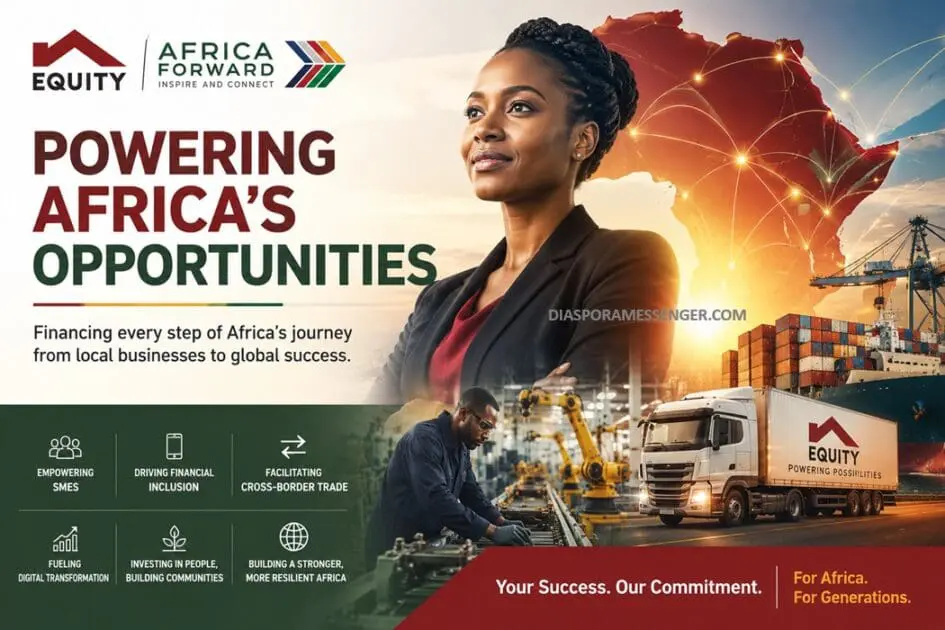
As global businesses rethink overdependence on concentrated supply chains, Africa is rapidly emerging as a strategic alternative for manufacturing, logistics, agriculture, and trade. At the center of this transformation is Equity Bank, a financial institution positioning itself as a major catalyst for economic growth, regional integration, and financial inclusion across East and Central Africa.
From financing small businesses to supporting large-scale manufacturing and agricultural value chains, Equity Bank is increasingly becoming a driving force behind Africa’s industrial and economic future.
Africa’s Rising Opportunity in Global Supply Chains
Global disruptions in recent years exposed the risks of relying heavily on a few manufacturing hubs. Companies around the world are now exploring diversified production and sourcing destinations, creating a major opportunity for African economies.
With its youthful population, expanding infrastructure, strategic geographic location, and growing digital economy, Africa is uniquely positioned to become a competitive manufacturing and logistics hub.
For the African diaspora, this shift represents more than a trend. It opens doors for investment, entrepreneurship, exports, technology partnerships, and wealth creation across the continent.
Equity Bank’s Role in Africa’s Economic Transformation
Equity Bank has grown into one of East Africa’s largest financial institutions by customer reach and asset base. Through its regional footprint, the bank is helping businesses scale across borders while expanding financial access to millions.
The institution operates in multiple African markets including Kenya, Uganda, Rwanda, Tanzania, South Sudan, and the Democratic Republic of Congo (DRC), creating a strong regional banking ecosystem that supports trade and investment.
Its strategy aligns with Africa’s push toward regional integration under the African Continental Free Trade Area (AfCFTA), which seeks to strengthen intra-African trade and reduce barriers between African economies.
Supporting SMEs and Manufacturing Growth
Small and medium enterprises (SMEs) remain the backbone of Africa’s economy. Equity Bank has invested heavily in empowering SMEs through:
- Asset financing
- Working capital solutions
- Manufacturing credit facilities
- Trade financing
- Supply chain financing
- Business advisory services
- Digital payment systems
Manufacturers and logistics businesses can access financing solutions that support every stage of production and distribution, from raw materials procurement to export operations.
This support is particularly important as African businesses seek to compete globally and build resilient local industries.
Expanding Financial Inclusion Across Africa
One of Equity Bank’s most transformative achievements has been financial inclusion.
Millions of Africans previously excluded from formal banking services now access financial products through:
- Mobile banking
- Agency banking
- Digital wallets
- Micro-loans
- Internet banking platforms
- Third-party agent networks
The bank’s mobile-first strategy has helped shift over 90% of retail transactions away from traditional branches into digital channels.
This digital transformation has made banking more accessible, affordable, and efficient, especially for rural communities and informal sector workers.
For Africans in the diaspora sending remittances home, these digital banking systems also improve convenience, speed, and accessibility for families and businesses.
Facilitating Cross-Border Trade in East and Central Africa
As regional trade expands, financial institutions play a critical role in enabling smooth business transactions across borders.
Equity Bank supports intra-African commerce by facilitating trade across:
- Kenya
- Uganda
- Rwanda
- Tanzania
- South Sudan
- Democratic Republic of Congo (DRC)
The bank’s regional integration model helps businesses:
- Move capital efficiently
- Access regional markets
- Simplify payment systems
- Reduce transaction barriers
- Expand supply chains across borders
This growing regional network strengthens Africa’s competitiveness in global markets.
The Africa Recovery and Resilience Plan
Equity Group’s ambitious “Africa Recovery and Resilience Plan” has become one of the continent’s largest private-sector economic empowerment initiatives.
The plan focuses on deploying billions in capital toward:
- Agricultural modernization
- Manufacturing expansion
- MSME growth
- Climate-smart investments
- Food security
- Digital transformation
- Youth entrepreneurship
The initiative aims to create sustainable economic opportunities while accelerating industrialization across Africa.
For diaspora investors and professionals, the plan also creates opportunities for partnerships, investment participation, skills transfer, and business expansion into African markets.
Equity Group Foundation and Social Impact
Beyond banking, Equity Group Foundation continues to anchor social transformation programs across Africa.
Its initiatives focus on:
- Education scholarships
- Healthcare access
- Leadership development
- Environmental sustainability
- Entrepreneurship training
- Financial literacy
Programs under the foundation have impacted thousands of students, young entrepreneurs, and vulnerable communities throughout the region.
Why This Matters to the African Diaspora
For Africans living abroad, the continent’s economic transformation presents growing opportunities in:
- Manufacturing
- Real estate
- Agribusiness
- Technology
- Logistics
- Export businesses
- Infrastructure development
- Financial services
Financial institutions like Equity Bank are helping bridge the gap between diaspora capital and African economic growth.
As Africa positions itself as a global production and supply chain alternative, diaspora communities are expected to play an increasingly important role in investment, innovation, and skills transfer.
Conclusion
Africa’s rise as a global economic and manufacturing alternative is gaining momentum, and Equity Bank is positioning itself at the heart of that transformation.
Through regional integration, SME financing, digital banking innovation, financial inclusion, and large-scale development initiatives, the bank continues to power opportunities across the continent.
For the African diaspora, this moment represents more than economic change — it is an invitation to participate in shaping Africa’s next chapter of growth and global competitiveness.

#EquityBank #AfricaForward #AfricanDiaspora #DiasporaInvestment #AfricaTrade #ManufacturingAfrica #FinancialInclusion #EastAfricaBusiness #SMEFinancing #DigitalBanking #AfricaEconomy #EquityGroupFoundation #AfricanOpportunities #RegionalIntegration #DiasporaBusiness