


Shocking Trump Plan Sparks Debate as Ebola-Exposed Americans Could Be Quarantined in Kenya
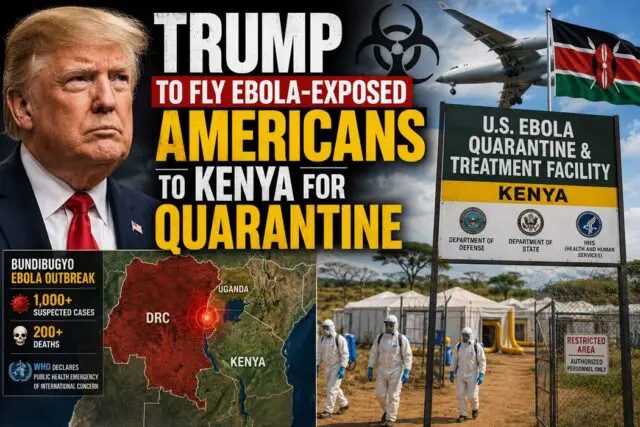
The Trump administration is reportedly preparing to establish a quarantine and treatment facility in Kenya for American citizens exposed to the Ebola virus, marking a major shift in how the United States responds to infectious disease emergencies abroad.
The proposed facility, which would be coordinated jointly by the U.S. Departments of Defense, State, and Health and Human Services (HHS), is expected to house and treat Americans working or traveling in East and Central Africa who either test positive for Ebola or are considered high-risk exposures.
The announcement has already triggered intense debate among public health experts, the Kenyan diaspora community, and global health officials, especially as East Africa faces renewed concerns over the spread of the deadly virus.
Kenya Selected for Strategic Ebola Response Hub
According to reports, the quarantine and treatment center will be established somewhere in Kenya, although the exact location has not yet been publicly disclosed.
The facility is expected to serve American medical personnel, scientists, humanitarian workers, diplomats, and contractors operating in regions affected by the ongoing Ebola outbreak centered in the Democratic Republic of Congo (DRC) and neighboring Uganda.
Administration officials argue that placing the facility in Kenya would allow faster treatment and containment while preventing potentially infected individuals from traveling directly into the United States.
Officials say the strategy eliminates the need for lengthy medical evacuation flights across the Atlantic, reducing exposure risks during transport.
Bundibugyo Ebola Outbreak Raises Global Alarm
The move comes as the World Health Organization (WHO) responds to a rapidly escalating outbreak of the rare Bundibugyo strain of Ebola.
The outbreak, primarily concentrated in the DRC, has reportedly spread into Uganda and raised fears across the East African region. Health authorities indicate that more than 1,000 suspected infections and over 200 deaths have already been recorded, making it one of the most serious Ebola outbreaks in recent years.
The WHO has classified the outbreak as a Public Health Emergency of International Concern, intensifying international coordination efforts to contain the virus before it spreads further.
Unlike some previous Ebola outbreaks, the Bundibugyo strain has limited vaccine availability, making containment and isolation strategies even more critical.
U.S. Public Health Officers Already Receiving Deployment Notices
Sources familiar with the operation indicate that officers from the U.S. Public Health Service Commissioned Corps have already begun receiving deployment notices in preparation for the Kenya facility.
The site is expected to operate under strict biocontainment protocols similar to those used in specialized Ebola treatment centers in the United States.
American officials believe Kenya’s relatively advanced healthcare infrastructure, regional transport connectivity, and strategic position make it an ideal location for the emergency response operation.
Kenya has previously worked closely with international agencies during regional disease outbreaks, including COVID-19 preparedness and cross-border health surveillance initiatives.
Kenya Signals Openness to Global Health Partnership
Kenya’s Health Cabinet Secretary Aden Duale reportedly indicated that the country is open to international partnerships aimed at strengthening global health security and emergency preparedness.
However, final approvals and agreements surrounding the proposed Ebola quarantine facility are still under discussion.
The possibility of hosting a U.S.-backed Ebola treatment site has already sparked mixed reactions among Kenyans online, with some supporting the economic and diplomatic benefits while others express fears about potential health risks.
For many Kenyans in the diaspora, especially those with families in East Africa, the development raises fresh concerns about regional health preparedness and public confidence.
Public Health Experts Criticize the Decision
Several American public health experts have criticized the Trump administration’s decision to keep exposed U.S. citizens abroad rather than transporting them back to highly specialized American biocontainment hospitals.
Critics argue that the move represents a significant departure from longstanding U.S. medical evacuation protocols that prioritize bringing infected citizens home for advanced treatment.
Others question whether a newly constructed field facility in Kenya could match the capabilities of established infectious disease centers in the United States.
Some experts also warn that the decision could place additional pressure on Kenya’s healthcare system if the outbreak worsens across the region.
Growing Concerns Across the Diaspora Community
The Kenyan diaspora community in the United States and Canada has also begun closely monitoring the situation.
Many diaspora families maintain strong travel and business ties with East Africa, particularly Kenya and Uganda, and fear that heightened Ebola concerns could affect travel, tourism, remittances, and regional economic activity.
Health authorities across East Africa continue to emphasize that no widespread outbreak has been reported in Kenya itself, while surveillance systems at airports and border crossings remain active.
The proposed facility now places Kenya at the center of a major international public health strategy that could significantly shape regional disease response efforts in the months ahead.