


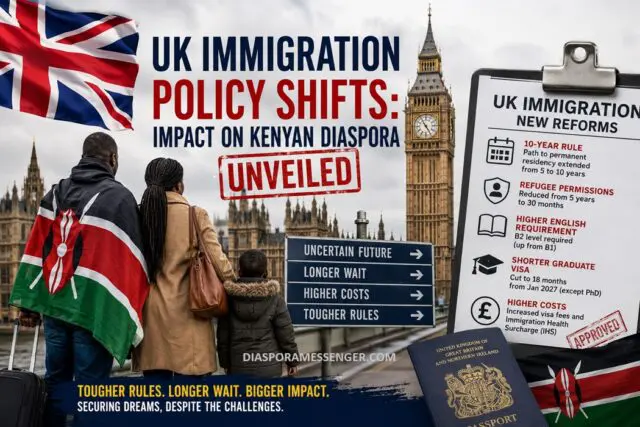
The latest reforms to United Kingdom immigration policy are sending shockwaves through the Kenyan diaspora community, raising concerns about permanent residency, financial stability, and long-term settlement opportunities for thousands of Kenyans living abroad.
With an estimated 130,000 to 150,000 Kenyan-born residents currently living in the UK, Britain remains Kenya’s second-largest diaspora destination after the United States. For decades, the UK has served as a critical economic and social lifeline for Kenyan families through employment opportunities, education, and billions in annual remittances.
However, the new phased immigration reforms are now dramatically reshaping the future for Kenyan professionals, students, workers, and families seeking stability in Britain.
UK Immigration Reforms Trigger Anxiety Among Kenyan Diaspora
The most controversial adjustment centers on the pathway to permanent residency, also known as Indefinite Leave to Remain (ILR).
New 10-Year Settlement Rule
Under the revised immigration framework, the standard period required for migrants to qualify for permanent settlement is expected to increase from five years to ten years for many visa categories.
For Kenyan professionals working in sectors such as healthcare, technology, finance, transport, and hospitality, the change represents a major setback.
Previously, many Kenyan migrants structured their careers, savings, and family plans around the five-year route to permanent residency. The extension now means years of additional uncertainty before achieving stable immigration status.
Prolonged Temporary Status Creates Economic Pressure
The longer pathway to settlement leaves many Kenyan migrants trapped in prolonged temporary legal status.
This delay affects major life decisions, including:
- Buying homes in the UK
- Accessing long-term financial products
- Planning family reunification
- Investing in businesses
- Applying for British citizenship
For many Kenyan families, the reforms create emotional and financial instability, especially for those who had already begun long-term settlement plans.
Diaspora advocates warn that the uncertainty could discourage skilled Kenyan workers from choosing the UK as a destination.
Refugee and Humanitarian Protections Reduced
The reforms also introduce major reductions to humanitarian protections.
Refugee permissions that previously lasted five years are reportedly being reduced to 30 months, requiring vulnerable migrants to repeatedly renew their status.
Human rights organizations and diaspora groups fear the shorter protection periods may increase stress and insecurity among asylum seekers and refugees already struggling to rebuild their lives.
Kenyan Remittances at Risk
The impact of the immigration changes extends far beyond Britain.
The Kenyan diaspora in the UK recently emerged as Kenya’s second-largest source of remittances, contributing millions of dollars annually to support families, education, healthcare, housing projects, and businesses back home.
Threat to Household Support Systems
Tighter immigration standards could reduce the number of Kenyans entering or remaining in the UK workforce.
This directly threatens future remittance flows that many Kenyan households rely on for:
- School fees
- Rent and housing
- Medical expenses
- Farming investments
- Daily household support
Economists warn that reduced diaspora earnings could place additional pressure on the Kenyan economy and weaken household financial resilience.
Tougher Entry Requirements for Skilled Workers
The UK government has also raised English language requirements for several visa categories.
Applicants for:
- Skilled Worker visas
- Scale-up visas
- High Potential Individual visas
must now demonstrate B2-level English proficiency instead of the previous B1 standard.
For many applicants from non-English-speaking educational backgrounds, this creates an additional barrier to employment and migration opportunities.
UK Student Pathway Becoming More Difficult
Kenyan students have traditionally used UK graduate routes to gain employment experience and transition into long-term careers abroad.
However, new changes are expected to reduce graduate visas to only 18 months starting January 2027 for non-PhD graduates.
This shortened period significantly reduces the time available for graduates to:
- Secure employment
- Transition into sponsorship opportunities
- Stabilize financially
- Build long-term careers
Many education consultants fear the reforms may discourage Kenyan students from pursuing higher education in the UK.
Rising Visa Costs Hit Kenyan Families Hard
Another major concern is the sharp increase in immigration-related expenses.
The UK government has significantly increased:
- Visa application fees
- Immigration Health Surcharge (IHS) payments
- Family sponsorship costs
For Kenyan families already facing high living expenses and currency exchange challenges, the additional financial burden may make migration unaffordable for many middle-income households.
Some families are now forced to delay relocation plans, while others risk accumulating debt to maintain legal immigration status.
Kenyan Diaspora Community Calls for Clarity
Members of the Kenyan diaspora community are increasingly calling for clearer guidance and transitional protections.
Immigration experts argue that the rapid pace of reforms has left many migrants confused about:
- Settlement timelines
- Visa renewal requirements
- Sponsorship obligations
- Future residency rights
Community organizations are urging affected Kenyans to seek legal immigration advice and avoid relying on unofficial information circulating online.
Future of Kenyan Migration to the UK Uncertain
The UK has historically remained one of the most attractive destinations for Kenyan migrants due to its strong labor market, educational opportunities, and established diaspora networks.
However, the latest immigration reforms are now forcing many Kenyans to reconsider their long-term plans.
Countries such as Canada, Australia, Germany, and the United States may increasingly become alternative destinations for skilled Kenyan workers and international students seeking more stable immigration pathways.
As uncertainty grows, many Kenyan diaspora families are watching closely to see whether additional reforms or legal challenges could reshape the future of migration to Britain.
Conclusion
The sweeping UK immigration reforms represent one of the most significant policy shifts affecting the Kenyan diaspora in recent years.
From extended settlement timelines and rising visa costs to stricter entry requirements and reduced post-study opportunities, the changes are reshaping the lives of thousands of Kenyans abroad.
For many diaspora families, the reforms introduce difficult questions about financial stability, long-term settlement, and the future of migration to the United Kingdom.
As policymakers continue implementing the phased changes, the Kenyan diaspora community remains deeply concerned about the long-term economic and social consequences for families both in Britain and back home in Kenya.