


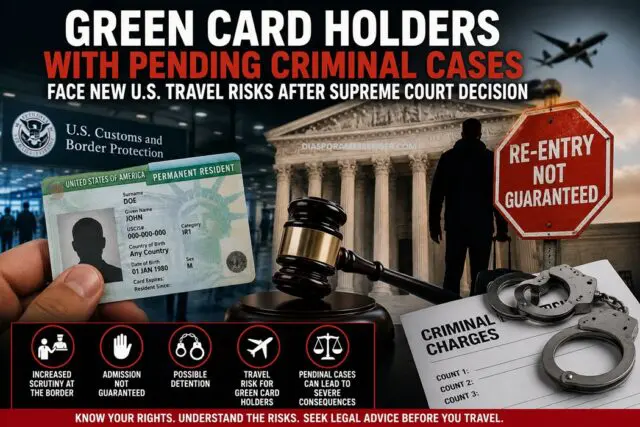
Green Card Holders with Pending Criminal Cases Face New U.S. Travel Risks After Supreme Court Decision
A landmark decision by the U.S. Supreme Court is sending shockwaves across immigrant communities, especially among lawful permanent residents (green card holders) who frequently travel abroad.
In a 6-3 ruling issued on June 23, 2026, the Supreme Court ruled in Blanche v. Lau that U.S. Customs and Border Protection (CBP) officers do not need “clear and convincing evidence” that a lawful permanent resident committed a crime before treating that person as someone seeking admission into the United States rather than someone automatically entitled to return.
The decision could significantly affect thousands of green card holders, including many Kenyans and other members of the African diaspora living in the United States.
Who Is Affected?
The ruling primarily affects:
- Lawful Permanent Residents (Green Card holders)
- Individuals with pending criminal charges
- People accused of crimes that may qualify as Crimes Involving Moral Turpitude (CIMTs)
- Green card holders traveling outside the United States before their criminal matters are resolved
Even if someone has not yet been convicted, international travel may now carry substantially greater immigration risks depending on the nature of the criminal allegations.
What Did the Supreme Court Decide?
The Court held that border officers do not have to possess clear and convincing evidence that a green card holder committed a disqualifying crime before deciding that the traveler is “seeking admission.”
This means CBP officers have broader discretion at airports and land borders when evaluating returning permanent residents with pending criminal matters.
The decision overturned a lower court ruling that had required stronger evidence before changing a permanent resident’s legal status at the border.
When Was the Decision Issued?
The Supreme Court announced its decision on June 23, 2026.
Because Supreme Court rulings become binding immediately, immigration attorneys are advising green card holders with pending criminal matters to carefully reconsider international travel plans.
Where Does This Apply?
The ruling applies throughout the United States at every official port of entry, including:
- International airports
- Land border crossings
- Seaports
- U.S. Customs and Border Protection inspection stations
Why Is This Decision So Important?
Normally, green card holders returning from a short trip abroad are treated as individuals already admitted to the United States.
Under this ruling, however, certain green card holders can instead be treated as new applicants for admission.
That seemingly technical distinction dramatically changes the legal process because:
- The burden shifts to the traveler to prove admissibility.
- Inadmissibility rules are often stricter than deportability rules.
- CBP may parole the traveler instead of admitting them.
- The traveler may be detained or placed into removal proceedings.
How Does Immigration Parole Work?
Immigration parole does not mean permanent admission into the United States.
Instead, it allows someone to be physically present while immigration authorities determine whether they should ultimately be admitted or removed.
Being paroled can result in:
- Additional immigration hearings
- Extended legal proceedings
- Possible detention
- Greater uncertainty regarding permanent resident status
Immigration Attorney Warns Green Card Holders
Texas immigration attorney Laban Opande of Opande Law Firm cautioned that lawful permanent residents with pending criminal cases should exercise extreme caution before traveling internationally.
According to Opande, a green card holder with pending criminal case who leaves the country may no longer be automatically admitted upon return.
Instead, immigration officers may:
- Parole the individual into the United States
- Detain them
- Begin removal proceedings if they believe the case involves a Crime Involving Moral Turpitude (CIMT)
His warning highlights the importance of consulting an experienced immigration attorney before making travel plans while any criminal matter remains unresolved.
Understanding Crimes Involving Moral Turpitude (CIMTs)
According to Lawyer Laban Opande, a Crime Involving Moral Turpitude (CIMT) is one of the most important concepts in U.S. immigration law.
Although Congress has never produced one definitive list, courts evaluate offenses individually.
Generally, CIMTs involve:
- Fraud
- Dishonesty
- Theft with criminal intent
- Serious violence
- Sexual offenses involving exploitation
- Crimes demonstrating intentional moral wrongdoing
Common Crimes That May Be Considered CIMTs
Examples often include:
- Fraud
- Wire fraud
- Tax fraud
- Forgery
- Perjury
- Robbery
- Burglary involving intent to steal
- Murder
- Aggravated assault
- Child abuse
- Certain prostitution offenses
- Certain crimes involving minors
Crimes That Usually Are NOT CIMTs
Many offenses generally do not qualify, including:
- Simple DUI without aggravating circumstances
- Minor traffic violations
- Fishing without a license
- Regulatory violations
- Simple assault without aggravating factors
- Certain negligence-based offenses
However, every criminal statute is analyzed individually under immigration law, meaning outcomes can vary depending on the specific state law involved.
Why CIMTs Matter for Immigration
A CIMT may affect:
Visa Applications
Applicants may be found inadmissible.
Green Card Holders
Returning permanent residents may face heightened scrutiny at the border.
Deportation Proceedings
Certain convictions can trigger removal proceedings.
U.S. Citizenship
A CIMT committed during the statutory good moral character period can negatively affect naturalization eligibility.
Some limited exceptions—such as the petty offense exception and the youthful offender exception—may apply depending on the circumstances.
Fresh U.S. Immigration Statistics
Recent official data underscore why this ruling matters:
- The United States has approximately 12.8 million lawful permanent residents (green card holders) living in the country.
- U.S. Customs and Border Protection processes hundreds of millions of traveler inspections annually across air, land, and sea ports of entry.
- Immigration enforcement decisions at ports of entry can have immediate consequences for lawful permanent residents with unresolved criminal matters.
What Green Card Holders Should Do Before Traveling
Immigration experts generally recommend that lawful permanent residents:
- Speak with an experienced immigration attorney before leaving the United States if any criminal case is pending.
- Understand whether the alleged offense could be classified as a CIMT.
- Carry complete legal documentation if travel cannot be postponed.
- Avoid assuming that possession of a green card guarantees automatic re-entry.
Every case is different, and immigration consequences often depend on the exact criminal statute involved.
Frequently Asked Questions (FAQ)
Can a green card holder now be denied re-entry because of pending criminal charges?
Potentially, yes. The Supreme Court ruled that CBP officers have broader discretion to treat certain returning green card holders as applicants for admission, even before a conviction, depending on the circumstances.
Does every arrest automatically prevent re-entry?
No. An arrest alone does not automatically make someone inadmissible. However, pending charges involving possible CIMTs may lead to increased scrutiny at the border.
Does this apply to all green card holders?
No. The ruling mainly affects lawful permanent residents whose criminal matters may fall within immigration laws covering Crimes Involving Moral Turpitude.
Is a simple DUI considered a CIMT?
Generally, a simple DUI without aggravating factors is not considered a Crime Involving Moral Turpitude, although certain aggravated DUI offenses may require separate legal analysis.
Should I travel if I have a pending criminal case?
Before traveling internationally, it is strongly advisable to seek legal advice from a qualified U.S. immigration attorney, especially if the pending charge could have immigration consequences.
Conclusion
The Supreme Court’s decision in Blanche v. Lau represents one of the most significant immigration rulings affecting lawful permanent residents in recent years. While it does not automatically bar green card holders from returning to the United States, it gives border officials broader authority to scrutinize travelers with pending criminal matters and, in some cases, treat them as applicants for admission rather than returning residents.
For members of the Kenyan diaspora and other immigrant communities, the ruling serves as an important reminder that international travel while facing unresolved criminal charges can carry serious immigration consequences. Anyone with a pending case should seek professional legal advice before leaving the United States to avoid unexpected complications upon re-entry.