


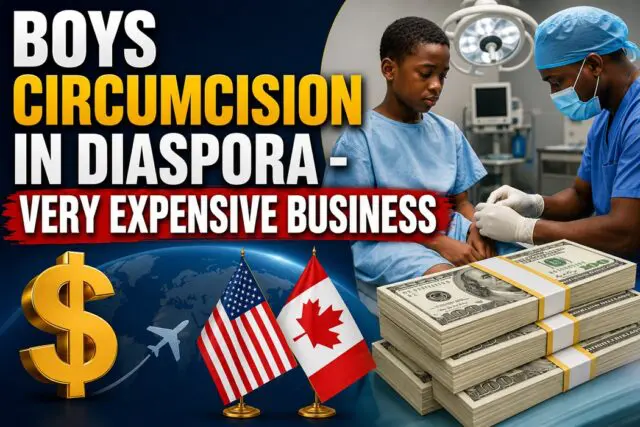
Boys Circumcision in the Diaspora: Why Kenyan Families in the US and Canada Face Costs of Up to $5,000
For many Kenyan families living in the United States and Canada, circumcision remains an important cultural milestone marking the transition from childhood to adulthood. However, what is often a community-supported tradition in Kenya has become one of the most expensive cultural practices for families living abroad.
Parents in North America are increasingly reporting paying between USD $1,500 and $5,000 (approximately KSh 195,000–650,000) for a single circumcision procedure performed in hospitals. In Canada, some families say they have received quotations exceeding CAD $6,000, depending on the child’s age, anesthesia requirements, and hospital fees.
The high cost has sparked discussions across Kenyan diaspora communities, with many questioning whether the tradition is becoming financially out of reach.
Why Circumcision Is More Expensive in the Diaspora
Unlike Kenya, where circumcision ceremonies are often community-organized and conducted during school holidays, most Kenyan families abroad must rely on licensed medical facilities.
Traditional circumcision outside approved medical settings is either heavily regulated or discouraged in most parts of North America because of strict health and safety laws.
As a result, parents must pay for:
- Surgical consultation
- Hospital operating room fees
- Pediatric surgeon
- Anesthesia
- Follow-up appointments
- Prescription medication
The procedure becomes even more expensive because many Kenyan communities traditionally circumcise boys between 12 and 15 years old, rather than during infancy.
Older children require:
- General anesthesia
- Longer operating time
- Additional medical monitoring
- Increased recovery care
These factors significantly increase the overall cost.
Average Circumcision Costs
United States
Estimated cost:
- USD $1,500–$4,500
- Some hospitals charge up to USD $5,000
Many private insurance companies classify cultural circumcision as an elective procedure, meaning families often pay entirely out of pocket.
Canada
Estimated cost:
- CAD $2,250–$3,250
- Higher in specialized hospitals
Most provincial health insurance plans—including Ontario’s OHIP—do not cover non-medically necessary circumcision.
Unless there is a diagnosed medical condition, parents are responsible for the entire bill.
Immigration Status Creates Additional Challenges
For many Kenyan families, returning home to Kenya for circumcision would significantly reduce costs.
However, immigration realities complicate that option.
Some parents:
- Hold temporary visas
- Are awaiting permanent residency
- Have pending asylum applications
- Face travel restrictions
- Risk delays when leaving North America
Others simply cannot afford international travel for the entire family.
As a result, many families feel they have no choice but to undergo the costly procedure locally.
A Different Social Environment
One interesting difference between Kenya and North America is the absence of peer pressure.
In Kenya, circumcision is often viewed as a rite of passage that entire age groups undergo together.
In contrast, many schools in the US and Canada have students from diverse cultural backgrounds where circumcision is considered a private medical decision.
One Kenyan parent humorously explained:
“HERE THE BOYS DON’T EVEN ASK EACH OTHER ABOUT CIRCUMCISION. SOME EVEN ASK, ‘DO I REALLY HAVE TO DO IT?'”
Because many North American boys are either circumcised at birth or not circumcised at all, there is far less social pressure than exists in many Kenyan communities.
Cultural Identity Remains Important
Despite the financial burden, many Kenyan families continue choosing circumcision because of its cultural significance.
Among communities such as the Kikuyu, Kalenjin, Meru, Embu, Maasai, Kisii, and others, circumcision represents more than a medical procedure.
It symbolizes:
- Responsibility
- Manhood
- Family heritage
- Cultural continuity
- Respect for tradition
Parents often describe the ceremony as preserving their children’s connection to Kenya despite growing up overseas.
Expert Opinion
Medical experts generally agree that when circumcision is performed, it should be conducted by qualified healthcare professionals using sterile equipment.
According to global health research, medical male circumcision reduces the lifetime risk of heterosexual HIV acquisition in men by approximately 60% in high-prevalence settings. It is also associated with lower rates of certain urinary tract infections during infancy and reduced risk of some sexually transmitted infections later in life.
However, pediatric associations in North America maintain that while the health benefits may outweigh the risks for some families, they are not substantial enough to recommend routine circumcision for every newborn, leaving the decision to parents based on medical, cultural, or religious considerations.
Healthcare professionals emphasize that families should make informed decisions after discussing benefits, risks, recovery, and costs with qualified physicians.
Statistics
Several studies illustrate how circumcision practices vary around the world:
- Approximately 37–39% of males worldwide are estimated to be circumcised.
- In the United States, newborn circumcision rates have declined over recent decades but remain relatively common.
- In Canada, circumcision rates vary significantly by province and are generally lower than in the US.
- Kenya has one of Africa’s highest male circumcision rates, with national surveys estimating prevalence above 90% among adult men, though rates differ by community and region.
These differences explain why Kenyan diaspora families often find themselves navigating healthcare systems where cultural circumcision is less common and usually not publicly funded.
Impact on the Kenyan Diaspora
The rising cost of circumcision highlights a broader challenge facing immigrant families—balancing cultural traditions with the realities of life abroad.
For many Kenyan parents, preserving heritage comes with unexpected financial obligations that extend beyond education, housing, and immigration expenses.
Community organizations and churches occasionally help families organize educational forums on adolescent health and cultural identity, but most medical expenses remain the responsibility of individual households.
The discussion has also sparked conversations about whether some traditions should evolve as Kenyan families adapt to life in multicultural societies.
Looking Ahead
As healthcare costs continue to rise across North America, circumcision is likely to remain a significant financial decision for many Kenyan diaspora families.
Some parents may continue traveling to Kenya when possible, while others may choose medical circumcision locally or decide not to proceed based on personal beliefs, finances, or their children’s preferences.
Whatever decision families make, experts encourage respectful dialogue, informed medical guidance, and recognition that cultural traditions can be maintained in different ways across generations.
Conclusion
Circumcision among Kenyan boys in the US and Canada has evolved from a community-based rite of passage into a costly medical procedure that can cost thousands of dollars. While many families remain committed to preserving cultural identity, high healthcare costs, insurance limitations, and immigration-related travel restrictions have made the decision more complex than ever before.
For the Kenyan diaspora, the conversation is no longer just about tradition—it is also about affordability, healthcare access, cultural identity, and adapting long-held customs to life in a new country.