

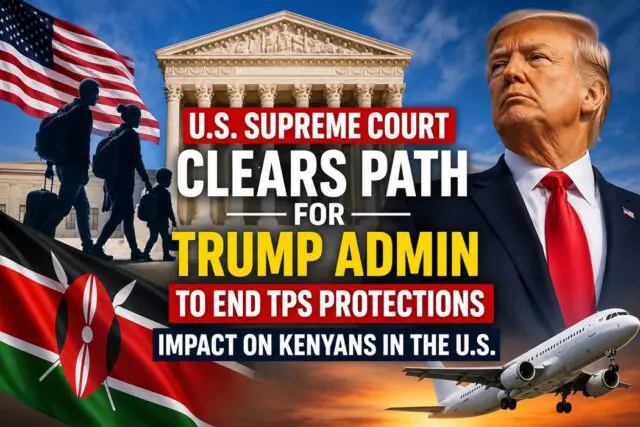
U.S. Supreme Court Clears Path for Trump Administration to End TPS Protections
The U.S. Supreme Court has handed the Trump administration a significant legal victory by allowing it to move forward with efforts to end humanitarian protections under the Temporary Protected Status (TPS) program for hundreds of thousands of immigrants.
The decision has generated concern among immigrant communities across the United States, including members of the Kenyan diaspora who may be affected either directly or indirectly by changes in U.S. immigration policy.
Although the ruling does not automatically remove anyone’s legal status overnight, it clears an important legal hurdle for the administration to implement policy changes affecting TPS beneficiaries.
What Is Temporary Protected Status (TPS)?
Temporary Protected Status (TPS) is a humanitarian immigration program established by the U.S. Congress in 1990.
TPS allows eligible nationals from designated countries experiencing:
- Armed conflict
- Natural disasters
- Extraordinary humanitarian crises
to temporarily live and work legally in the United States.
TPS is not a permanent immigration status and does not automatically lead to a Green Card or U.S. citizenship. Instead, it offers temporary protection from deportation while conditions remain unsafe in the beneficiary’s home country.
Trump Administration’s Position
The administration has maintained that TPS was intended to be temporary rather than a long-term immigration solution.
Officials have encouraged eligible immigrants to:
- Apply for permanent legal residency if they qualify under existing immigration laws.
- Explore employment-based or family-sponsored immigration options.
- Leave the United States voluntarily if no legal pathway exists.
Under the administration’s voluntary departure initiative, qualifying individuals who choose to return home voluntarily may receive:
- A government-funded airline ticket.
- Approximately USD 2,100 (about KSh 271,000) to assist with resettlement.
Officials argue that voluntary departure reduces enforcement costs while allowing migrants to return with financial assistance.
How Many Kenyans Live in the United States?
According to estimates from the U.S. Census Bureau, Migration Policy Institute, and Kenya’s State Department for Diaspora Affairs:
- Between 157,000 and 170,000 Kenyans currently live in the United States.
- Thousands are permanent residents or U.S. citizens.
- Others are in the country on work visas, student visas, asylum, family sponsorship, or other immigration categories.
Only a relatively small number of Kenyans have been directly associated with TPS protections, but immigration policy changes often affect broader immigrant communities through legal uncertainty and changing enforcement priorities.
Impact on the Kenyan Diaspora
The Supreme Court decision is being closely watched by the Kenyan diaspora because it highlights the changing landscape of U.S. immigration policy.
Potential impacts include:
1. Increased Demand for Immigration Legal Services
Immigration attorneys are expected to see more inquiries from immigrants seeking:
- Green Cards
- Adjustment of status
- Employment sponsorship
- Family petitions
- Asylum alternatives
2. Greater Immigration Uncertainty
Many immigrants who have relied on temporary protections may now face difficult decisions about their long-term future in the United States.
3. Family Separation Concerns
Some affected individuals have U.S.-born children, spouses, or extended family members.
Changes to immigration status can complicate family unity and financial stability.
4. Financial Consequences
Many Kenyan immigrants support relatives back home through remittances.
According to the Central Bank of Kenya:
- Kenyans abroad sent over USD 5.08 billion in remittances to Kenya in 2025.
- The United States remains the single largest source of these remittances.
Any reduction in employment authorization could eventually affect remittance flows to Kenyan families.
Immigration Implications
Immigration experts caution that individuals should avoid making rushed decisions.
Each immigration case is unique.
Possible legal options may include:
- Family-based immigration
- Employment sponsorship
- Marriage to U.S. citizens
- Adjustment of status
- Asylum (where applicable)
- Other humanitarian protections
Experts strongly advise consulting licensed immigration attorneys rather than relying on social media rumors or unverified advice.
Expert Opinion
Immigration policy analysts note that the Supreme Court ruling primarily addresses the administration’s authority to implement its policy while broader legal challenges continue.
According to immigration experts:
“Temporary Protected Status has always been designed as a temporary humanitarian measure rather than a permanent immigration pathway. Individuals who may be affected should review all available legal options before making decisions about voluntary departure or other immigration actions.”
Legal experts also emphasize that eligibility for permanent residence depends on individual circumstances and cannot be generalized.
What Happens Next?
The ruling allows the administration to proceed with implementing its policy while additional legal and administrative processes continue.
Affected immigrants should:
- Monitor official announcements from the U.S. Department of Homeland Security.
- Seek qualified legal advice.
- Avoid immigration scams.
- Ensure their immigration documents remain current.
Why This Matters to the Kenyan Diaspora
The Kenyan diaspora has become one of Kenya’s most important economic and social pillars.
Beyond remittances, Kenyans abroad contribute through:
- Business investments
- Real estate development
- Technology transfer
- Skills exchange
- Community philanthropy
Changes in U.S. immigration policy therefore have implications that extend beyond individuals to families, businesses, and communities in both Kenya and the United States.
Conclusion
The U.S. Supreme Court’s decision represents a significant milestone in the Trump administration’s immigration agenda. While the ruling does not immediately affect every immigrant, it signals potential changes for those relying on Temporary Protected Status and other humanitarian protections.
For Kenyans living in the United States, the decision serves as a reminder of the importance of maintaining lawful immigration status, exploring permanent legal pathways where possible, and seeking professional legal guidance when facing complex immigration issues.
As the legal and policy landscape continues to evolve, the Kenyan diaspora will be watching closely to understand how future implementation of the ruling may affect individuals, families, and the broader community.