


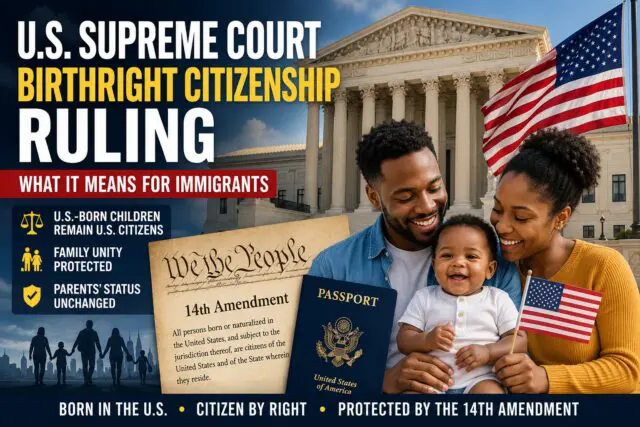
What the U.S. Supreme Court Birthright Citizenship Ruling Means for Immigrants
In one of the most consequential immigration decisions in recent U.S. history, the U.S. Supreme Court has reaffirmed the constitutional guarantee of birthright citizenship, delivering a major victory for immigrant families across America.
In a 6-3 ruling in Trump v. Barbara, the Court struck down President Donald Trump’s 2025 executive order that sought to deny automatic U.S. citizenship to children born in America whose parents were undocumented immigrants or temporary foreign residents. The Court held that the executive order violated the Citizenship Clause of the 14th Amendment, preserving more than 150 years of constitutional precedent.
For millions of immigrant families—including thousands of Kenyans living in the United States—the decision provides clarity and legal certainty regarding the citizenship rights of children born on American soil.
The Supreme Court’s Decision Explained
The Court reaffirmed one of the oldest principles in American constitutional law:
Any child born in the United States is automatically a U.S. citizen, regardless of the immigration status of the parents, with very limited exceptions.
Chief Justice John Roberts, writing for the majority, emphasized that the Citizenship Clause of the 14th Amendment guarantees citizenship to nearly everyone born in the United States and cannot be altered through an executive order. The ruling also reaffirmed the long-standing precedent established in the 1898 case of United States v. Wong Kim Ark.
What Is Birthright Citizenship?
Birthright citizenship, also known by the Latin term jus soli (“right of the soil”), means that citizenship is determined by the place of birth rather than the nationality of one’s parents.
The principle is rooted in the 14th Amendment to the U.S. Constitution, adopted in 1868 following the Civil War to ensure equal citizenship rights.
The only generally recognized exceptions remain children born to active foreign diplomats, who are not considered fully subject to U.S. jurisdiction for citizenship purposes.
What This Means for Immigrant Families
The ruling carries several important implications.
1. U.S.-Born Children Remain American Citizens
Children born in the United States continue to receive:
- U.S. citizenship at birth
- U.S. passports
- Social Security numbers
- Full constitutional protections
- The right to vote upon reaching adulthood
- Eligibility for federal benefits subject to applicable laws
These rights remain protected regardless of whether their parents are undocumented, asylum seekers, temporary workers, students, or visitors.
2. Parents Do Not Automatically Receive Legal Status
One of the most misunderstood aspects of the ruling is that it does not legalize the parents.
Parents who are:
- Undocumented
- On temporary visas
- Awaiting asylum decisions
- Out of legal status
remain subject to existing immigration laws.
The Supreme Court ruling protects only the citizenship rights of children born in the United States—not the immigration status of their parents.
3. Deportation Laws Remain Unchanged
Immigration enforcement policies continue independently of this ruling.
Parents without lawful status may still:
- Face removal proceedings
- Be detained
- Need to pursue legal immigration pathways
However, their U.S.-citizen children retain their constitutional rights.
Impact on the Kenyan Diaspora
The ruling is particularly significant for the Kenyan diaspora in the United States.
An estimated 157,000 to 170,000 Kenyans live in the U.S., including permanent residents, international students, temporary workers, asylum seekers, and individuals with various immigration statuses.
Many Kenyan families have children born in America.
This decision provides reassurance that those children will continue to enjoy full U.S. citizenship regardless of their parents’ immigration circumstances.
For Kenyan parents navigating complex immigration processes, the ruling removes uncertainty about their children’s legal identity and future opportunities.
Immigration Implications
Although the ruling preserves birthright citizenship, immigration experts note that it does not signal broader changes to U.S. immigration policy.
Families should continue to:
- Maintain valid immigration status where possible.
- Consult qualified immigration attorneys before making major decisions.
- Pursue lawful pathways to permanent residence or citizenship if eligible.
- Avoid relying on misinformation circulating on social media.
The decision reinforces constitutional protections while leaving immigration enforcement and visa policies unchanged.
Expert Opinion
Constitutional scholars widely view the decision as a reaffirmation of established legal doctrine rather than the creation of a new right.
The Court’s majority concluded that the Citizenship Clause has been consistently interpreted for more than a century and that any attempt to redefine birthright citizenship would require constitutional or legislative changes—not unilateral executive action.
Immigration attorneys also note that the ruling provides much-needed certainty for hospitals, schools, state agencies, and families by maintaining a uniform national standard for citizenship at birth.
Statistics That Highlight the Decision’s Importance
Several figures illustrate the significance of the ruling:
- Approximately 150,000 to 250,000 children born annually in the United States could have been affected had the executive order been upheld.
- The Supreme Court ruled 6-3 in favor of preserving birthright citizenship.
- Birthright citizenship has been recognized under the 14th Amendment since 1868 and reinforced by Supreme Court precedent in 1898.
Why the Decision Matters Beyond Immigration
Beyond immigration policy, the ruling underscores the importance of constitutional stability.
It reassures millions of Americans that longstanding constitutional protections cannot be altered by executive action alone. The decision also helps prevent legal uncertainty over citizenship documentation, voting rights, education access, and participation in civic life for future generations born in the United States.
For immigrant communities, including the Kenyan diaspora, the judgment reinforces confidence that constitutional rights remain protected even amid changing political administrations.
Conclusion
The Supreme Court’s ruling in Trump v. Barbara represents one of the most significant immigration and constitutional decisions in recent years. By striking down the executive order seeking to limit birthright citizenship, the Court reaffirmed that children born in the United States remain American citizens under the 14th Amendment, regardless of their parents’ immigration status.
For Kenyan families living in the United States, the decision offers legal certainty for their U.S.-born children while serving as a reminder that parents must still comply with existing immigration laws. As immigration debates continue, this landmark ruling reinforces a constitutional principle that has shaped American citizenship for more than a century and remains central to the nation’s legal framework.