

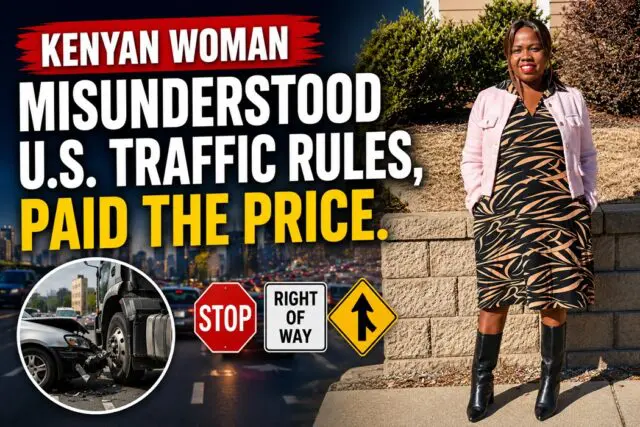
Kenyan Woman Shares Painful Lesson After Misunderstanding U.S. Traffic Rules
For many Kenyans relocating to the United States, adjusting to a new country involves far more than finding employment or settling into a new community. Everyday activities—including driving—can present unexpected challenges.
That reality became painfully clear for Beldina Kirito, a Kenyan woman who was involved in a serious road accident only two weeks after arriving in the United States.
Despite having driven safely in Kenya for nine years without a single accident, Beldina found herself in a collision with a truck after misunderstanding a U.S. traffic rule at an intersection.
Her experience has since become a powerful reminder that even experienced drivers need time to adapt to America’s road systems and traffic regulations.
A Collision That Changed Everything
Beldina explained that the accident occurred shortly after relocating to the U.S., at a time when she was still adjusting to unfamiliar traffic signs, right-of-way rules, and driving culture.
Although she had extensive driving experience in Kenya, she quickly discovered that driving in America requires understanding a different set of laws and road expectations.
The collision left her shaken and emotionally overwhelmed as she navigated the aftermath while living thousands of miles away from family and familiar support systems.
Fortunately, she escaped without life-threatening injuries.
However, the incident resulted in a traffic citation, vehicle damage, and significantly higher auto insurance premiums—expenses that many new immigrants are often unprepared to face.
Community Support Made the Difference
One of the brightest moments during the difficult experience was the support Beldina received from fellow Kenyans and compassionate strangers.
She credits members of the Kenyan diaspora community with helping her emotionally and practically during one of the lowest moments of her relocation journey.
Their assistance reinforced the importance of community networks that frequently help newcomers adjust to life abroad.
Across the United States, Kenyan community organizations, churches, and social groups often assist new arrivals by providing guidance on transportation, housing, employment, healthcare, and navigating everyday life.
Why Driving in America Can Be Challenging for New Immigrants
While many immigrants arrive with years of driving experience from their home countries, traffic regulations differ significantly across nations.
Common areas that require adjustment include:
- Right-of-way rules at intersections
- Four-way stop procedures
- Yield signs
- School bus stopping laws
- Lane discipline on multi-lane highways
- Speed limit enforcement
- Insurance requirements
- Police traffic stops
- Defensive driving expectations
Even small misunderstandings can result in expensive citations or serious accidents.
According to the U.S. Federal Highway Administration (FHWA), the United States records more than 6 million police-reported traffic crashes annually, demonstrating the importance of driver education and road awareness for all motorists.
Expert Advice: Learn Local Traffic Laws Before Driving
Road safety experts encourage immigrants to avoid assuming that driving rules are identical to those in their home countries.
Transportation safety professionals recommend that newcomers:
- Study their state’s driver’s handbook.
- Take a defensive driving course.
- Practice driving with experienced local drivers.
- Learn intersection and right-of-way rules.
- Understand insurance requirements.
- Obtain a valid driver’s license as required by state law.
Many states also offer multilingual driver education materials designed to help immigrants safely transition to American roads.
Immigration Adjustment Extends Beyond Paperwork
For many members of the Kenyan diaspora, immigration is often viewed primarily through the lens of visas, employment authorization, and permanent residency.
However, successful integration also involves learning practical aspects of daily life, including banking, healthcare, taxation, transportation, and driving.
Experts note that cultural adaptation is one of the most overlooked aspects of immigration, yet it has a significant impact on long-term success and safety.
Stories like Beldina’s illustrate that preparation for life abroad should extend beyond immigration documents.
Kenyan Diaspora Continues to Grow
The Kenyan diaspora in the United States continues to expand each year.
According to estimates from the Migration Policy Institute and the U.S. Census Bureau, more than 150,000 Kenyan-born immigrants currently live in the United States, with larger communities found in states such as:
- Texas
- Maryland
- Minnesota
- Washington
- Georgia
- Massachusetts
- California
As these communities continue to grow, experienced immigrants increasingly play an important role in mentoring newcomers and sharing practical advice that helps others avoid costly mistakes.
Turning a Painful Experience Into a Lesson
Today, Beldina views the accident not simply as a frightening memory but as a valuable learning experience.
She hopes that by sharing her story, other Kenyans preparing to move abroad will take time to familiarize themselves with U.S. traffic laws before getting behind the wheel.
Her message is simple: experience alone is not enough when driving in a new country. Understanding local laws can save lives, reduce financial hardship, and make the transition to life in America much smoother.
For many new immigrants, her experience serves as a reminder that adapting successfully means learning not only a new culture but also the everyday rules that come with it.
Frequently Asked Questions
Can Kenyans drive in the United States with a Kenyan driver’s license?
Rules vary by state. Some states allow temporary visitors to drive with a valid foreign license for a limited period, while new residents are generally required to obtain a state-issued driver’s license within a specified timeframe.
Why are U.S. traffic rules different from Kenya’s?
Kenya drives on the left side of the road, while the U.S. drives on the right.) Traffic signs, intersection rules, road markings, and enforcement practices also differ significantly.
Why is auto insurance important in America?
Most U.S. states require drivers to carry minimum liability insurance. Traffic violations and at-fault accidents can significantly increase insurance premiums for several years.