


Washington Supreme Court Ends Live-In Caregiver Wage Exemption
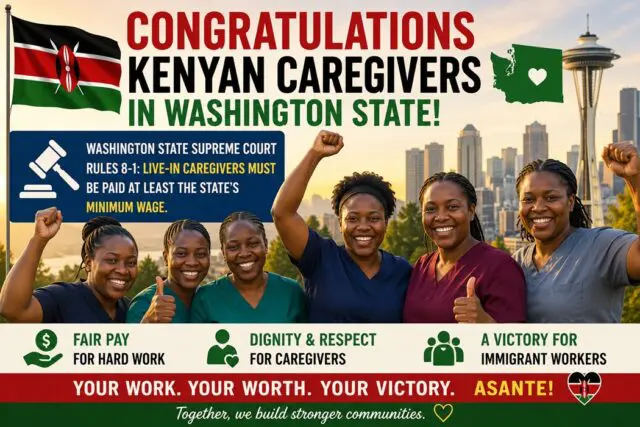
In a historic victory for workers’ rights, the Washington Supreme Court has ruled that live-in caregivers employed in adult family homes are constitutionally entitled to receive Washington State’s minimum wage of $17.13 per hour.
The landmark decision eliminates a decades-old legal exemption that allowed some employers to compensate live-in caregivers with flat daily rates that often translated to only $4 to $6 per hour.
The ruling is expected to transform the lives of thousands of caregivers across Washington State, including a significant number of Kenyan immigrants working in the home care industry.
Court Declares Exemption Unconstitutional
The decision came in the case Bolina v. AssureCare Adult Home LLC, where six live-in caregivers challenged the legality of the wage exemption after alleging years of unfair compensation and labor rights violations.
The caregivers argued that despite working long hours—often remaining on-site around the clock—they were denied the protections guaranteed to other workers under Washington law.
The Washington Supreme Court agreed, finding that the exemption violated the Washington Constitution, which requires lawmakers to protect employees working in dangerous occupations.
According to the Court, excluding live-in caregivers from minimum wage protections was inconsistent with the state’s constitutional commitment to safeguarding vulnerable workers.
A Major Win for Kenyan Caregivers in Washington
The ruling is particularly significant for the Kenyan diaspora, as thousands of Kenyan immigrants have built careers in Washington’s caregiving and healthcare sectors.
Many Kenyan caregivers work in:
Adult family homes
Assisted living facilities
Residential care homes
Home health services
Long-term care facilities
For years, some workers accepted below-minimum wages because of the now-invalid exemption. With the Court’s decision, these caregivers will now be legally entitled to receive at least Washington’s minimum wage of $17.13 per hour.
For many families, this means:
Higher monthly income
Greater financial stability
Improved quality of life
Better protection against labor exploitation
Case Returns to Court for Back Pay
While the constitutional issue has now been resolved, the legal battle is not yet over.
The Washington Supreme Court has sent the case back to the King County Superior Court, where judges will determine:
Retroactive unpaid wages
Financial damages
Additional compensation owed to affected workers
This means employers who underpaid caregivers under the previous exemption could now face significant financial liability.
Ending a Long History of Worker Exclusions
For decades, domestic workers and caregivers across the United States have often been excluded from labor protections that apply to other industries.
Historically, many caregivers have worked:
Extremely long shifts
Overnight schedules
Live-in arrangements
On-call responsibilities
Yet many received compensation well below the standard minimum wage.
Worker advocates have long argued that caregiving is physically demanding, emotionally exhausting, and essential to society—making fair compensation a basic issue of dignity and justice.
Advocates Celebrate Historic Precedent
Organizations supporting worker rights welcomed the ruling as one of the most important labor decisions in Washington in recent years.
Advocates, including the Fair Work Center, say the decision establishes a powerful legal precedent that could strengthen protections for workers throughout the care economy.
The ruling also reinforces the principle that workers providing essential healthcare and caregiving services deserve the same legal protections as employees in other industries.
What the Decision Means Going Forward
The immediate effects of the ruling include:
Live-in caregivers must receive at least Washington’s minimum wage.
The adult family home exemption is no longer valid.
Thousands of immigrant workers will benefit immediately.
Employers must review payroll practices to comply with the law.
Courts will determine back wages and damages owed in pending cases.
Employment attorneys expect many caregivers to review past wage records to determine whether they may qualify for unpaid compensation.
A Victory Beyond Washington
Although the decision applies specifically to Washington State, labor experts believe it could influence similar legal challenges elsewhere in the United States.
As demand for caregivers continues to grow due to an aging population, policymakers across the country may face increasing pressure to strengthen labor protections for home care workers.
For immigrant communities—including the Kenyan diaspora—the ruling represents not only a financial victory but also recognition of the essential role caregivers play in supporting families and healthcare systems.
Conclusion
The Washington Supreme Court’s decision marks a historic turning point for live-in caregivers. By striking down the outdated exemption, the Court has affirmed that caregivers deserve fair wages and equal protection under the law.
For thousands of Kenyan caregivers and other immigrant workers across Washington State, the ruling promises better pay, stronger legal protections, and greater respect for the invaluable work they perform every day. As the case moves forward to determine back pay and damages, it may also pave the way for broader reforms that improve working conditions throughout the caregiving profession.