


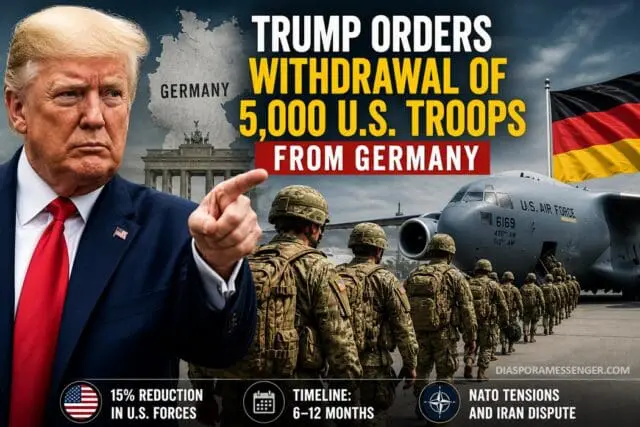
In a move that has sparked global debate, Donald Trump has ordered the withdrawal of approximately 5,000 U.S. troops from Germany in May 2026. The decision marks a significant shift in U.S. foreign policy and raises concerns about the future of NATO alliances, European security, and ongoing geopolitical tensions—particularly involving Iran.
The withdrawal represents about 15% of the U.S. military presence in Germany, where roughly 35,000 to 38,000 troops are currently stationed.
Why Trump Is Withdrawing U.S. Troops from Germany
1. Escalating Dispute Over Iran Policy
A major trigger for the withdrawal is a growing disagreement between Trump and Friedrich Merz over the ongoing conflict with Iran.
Trump has criticized Germany and other NATO allies for what he sees as a lack of support for U.S. military operations in the Middle East. Tensions intensified after Merz reportedly suggested that the U.S. was being “humiliated” by Iranian leadership and lacked a clear exit strategy.
This clash highlights deep divisions within NATO over how to handle Iran, with the U.S. pushing for a more aggressive stance while European allies advocate caution.
2. Ongoing NATO Defense Spending Tensions
Despite Germany increasing its defense spending to over 3% of GDP, Trump continues to argue that Berlin is not contributing enough to NATO.
For years, Trump has accused NATO members of being “delinquent” in meeting their financial obligations, insisting that the U.S. bears an unfair burden for European security. The troop withdrawal is seen by many analysts as part of a broader effort to pressure allies into increasing defense contributions.
3. Retaliatory Political Signaling
Critics suggest the move is not purely strategic but also politically motivated. Trump’s public criticism of Chancellor Merz—including remarks urging him to “fix his broken country”—has fueled speculation that the withdrawal is partly retaliatory.
This personal dimension has raised concerns among policymakers who fear that military decisions are being influenced by diplomatic tensions rather than long-term security planning.
4. Strategic Shift Toward European Self-Defense
According to the Pentagon, the decision follows a “thorough review of force posture” aimed at adapting to evolving global threats.
The U.S. has long pushed for Europe to take greater responsibility for its own defense. By reducing troop levels in Germany, Washington is signaling a transition toward a model where European nations play a larger role in conventional military readiness.
Key Details of the Troop Withdrawal
- Number of Troops: Approximately 5,000
- Percentage Reduction: About 15% of U.S. forces in Germany
- Timeline: Expected completion within 6–12 months
- Military Changes:
Removal of one Army brigade
Cancellation of a planned missile battalion deployment
Strategic Locations Affected
Germany hosts several critical U.S. military installations, including Ramstein Air Base—a key logistics and operations hub for U.S. forces in Europe and the Middle East.
While the German government has indicated that major bases like Ramstein are not currently slated for closure, the reduction could still impact operational capacity and coordination within NATO.
Global Implications
Impact on NATO Unity
The withdrawal could strain relations within NATO, as European allies may interpret the move as a weakening of U.S. commitment to collective defense.
European Security Concerns
Germany has traditionally served as a strategic hub for U.S. military operations. A reduced presence may force European nations to accelerate military investments and coordination efforts.
Signal to Global Rivals
Geopolitical analysts warn that the move could be perceived by rivals such as Russia and Iran as a sign of reduced U.S. military engagement in Europe—potentially shifting the global balance of power.
What This Means for the Future
Trump’s decision reflects a broader “America First” approach to foreign policy—prioritizing domestic interests while urging allies to shoulder more responsibility.
However, the long-term consequences remain uncertain. While the move may push Europe toward greater self-reliance, it also risks weakening alliances that have underpinned global stability for decades.
Conclusion
The withdrawal of 5,000 U.S. troops from Germany is more than a military adjustment—it is a geopolitical signal with far-reaching implications. From NATO unity to Iran policy and transatlantic relations, the decision underscores a shifting global order where alliances are being tested and redefined.