

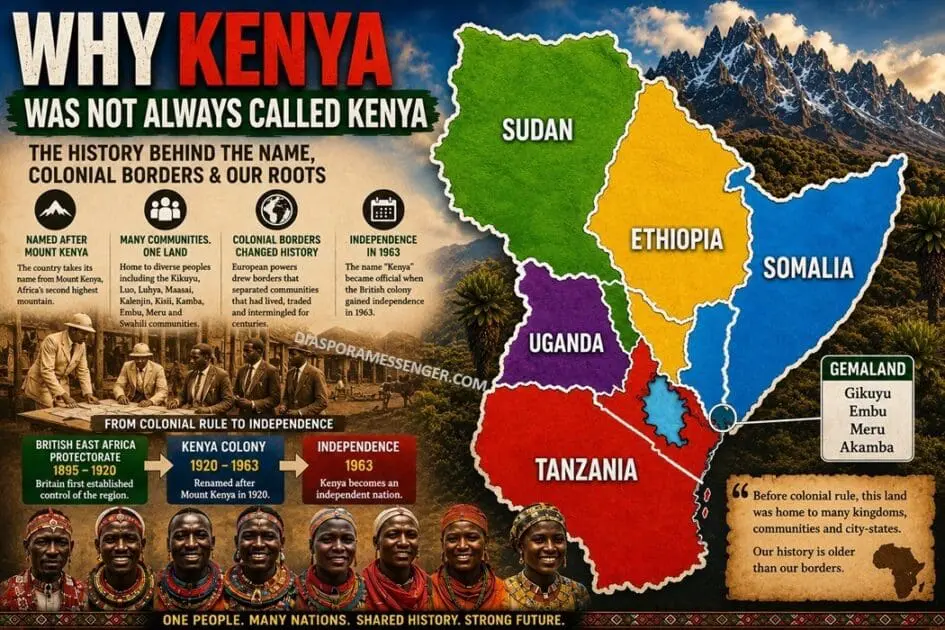
The modern country known today as Kenya did not always exist as a unified nation. Before colonial rule and the drawing of modern borders, the region was home to dozens of independent communities, kingdoms, and trading societies that lived across East Africa for centuries.
Today, discussions about historical identity and colonial boundaries continue to spark debate among Africans and members of the diaspora, especially after viral maps and historical illustrations circulate online showing how East Africa looked before European colonization.
How Kenya Got Its Name
The country now called Kenya derived its modern name from Mount Kenya, the highest mountain in the country and the second-highest mountain in Africa after Mount Kilimanjaro.
The name “Kenya” officially became the national identity when the British colony gained independence in 1963.
Before independence, the territory went through different administrative names under British colonial rule.
British East Africa Protectorate (1895–1920)
When Britain formally took control of the territory in 1895, the region was called the British East Africa Protectorate.
This was not a unified African nation but a colonial administrative area created by European powers during the partition of Africa.
Kenya Colony (1920–1963)
In 1920, Britain officially renamed the territory the Kenya Colony, drawing the name from Mount Kenya.
From that point until independence in 1963, the territory was commonly referred to as Kenya.
Before Colonial Rule, There Was No Unified “Kenya”
Prior to European colonization, there was no single political entity called Kenya.
Instead, the land consisted of many autonomous communities, kingdoms, and coastal city-states. These societies had their own leadership systems, territories, trade networks, and cultural identities.
Some of the major communities included:
- Kikuyu
- Luo
- Luhya
- Maasai
- Kalenjin
- Kisii
- Kamba
- Embu
- Meru
- Swahili coastal communities
Many communities moved freely across regions that later became modern national borders such as Kenya, Uganda, Tanzania, Ethiopia, and Somalia.
Colonial Borders Changed East Africa Forever
European colonization dramatically reshaped East Africa.
The borders that exist today were largely created by colonial powers without considering ethnic, cultural, or migration patterns of African communities already living in the region.
This explains why some communities today share close cultural and linguistic ties across modern borders.
Historical interpretations and viral maps often argue that some groups now living in Kenya — including the Luo, Luhya, Kalenjin, and Kisii communities — once occupied areas associated with present-day Uganda or broader interlinked East African territories before colonial boundary changes.
Historians note that African communities were highly mobile long before colonial rule, with migration, trade, intermarriage, and settlement happening across the region for centuries.
The Meaning Behind Mount Kenya’s Name
The exact origin of the word “Kenya” remains debated among historians and linguists.
One commonly cited explanation connects the name to the Kikuyu word “Kirinyaga,” meaning “place of whiteness” or “mountain of brightness,” referencing the snow-capped peak of Mount Kenya.
Other scholars point to Embu and Kamba linguistic roots connected to the mountain’s appearance and sacred significance.
Regardless of the exact origin, Mount Kenya became one of the most recognizable landmarks in East Africa and eventually gave its name to the modern nation.
Why This History Matters Today
For many Africans in the diaspora, understanding pre-colonial African history helps explain modern ethnic connections, migration patterns, and regional identities across East Africa.
It also highlights how colonial borders transformed the political map of Africa while separating communities that had interacted for generations.
Today, Kenya stands as a diverse nation built from many cultures, languages, and histories — all contributing to the country’s identity more than 60 years after independence.