

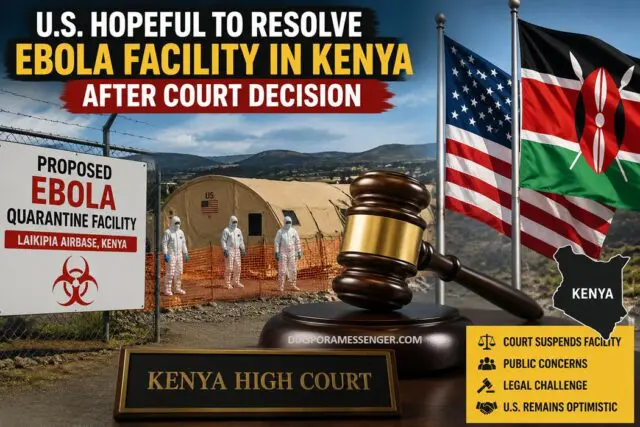
The United States government has expressed confidence that ongoing concerns surrounding a proposed Ebola quarantine facility in Kenya can be resolved through continued engagement with Kenyan authorities, despite a recent court ruling that temporarily halted the project.
The U.S. State Department confirmed that it remains actively involved in discussions with the Kenyan government and is optimistic that both nations can address legal and public concerns surrounding the controversial health initiative.
The facility, which was planned for a military airbase in Laikipia County, approximately 100 miles north of Nairobi, was intended to serve as a specialized quarantine and monitoring center for American citizens who may have been exposed to Ebola while working or traveling in neighboring countries such as Uganda and the Democratic Republic of Congo (DRC).
High Court Suspends Ebola Facility Operations
Kenya’s High Court recently issued orders temporarily suspending the establishment and operation of the 50-bed Ebola isolation facility pending a constitutional review of the bilateral health agreement between Kenya and the United States.
The court’s decision followed legal petitions challenging the legality of the arrangement and questioning whether the agreement complied with Kenya’s constitutional requirements regarding public participation, transparency, and environmental and health safeguards.
As a result, all implementation activities linked to the facility have been placed on hold until the matter is fully reviewed by the judiciary.
Purpose of the Proposed Ebola Facility
According to details surrounding the agreement, the quarantine center was not intended to receive active Ebola patients from the United States.
Instead, it would have accommodated asymptomatic American citizens who may have been exposed to the virus while stationed or traveling in East and Central Africa. The goal was to monitor these individuals closer to the region of exposure rather than transporting them immediately to the United States.
Health experts involved in similar international containment efforts argue that regional quarantine facilities can help limit cross-border disease transmission while ensuring exposed individuals receive medical monitoring.
However, the proposal quickly became a source of public controversy within Kenya.
Strong Opposition from Activists and Health Professionals
The planned facility triggered significant resistance from various sectors of Kenyan society, including civil society organizations, healthcare workers, legal experts, and community activists.
Critics argued that the Kenyan public had not been adequately informed about the project and raised concerns about the potential risks associated with hosting an Ebola-related facility within the country.
Some opponents warned that Kenya risked being transformed into what they described as a “containment colony” for foreign health emergencies.
Others questioned whether adequate safeguards existed to protect local communities and healthcare personnel in the event of accidental exposure or operational failures.
The controversy quickly gained national attention, sparking intense public debate about sovereignty, public health security, and international cooperation.
Legal Challenge Raises Constitutional Questions
One of the most prominent legal challenges was filed by the Katiba Institute, a Kenyan governance and constitutional watchdog organization.
The petition argues that the agreement between Kenya and the United States may have bypassed constitutional procedures by failing to involve meaningful public participation before implementation.
Legal experts supporting the challenge contend that major public health agreements affecting Kenyan citizens should undergo transparent consultation processes and parliamentary scrutiny.
The High Court’s constitutional review will now determine whether the agreement met Kenya’s legal and constitutional standards.
U.S. Maintains Optimistic Outlook
Despite the temporary suspension, the U.S. State Department has signaled that it remains committed to working collaboratively with Kenyan authorities to address concerns raised by stakeholders.
Officials believe ongoing discussions could lead to a mutually acceptable solution that balances public health preparedness with Kenya’s constitutional and sovereignty requirements.
The United States and Kenya have maintained strong diplomatic, security, and health partnerships for decades, including cooperation in combating infectious diseases, strengthening healthcare systems, and responding to regional health emergencies.
Analysts note that the outcome of the court review could set an important precedent for future international health agreements involving Kenya and foreign governments.
Implications for Kenya and the Diaspora
The case has attracted attention among Kenyans living abroad, particularly in the United States, where many diaspora members closely follow developments affecting bilateral relations between the two countries.
The dispute highlights broader questions about global health cooperation, emergency preparedness, and the responsibilities nations share in responding to infectious disease outbreaks.
As the court proceedings continue, both supporters and critics of the project will be watching closely to see whether a revised agreement can emerge that addresses public concerns while preserving international health collaboration.
Conclusion
The suspension of the proposed Ebola quarantine facility in Laikipia marks a significant moment in Kenya’s ongoing debate over public health governance and international agreements. While the U.S. government remains optimistic that concerns can be resolved through dialogue and legal review, the High Court’s decision underscores the importance of transparency, public participation, and constitutional compliance.
For now, the project remains on hold as Kenya’s judiciary examines the legality of the agreement. The final ruling could shape not only the future of the Ebola facility but also the framework for future international health partnerships involving Kenya.