

David Mungai Njenga Sentenced to Over 14 Years in U.S. Prison
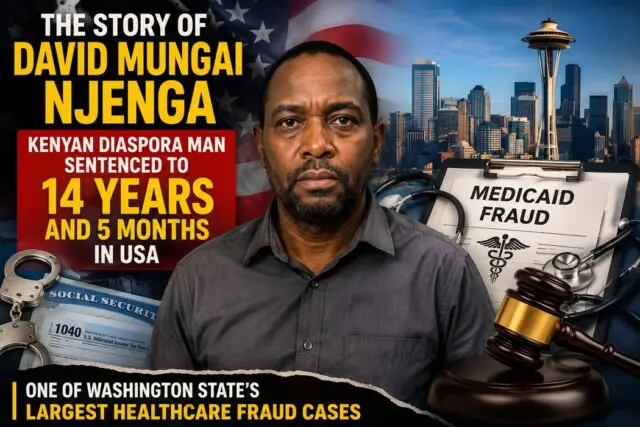
The sentencing of David Mungai Njenga, a Kenyan national living in Washington State, has become one of the most significant criminal cases involving a member of the Kenyan diaspora in recent years.
On June 16, 2026, a King County Superior Court judge sentenced the 65-year-old to 14 years and five months in prison, followed by 18 months of community custody, after a jury convicted him on 11 felony counts related to an extensive Medicaid fraud operation.
Prosecutors described the scheme as one of the largest and most dangerous healthcare fraud cases in Washington State history, alleging that vulnerable elderly patients were placed at risk through the use of unlicensed caregivers posing as registered nurses.
The case has attracted attention not only because of the scale of the fraud but also because it highlights the long-term consequences of immigration violations, identity theft, and abuse of public healthcare systems.
A Criminal History Dating Back More Than Two Decades
Court records indicate that Njenga’s encounters with the U.S. justice system began long before the healthcare fraud investigation.
In 2001, he was convicted in federal court for participating in a tax fraud conspiracy involving:
- Counterfeit Social Security numbers
- Forged W-2 forms
- False federal tax returns
- Fraudulent tax refund claims
- Refund Anticipation Loan scams
Investigators found that he and an accomplice created fake identities and convincing employment records to obtain tax refunds that were never legitimately earned.
The fraudulent claims exceeded $37,000, resulting in his conviction for conspiracy and filing false tax claims.
He served approximately 16 months in federal prison.
Deportation Order and Immigration Proceedings
Following his prison sentence, U.S. immigration authorities initiated deportation proceedings.
Like many non-citizens convicted of federal crimes, Njenga was transferred to immigration custody after completing his prison term.
However, according to court records:
- He was released on bond pending immigration hearings.
- He failed to appear before the immigration court.
- An immigration judge issued a deportation order in absentia.
- He later challenged the order through the U.S. immigration appeals process.
His legal battle continued for years.
In 2008, he filed a Motion to Reopen his immigration case, arguing that conditions in Kenya had changed and returning would place him in danger.
The Ninth Circuit Court of Appeals ultimately rejected his arguments in 2013, finding insufficient evidence to overturn the deportation order.
Despite the final ruling, authorities were unable to locate him for removal.
Building a Fraudulent Medical Staffing Company
According to prosecutors, Njenga later established Heritage Medical Staffing Inc., later renamed Pro Med Alliance Medical Staffing Inc., in Kent, Washington.
Between 2017 and 2019, investigators say the company systematically infiltrated nursing homes across Washington State.
The operation allegedly relied on:
- Identity theft
- Forged nursing credentials
- Fake employment files
- Counterfeit identification badges
- Fraudulent background documentation
Authorities alleged that personal information belonging to five licensed registered nurses was stolen and used without permission.
Those identities were then attached to individuals who allegedly had little or no medical training.
Elderly Patients Placed at Risk
Prosecutors argued that the fraudulent staffing operation endangered elderly residents living in long-term care facilities.
Court testimony alleged that imposters:
- Failed to monitor patients correctly
- Improperly administered medications
- Could not perform routine nursing procedures
- Misrepresented themselves as licensed healthcare professionals
Healthcare facilities reportedly paid premium rates believing they were receiving qualified nursing services.
Instead, investigators alleged that much of the money was diverted to Njenga while unlicensed workers received significantly lower wages.
Investigation Began With One Arrest
Ironically, prosecutors say the elaborate scheme unraveled because of a single arrest.
In 2019, authorities arrested a woman allegedly using forged nursing credentials at a medical facility.
During questioning, investigators discovered she had been recruited through Njenga’s staffing agency.
That revelation prompted the Washington Attorney General’s Medicaid Fraud Control Unit to launch a wider investigation.
Investigators eventually uncovered:
- Stolen nursing identities
- False employment records
- Financial transactions
- Fraudulent staffing contracts
- Identity theft documentation
The investigation ultimately led to Njenga’s arrest and prosecution.
Historic Conviction
On May 28, 2026, a King County jury convicted David Mungai Njenga on all 11 criminal counts.
According to prosecutors, it marked:
Washington State’s first Medicaid fraud prosecution involving a Class A felony conviction for Leading Organized Crime
One of the state’s largest healthcare identity fraud cases
His sentence includes:
- 14 years and five months imprisonment
- 18 months community custody after release
Co-Defendant Remains Wanted
Njenga’s alleged business partner, Everlyn Louise Wambui Njuki, left the United States before criminal charges could be completed.
Authorities have issued an active bench warrant for her arrest.
Law enforcement agencies continue efforts to locate and extradite her back to Washington State.
What This Means for the Kenyan Diaspora
The overwhelming majority of Kenyans living abroad contribute positively to their host countries.
According to the Central Bank of Kenya, Kenyans abroad remit over KSh 650 billion annually, making diaspora remittances Kenya’s largest source of foreign exchange ahead of many traditional exports.
Thousands of Kenyan professionals work in:
- Healthcare
- Technology
- Engineering
- Education
- Finance
- Public service
Cases involving serious criminal conduct remain extremely rare relative to the size of the Kenyan diaspora.
However, high-profile convictions can damage community reputation and increase scrutiny from immigration and licensing authorities.
Immigration Implications
Immigration attorneys note that criminal convictions involving:
- Fraud
- Identity theft
- Financial crimes
- Healthcare fraud
- Crimes involving moral turpitude
can carry severe immigration consequences.
These may include:
- Deportation
- Permanent inadmissibility
- Loss of lawful immigration status
- Difficulty obtaining citizenship
- Denial of future immigration benefits
Even lawful permanent residents can face removal proceedings following convictions for certain serious offenses.
For undocumented immigrants, criminal convictions often accelerate immigration enforcement actions.
Expert Opinion
Legal and immigration experts frequently emphasize that fraud involving healthcare systems is prosecuted aggressively because it combines financial crime with risks to public safety.
Healthcare fraud investigations often involve multiple agencies, including:
- State Attorneys General
- Medicaid Fraud Control Units
- Federal investigators
- IRS Criminal Investigation
- Immigration authorities
- Professional licensing boards
Experts also note that identity theft crimes leave long-term consequences for innocent professionals whose credentials are stolen.
Statistics on Healthcare Fraud
Healthcare fraud remains a major concern across the United States.
Recent government estimates indicate:
- Healthcare fraud costs the U.S. healthcare system billions of dollars annually.
- Medicaid Fraud Control Units recover hundreds of millions of dollars through investigations each year.
- Identity theft continues to be one of the fastest-growing financial crimes affecting both individuals and businesses.
These figures demonstrate why authorities devote significant resources to investigating organized healthcare fraud schemes.
Lessons for Kenyans Living Abroad
David Mungai Njenga’s case serves as a cautionary reminder that opportunities abroad come with significant responsibilities.
Building a successful life in the diaspora depends on integrity, compliance with immigration laws, and respect for professional standards.
While millions of Kenyans overseas continue making valuable contributions to their host countries and to Kenya through remittances, investment, and skills transfer, criminal cases involving fraud can undermine public trust and cast a shadow over the wider community.
Maintaining honesty, professionalism, and respect for the law remains essential for preserving the positive reputation of the Kenyan diaspora around the world.