


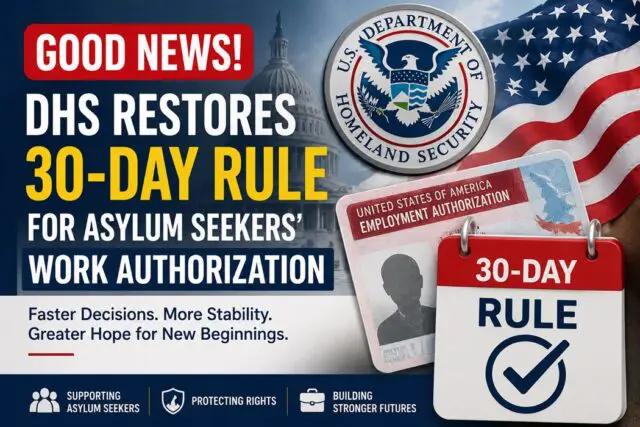
DHS Restores 30-Day Rule for Asylum Seekers’ Work Authorization: What It Means for Immigrants and the Kenyan Diaspora
In a significant development for asylum seekers across the United States, the Department of Homeland Security (DHS) has officially restored the long-standing 30-day processing deadline for initial Employment Authorization Document (EAD) applications.
The correction, published in the Federal Register on July 20, 2026, reverses an earlier administrative change that had unintentionally removed the requirement. The move provides much-needed certainty for thousands of asylum seekers—including many members of the Kenyan and wider African diaspora—who depend on timely work authorization while their asylum claims are being processed.
The decision is being welcomed by immigration advocates as an important safeguard that protects vulnerable individuals seeking safety, stability, and the opportunity to support themselves legally in the United States.
What Changed?
Under the restored rule, U.S. Citizenship and Immigration Services (USCIS) is once again legally required to:
- Approve or deny an initial asylum-related Employment Authorization Document (EAD) application within 30 days of receiving it.
- Maintain timely processing for first-time work authorization requests from eligible asylum applicants.
The restoration means asylum seekers who qualify for work authorization will once again have legal protection against indefinite processing delays.
Why Was the Rule Removed?
Earlier this year, an April 29, 2026 Interim Final Rule inadvertently eliminated the language requiring USCIS to process initial asylum work permits within 30 days.
The omission occurred while DHS implemented provisions connected to H.R. 1, the Republican tax and spending legislation.
Although DHS later described the removal as unintentional, immigration organizations quickly identified the missing protection and challenged the change through a federal lawsuit filed in Boston.
Following growing legal and public pressure, DHS issued an official correction restoring the processing deadline.
Why the 30-Day Rule Matters
For asylum seekers, obtaining work authorization is often the difference between independence and financial hardship.
A timely Employment Authorization Document allows individuals to:
- Secure lawful employment.
- Support themselves and their families.
- Reduce dependence on public or charitable assistance.
- Begin rebuilding their lives while awaiting decisions on their asylum cases.
Without a processing deadline, applications could potentially remain pending for extended periods, leaving applicants unable to legally work despite meeting eligibility requirements.
The restored rule therefore provides greater predictability and protection for thousands of people seeking refuge in the United States.
Impact on the Kenyan Diaspora
The decision is particularly relevant for members of the Kenyan diaspora and other African immigrant communities.
Many asylum applicants arrive in the United States fleeing political persecution, violence, or other humanitarian crises. Timely access to legal employment enables them to:
- Pay rent and living expenses.
- Support family members both in the United States and abroad.
- Integrate more quickly into American society.
- Contribute to local economies through lawful employment.
For diaspora communities, this policy restoration offers reassurance that eligible asylum seekers will not face unnecessary delays caused by administrative oversight.
Important: Other Proposed Restrictions Are Still Moving Forward
While restoring the 30-day processing requirement is widely viewed as a positive step, asylum seekers should also be aware that broader immigration policy proposals remain under consideration.
Among the proposals introduced earlier in 2026 are measures that would:
- Increase the waiting period before asylum seekers may apply for work authorization from 180 days to 365 days.
- Allow DHS to temporarily stop accepting new work permit applications if processing backlogs become excessive.
- Introduce additional administrative restrictions affecting future applicants.
These proposals have not replaced the restored 30-day adjudication requirement for eligible initial EAD applications.
As of now, the 30-day processing deadline remains the governing legal standard for first-time asylum work permit applications.
What Asylum Seekers Should Do
Individuals with pending or planned asylum applications should:
- Ensure all application forms are complete and accurate.
- Monitor USCIS announcements for any future regulatory changes.
- Keep copies of all immigration filings and correspondence.
- Seek advice from qualified immigration attorneys or accredited legal representatives if they have questions regarding eligibility or timelines.
Because immigration regulations can change quickly, applicants should remain informed through official government updates.
Conclusion
The restoration of the 30-day work authorization processing rule marks an important victory for asylum seekers and immigrant advocacy organizations.
By reinstating a clear legal deadline, DHS has strengthened protections that help vulnerable individuals gain timely access to lawful employment while their asylum cases move through the immigration system.
Although debates over broader asylum policies continue, the reinstated requirement offers immediate relief and greater certainty for thousands of applicants—including many within the Kenyan diaspora—who rely on work authorization to build stable and productive lives in the United States.