


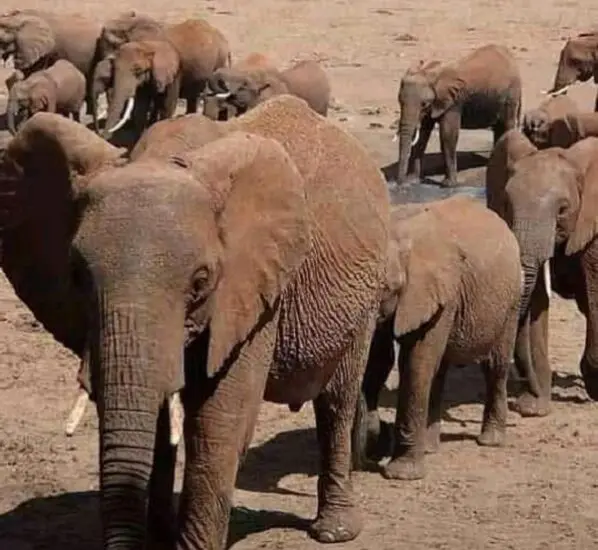
Kenya and United Kingdom (UK) are planning to fly thirteen African elephants from the UK to Mwaluganje Elephant Sanctuary in Kwale County. This exciting project involving the first elephants being relocated captures the imagination.
The thirteen elephants weighing 25 tonnes in total will be flown more than 7,000 km (4,350 miles) across the globe. They will return to their ancestral sanctuary in Mwaluganje Elephant Sanctuary for rewilding.
Each elephant will be transported in an individual container customised to their needs. Moreover, vets will be on hand throughout the flight. This move highlights the first elephants involved in the current exciting project.
Rewilding is a progressive approach to conservation. It’s about letting nature take care of itself, enabling natural processes to shape land and sea, repair damaged ecosystems and restore degraded landscapes.
Rewilding aims to restore ecosystems to a natural state, and often involves the reintroduction of native animals.
The exercise is scheduled for August and is spearheaded by Aspinall Foundation (TAF), in partnership with Sheldrick Wildlife Trust (SWT) and Kenya Wildlife Service (KWS). This marks a milestone with these first elephants involved in this exciting project.
The elephants shall be translocated from the Howetts Wild Animal Park in Kent in the UK where they have been in captivity in an eight-acre enclosure.
The group is one of the most successful breeding herds of African elephants in Europe.
Speaking to KNA, Kwale County KWS Senior, Warden Jacob Orale, said substantive preparations are ongoing to guarantee their safe arrivals. These preparations are crucial for this exciting project with the first elephants.
Orale added that already the government has initiated a tsetse fly eradication program across the elephant sanctuary. This extends through the entire Shimba Hills National Reserve ecosystem.
“We want to reduce the density of the tsetse flies in the ecosystem for the safety of the elephants. The breeds have been in a tsetse fly-free environment and we don’t want them to encounter the problem we have here,” Orale said.
The Aspinall Foundation is a world-class animal conservation charity founded in 1984 in the United Kingdom.
The foundation is dedicated to returning captive-bred animals to protected wilderness areas and reserves in their native habitats.
The Aspinall Foundation fund and manage animal protection projects in Congo, Gabon, Java, and Madagascar. They also provide financial support to other animal protection schemes around the world including India and Cambodia.
Last week the government through Kenya Tsetse and Trypanosomiasis Eradication Council (KENTTEC) in partnership with Wildlife Research Institute (WRI), conducted research. This was to determine the levels of tsetse flies in the entire Shimba Hills National Reserve. Such meticulous preparations are part of the larger exciting project involving these first elephants.
The two institutions discovered that the density of tsetse flies in the reserve is at an alarming rate. This poses a threat to certain species of elephants especially the Black African Elephants that are set for relocation from the UK.
The alarming results pushed the government to initiate a control campaign. They aim to eradicate the blood-sucking flies in collaboration with Aspinall Foundation and Sheldrick Wildlife Trust. This further solidifies the significance of this exciting project—the first elephants being relocated.
The Senior Warden said already close to 300 traps have been deployed across the Mwaluganje Elephant Sanctuary. These traps aim to catch the blood-sucking and disease-spreading insects.
He noted that the trapping exercise shall be done continuously for close to eight months or one year. This will continue until all the tsetse flies are completely eradicated in the entire Shimba Hills ecosystem. Thus, it ensures the success of this exciting first elephant project.
“The tsetse flies are many in the entire Shimba hills ecosystem but since the elephants shall be deployed in Mwaluganje, we hope to trap all tsetse flies by August,” Orale said.
Kenya Tsetse and Trypanosomiasis Eradication Council is a State Corporation under the Ministry of Agriculture, Livestock, Fisheries, and Co-operative’s. It was gazetted in 2012 by the government as a successor to the Pan-African Tsetse and Trypanosomiasis Eradication Campaign (PATTENC).
The council is mandated to coordinate the eradication of tsetse fly in the country. It sets standards and mitigates the socio-economic constraints brought by the tsetse infection.
The county KWS boss disclosed that already Aspinall Foundation and Sheldrick Wildlife Trust have contacted a contractor. They aim to renovate the over 8 kilometer fence in the sanctuary. Additionally, they plan another 6 kilometers in the reserve to guarantee the safety of the animals.
Further, he said the government has put in place enlightened security and monitoring measures across the reserve to protect the animals, ensuring the exciting project’s success for the first elephants.
Sheldrick Wildlife Trust is one of the pioneering conservation organisations for wildlife and habitat protection in East Africa.
It’s centered on operating a successful orphan elephant rescue and rehabilitation program in the world.
The organisation has successfully translocated more than 100,000 animals.
Currently, the National Environmental Management Authority [NEMA], is conducting public participation on an environmental and social impact on the anticipated translocation and rewilding of the elephants. This is integral to the success of this exciting project involving the first elephants.
Among the issues being considered is the potential impact of the exercise which includes risks of contracting diseases, Human-wildlife conflict, poaching, competition for resources in the ecosystem, and predation of the elephants.
By Raymond Zaka and Hussein Abdullahi
Source:https://www.kenyanews.go.ke/