


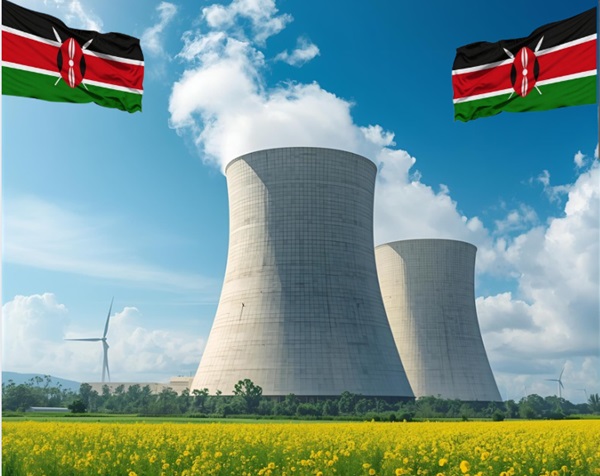
 Kenya has announced plans to build its first nuclear power plant as part of an ambitious long-term strategy to diversify its energy sources. It aims to meet rising electricity demands.
Indeed, Kenya plans to build nuclear facilities to ensure a stable energy supply. The country aims to connect nuclear power to its national grid by 2034. This is according to a statement from the Nuclear Power and Energy Agency (NuPEA) shared with Mongabay.
Currently in the second phase of its Nuclear Power Programme development, Kenya is laying the groundwork for this major energy transition. The process includes rigorous feasibility studies, potential site identification, and regulatory planning. This marks a significant phase as Kenya plans to build nuclear infrastructure.
On June 27, during the Nuclear Power Conference held at Jaramogi Oginga Odinga University of Science and Technology (JOOUST), the Ministry of Energy and Petroleum quietly revealed that Luanda Kotieno in Siaya County’s Bondo area is under consideration as a possible site for the facility.
Located on the shores of Lake Victoria, the area is being evaluated for its suitability. It has potential to host what would be a landmark infrastructure project for the country. Kenya plans to build nuclear sites at these strategic locations to optimize energy output.
Further clarity on potential sites came when NuPEA published a draft of its Strategic Environmental and Social Assessment (SESA) report online. According to the document, there are currently three proposed locations for the nuclear plant:
-
Uyombo in Kilifi County, along Kenya’s Indian Ocean coast;
-
Luanda Kotieno in Siaya County, on the banks of Lake Victoria;
-
An unspecified site in Turkana County, in the country’s arid northwestern region. Turkana, which hosts Lake Turkana, has gained recent attention due to the discovery of oil deposits.
The inclusion of these sites shows a strategic effort to balance geographic distribution, resource availability, and ecological considerations. Each location presents unique advantages and challenges—coastal access in Kilifi, freshwater availability in Siaya, and proximity to new industrial developments in oil-rich Turkana.
Despite the early-stage planning, NuPEA emphasized that no final site has been selected. “The country is still in the process of developing its Nuclear Power Programme and undertaking feasibility studies, which include identification of potential sites,” the agency stated.
“No final site has been approved, and any such decision will be subject to comprehensive Environmental and Social Impact Assessments (ESIAs), public participation, and regulatory approvals.”
Balancing Growth and Sustainability
The move to explore nuclear energy aligns with Kenya’s broader goals for energy security and sustainable growth. With electricity demand rising in tandem with economic and population growth, nuclear power is being considered as a viable complement to the country’s already impressive renewable energy mix.
Kenya has earned a reputation as a renewable energy leader in Africa. According to the International Energy Agency (IEA), 90% of Kenya’s electricity is generated from low-emission sources. These include geothermal, hydropower, wind, and solar. The IEA also projects that the country is on track to achieve universal electricity access by 2030.
Nuclear energy, while controversial, is seen by proponents as a reliable baseload power source. This can provide steady electricity regardless of weather conditions. It could help reduce Kenya’s reliance on diesel generators during dry seasons or times of low renewable output.
Next Steps: Public Participation and Oversight
As Kenya advances toward its 2034 target, public engagement will be a key pillar of the process. Environmental groups, community leaders, and local stakeholders have called for full transparency and meaningful participation. These aspects are especially important in areas being considered for the project because Kenya plans to build nuclear facilities that may impact these communities.
The government has pledged to follow international safety and environmental standards. NuPEA promises that site selection and construction will only proceed after thorough Environmental and Social Impact Assessments (ESIAs). Importantly, this will occur after obtaining all necessary regulatory approvals.
If successful, Kenya would become only the second African country, after South Africa, to operate a commercial nuclear power plant. The years ahead will determine whether nuclear power becomes a viable and accepted part of Kenya’s energy future. Alternatively, the country may choose to deepen its investments in renewable alternatives instead.
Follow our WhatsApp Channel and X Account for news updates.