

Visibility Without Control
Kenyan content creators and influencers are at the center of a booming digital economy—yet many remain on the margins of true wealth creation. Despite an industry estimated to exceed KSh 1.27 trillion in value by early 2026, a growing number of analysts argue that creators are caught in a “status trap”—prioritizing visibility, proximity to power, and short-term prestige over long-term financial ownership.
The result? High public profiles, but limited control over sustainable income streams.
The Status Trap: Fame Over Financial Strategy
In Kenya, influence is often closely tied to social and political visibility. For many creators, success is measured by:
- Invitations to elite events
- Alignment with political figures
- Short-term brand endorsements
However, critics say this model is fragile. Influencers integrated into institutional or political communication strategies often function as interchangeable assets—valued for reach, but easily replaced.
This creates a dangerous illusion: that current relevance guarantees future security.
1. The Burn Rate Problem: Campaign Spending vs. Capital Investment
A key issue lies in how capital is used.
Running for political office—such as Member of Parliament (MP) or Member of County Assembly (MCA)—can cost tens of millions of shillings. This spending is largely consumptive:
- Campaign logistics
- Advertising and billboards
- Mobilization and handouts
Once the election ends, the capital is gone.
Now compare that with investing the same funds into:
- A tech startup
- A manufacturing facility
- A logistics company
One creates temporary visibility. The other builds long-term economic infrastructure.
2. Influencers as Industrialists: The Untapped Advantage
Kenyan creators already possess something extremely powerful: distribution.
Millions of followers across platforms like TikTok, Instagram, and YouTube represent direct access to consumers. Yet, most influencers monetize this access through:
- Sponsored posts
- Brand ambassadorships
- Affiliate marketing
Globally, top creators have taken a different route.
MrBeast leveraged his audience to build Feastables, a consumer goods brand.
Rihanna transformed her influence into Fenty Beauty, a global cosmetics empire.
These creators didn’t just promote brands—they became the brand owners.
The Kenyan Potential
A Kenyan influencer with 1–5 million followers has the ability to:
- Launch direct-to-conser brands
- Scale products regionally
- Build loyal customer ecosystems
With the African Continental Free Trade Area (AfCFTA) opening access to a 1.3 billion-person market, the opportunity extends far beyond national borders.
3. The Scalability Mindset: Learning from Global Industrialists
The world’s most influential wealth creators share a common trait: they build scalable systems.
- Elon Musk invests in industries like energy, transportation, and space
- Aliko Dangote built Africa’s largest industrial conglomerate in cement, sugar, and oil
- Mukesh Ambani transformed telecom and retail across India
These leaders didn’t pursue short-term visibility—they built infrastructure that economies depend on.
The Kenyan Shift
If Kenyan youth and creators redirected their ambition toward:
- 10–20 year business strategies
- Scalable production systems
- Regional expansion
The country could produce homegrown multinational corporations dominating East and Central Africa.
4. Beyond Soft Power: Why Ownership Matters
Content creation and entertainment are forms of soft power—they shape culture, influence opinions, and drive trends.
Politics represents hard power—control of policy and governance.
But the most enduring force is economic power.
When creators:
- Build companies
- Control supply chains
- Generate employment
They gain influence that extends beyond both media and politics.
Instead of entering slow-moving systems, creators who build businesses can shape policy indirectly—by becoming too economically significant to ignore.
The Core Problem: A Misplaced Search for Security
At the heart of this issue is a mindset challenge.
Many creators equate:
- Political proximity = security
- Visibility = success
But in reality:
- Production creates wealth
- Ownership creates stability
- Scale creates influence
A parliamentary seat lasts five years.
A successful enterprise can last generations.
Conclusion: Rewriting the Future of the Creator Economy
Kenyan content creators stand at a crossroads.
They can continue to:
- Chase short-term deals
- Prioritize status and visibility
- Remain dependent on external brands
Or they can:
- Build their own products
- Invest in scalable businesses
- Leverage their audiences into ownership
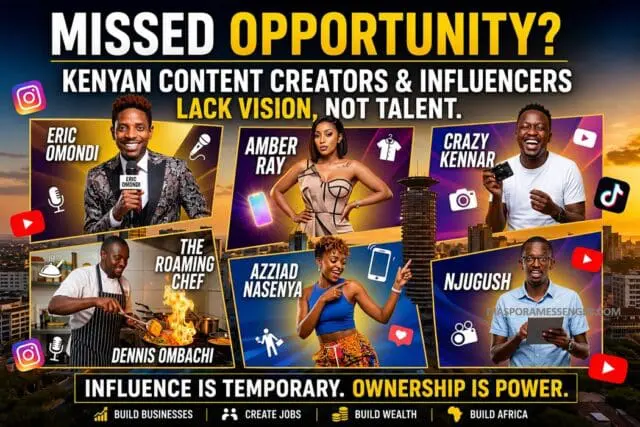
The real missed opportunity is not a lack of talent or reach—it is a lack of long-term vision.
If this mindset shifts, Kenya’s creator economy could evolve from a culture-driven sector into a powerhouse of industrial and economic growth across Africa.