

Kenyan U.S. Army Veteran Bariu David Kinyua’s Appeal to Congress Highlights Plight of Deported Immigrant Veterans
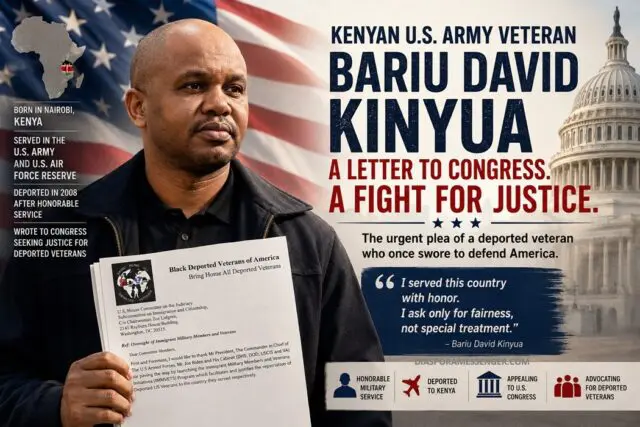
The story of David Kinyua Bariu, a Kenyan-born U.S. Army veteran who was deported from the United States after serving in the military, has once again drawn attention to the challenges facing immigrant veterans. Through a heartfelt letter addressed to the U.S. House Committee on the Judiciary’s Subcommittee on Immigration and Citizenship, Kinyua appealed for greater recognition, support, and fairness for deported veterans who once wore the American uniform.
His case has become part of a broader national conversation about the treatment of non-citizen service members and whether military service should carry greater weight in immigration decisions.
Who Is David Kinyua Bariu?
David Kinyua Bariu was born in Nairobi, Kenya, on June 20, 1976, and grew up in a Catholic family. According to his letter to Congress, he moved to the United States on August 17, 1998, on an F-1 student visa to pursue higher education at Southern Arkansas University (SAU).
While studying in the United States, Kinyua says he was recruited into the U.S. Army after being promised educational benefits and an opportunity to become a U.S. citizen through military service. He later served honorably in the United States Army and the U.S. Air Force Reserve, working as both a Surgical Technician and Optometry Technician.
During his military career, he received the U.S. Army Achievement Medal (1999–2001) in recognition of his service.
What Happened?
Despite his honorable military service, Kinyua’s path to American citizenship did not unfold as he had expected.
According to his account, his first naturalization process was cancelled shortly before his citizenship interview. In April 2007, he was detained by U.S. immigration authorities and spent approximately one year in detention before being deported to Kenya in April 2008.
His deportation ended his life in the United States and separated him from opportunities he believed military service had earned him.
Life After Deportation
Returning to Kenya proved difficult.
In his letter, Kinyua described struggling to secure stable employment and support his family. He also said he experienced isolation and hardship after losing access to the network and opportunities he had built during his years in the United States.
He further expressed concern about his safety as a deported U.S. military veteran living in East Africa, noting that regional security threats and extremist activity added to his anxiety.
Kinyua also stated that accessing veterans’ benefits and assistance from U.S. agencies became significantly more challenging after his deportation.
Writing to Congress
Seeking justice for himself and other deported veterans, Kinyua wrote to the U.S. House Judiciary Committee’s Subcommittee on Immigration and Citizenship.
In his letter, he thanked President Joe Biden and several federal agencies—including the Department of Homeland Security (DHS), Department of Defense (DoD), U.S. Citizenship and Immigration Services (USCIS), and the Department of Veterans Affairs (VA)—for launching the Immigrant Military Members and Veterans Initiative (IMMVI), a program intended to assist immigrant service members and deported veterans.
However, he also outlined several challenges facing the initiative.
According to Kinyua, communication delays between federal agencies, U.S. embassies, and consulates slowed efforts to process immigration cases involving deported veterans.
He explained that after receiving approval on May 26, 2022, for humanitarian parole to return to the United States and attend a scheduled naturalization interview on July 11, 2022, the U.S. Consulate in Nairobi reportedly could not schedule his appointment until it received additional guidance from USCIS.
Kinyua urged Congress to improve coordination among government agencies so that immigrant veterans would not face unnecessary bureaucratic obstacles.
He also appealed to lawmakers to carefully consider the consequences of deporting military veterans to countries where they may face hardship, insecurity, or limited opportunities.
Why His Story Matters
Kinyua’s experience reflects a broader debate over the treatment of immigrant veterans in the United States.
Supporters of immigration reform argue that military service demonstrates extraordinary commitment to the nation and should be given greater consideration in immigration proceedings. Others maintain that immigration laws should apply equally to everyone, regardless of military service.
His case has become a symbol of the difficult balance between enforcing immigration laws and recognizing the sacrifices made by immigrant service members.
Fresh Statistics on Immigrant Military Service
Immigrants continue to play an important role in defending the United States.
Recent data shows:
- Approximately 45,000 non-U.S. citizens currently serve in the U.S. Armed Forces.
- More than 700,000 U.S. veterans are foreign-born.
- Since 2002, over 150,000 service members have obtained U.S. citizenship through expedited military naturalization.
- Thousands of lawful permanent residents continue serving across every branch of the U.S. military.
Sources: U.S. Department of Defense, U.S. Citizenship and Immigration Services (USCIS), Congressional Research Service, Migration Policy Institute.
Why This Matters to the Kenyan Diaspora
For many Kenyans living abroad, Bariu David Kinyua’s story serves as both an inspiration and a cautionary tale. It demonstrates the opportunities available through military service while highlighting the importance of understanding immigration laws and protecting one’s legal status.
His appeal to Congress also underscores the ongoing efforts by immigrant veterans and advocacy groups to ensure that military service is given appropriate consideration when immigration decisions are made.
Frequently Asked Questions (FAQ)
Who is Bariu David Kinyua?
David Kinyua Bariu is a Kenyan-born U.S. Army veteran who was deported to Kenya after serving in the U.S. military and later appealed to Congress for reforms affecting deported immigrant veterans.
Why was he deported?
According to available accounts, Kinyua was deported following immigration proceedings after legal issues arose following his military service.
What is the Immigrant Military Members and Veterans Initiative (IMMVI)?
IMMVI is a U.S. government initiative designed to improve assistance and coordination for immigrant military personnel, veterans, and deported veterans navigating immigration-related matters.
Why did Kinyua write to Congress?
He wrote to highlight the difficulties faced by deported veterans, including delays in immigration processing, limited access to benefits, and the need for stronger coordination among U.S. government agencies.
Why is his case significant?
His story continues to fuel discussions about immigration reform, veterans’ rights, and whether military service should receive greater consideration in immigration decisions.
Conclusion
David Kinyua Bariu’s journey from Nairobi to the U.S. military and ultimately to deportation illustrates the complex intersection of military service and immigration law. Through his appeal to Congress, he has become an advocate for deported immigrant veterans seeking fair treatment and recognition for their service.
While opinions differ on how immigration laws should be applied, Kinyua’s story continues to remind policymakers and the public of the human impact behind immigration decisions. His experience remains an important part of the ongoing conversation about honoring military service while balancing the principles of justice, accountability, and compassion.