

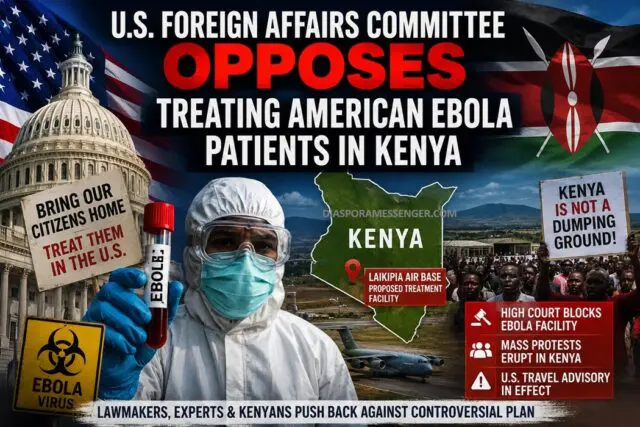
A major controversy is unfolding over a proposed plan to treat American Ebola patients in Kenya after the U.S. House Committee on Foreign Affairs formally rejected the Trump administration’s strategy.
In a strongly worded statement released on June 2, 2026, lawmakers argued that the United States should repatriate infected American citizens and provide treatment within specialized medical facilities on U.S. soil rather than transferring the responsibility to Kenya.
The dispute has intensified diplomatic discussions between Washington and Nairobi while fueling legal challenges and public demonstrations across Kenya.
Why the U.S. Administration Chose Kenya
The controversy centers on a proposal by the Trump administration to establish a 50-bed Ebola quarantine and treatment facility at the Laikipia Air Base in Kenya.
The facility was intended to accommodate American citizens infected with the rare Bundibugyo strain of Ebola, which is currently spreading in parts of the Democratic Republic of Congo and Uganda.
According to administration officials, the arrangement was designed to reduce the risk of the virus entering the United States while ensuring infected Americans receive medical care in a controlled environment outside U.S. borders.
The proposal was reportedly developed through cooperation with the Kenyan government under President William Ruto.
U.S. Lawmakers Demand Medical Repatriation
Members of the House Foreign Affairs Committee sharply criticized the proposal, arguing that the United States possesses some of the world’s most advanced infectious disease treatment facilities and should utilize them instead.
Lawmakers stated that outsourcing the treatment of American citizens to another country undermines Washington’s responsibility to protect its own people.
The committee also pointed to what it described as a policy contradiction, noting that previous reductions in U.S. public health funding to Kenya make it unreasonable to expect Kenya to shoulder the risks associated with treating Ebola patients from abroad.
According to the committee, bringing infected Americans home for treatment remains the most ethical and medically responsible option.
Health Experts Support Congressional Concerns
The committee’s position has received support from several prominent American healthcare professionals and former officials from the Centers for Disease Control and Prevention (CDC).
In an open letter, the experts warned that refusing to medically repatriate U.S. citizens could establish a dangerous precedent for future public health emergencies.
They argued that advanced containment facilities already exist within the United States and are specifically designed to safely manage highly infectious diseases such as Ebola.
Medical experts further emphasized that patient repatriation has historically been a standard practice during international health crises involving American citizens.
Legal Challenges Stall Ebola Facility in Kenya
The proposed Ebola treatment center has already encountered significant legal obstacles in Kenya.
On May 29, 2026, Kenya’s High Court temporarily suspended the construction and operation of the Laikipia facility following petitions filed by civil society organizations and the Law Society of Kenya.
Petitioners argue that the project poses serious risks to Kenya’s healthcare system and public safety.
Critics maintain that Kenya should not become a treatment hub for foreign Ebola patients, particularly when the country currently has no active Ebola cases.
The court’s temporary orders have effectively halted implementation of the project pending further hearings.
Public Protests Escalate Across Kenya
Public opposition to the proposal has grown rapidly in recent days.
Residents in Nanyuki and neighboring communities have staged demonstrations against the planned facility, expressing fears of accidental exposure to the deadly virus.
The protests intensified on June 1, 2026, when clashes reportedly turned violent, resulting in at least two civilian deaths.
The unrest has drawn international attention and heightened concerns about the broader implications of the proposed facility.
Following the disturbances, the U.S. government issued an active travel advisory for American citizens in Kenya, citing security concerns related to the ongoing demonstrations.
Impact on Kenya-U.S. Relations
The dispute has introduced a new challenge into Kenya-U.S. diplomatic relations.
While both countries have historically cooperated on health security, counterterrorism, trade, and regional stability initiatives, the Ebola treatment proposal has become a highly sensitive political issue.
Kenyan leaders now face pressure from citizens, civil society organizations, health professionals, and lawmakers who oppose hosting infected foreign patients.
At the same time, U.S. policymakers are debating whether the administration’s strategy aligns with America’s obligations to its citizens and international health standards.
What Happens Next?
The future of the proposed Laikipia Ebola facility remains uncertain.
The High Court’s temporary suspension, growing public opposition, and now formal resistance from the U.S. House Foreign Affairs Committee have created significant obstacles for the project.
As legal proceedings continue and policymakers on both sides of the Atlantic evaluate their next steps, the controversy is likely to remain a major topic in discussions about global health security, medical ethics, and international cooperation.
For Kenyans in the diaspora and those closely following U.S.-Kenya relations, the outcome could have far-reaching implications for future public health partnerships between the two nations.
Conclusion
The U.S. House Foreign Affairs Committee’s rejection of the Kenya Ebola treatment plan marks a significant setback for the Trump administration’s strategy. With legal challenges mounting in Kenya, public protests escalating, and healthcare experts advocating for patient repatriation, pressure continues to build for the United States to treat its Ebola patients domestically. The coming weeks will determine whether the controversial proposal survives judicial scrutiny and political opposition on both sides of the globe.