


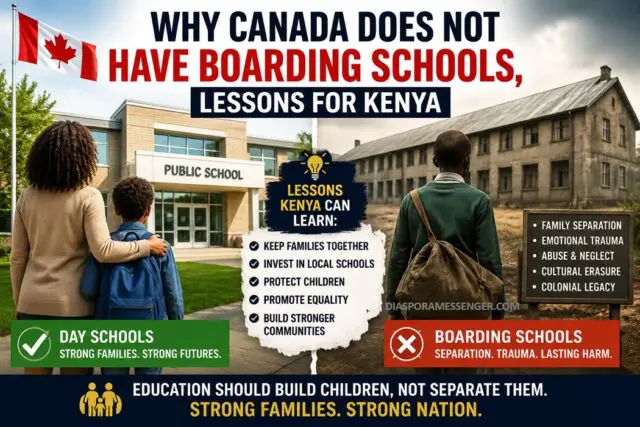
Why Canada Does Not Have Boarding Schools: Powerful Lessons Kenya Can Learn
For generations, boarding schools have been considered a prestigious part of Kenya’s education system. Many parents believe that children perform better academically when they live away from home under strict supervision.
However, Canada—a country with one of the world’s most respected education systems—has taken a completely different path.
Today, the overwhelming majority of Canadian children attend local day schools rather than boarding institutions. This shift was shaped by one of the darkest chapters in Canadian history: the Indian Residential School system.
As Kenya continues implementing education reforms under the Competency-Based Curriculum (CBC), Canada’s experience offers important lessons about balancing academic excellence with children’s emotional well-being.
Canada’s Painful History with Boarding Schools
Between the late 1800s and the 1990s, more than 150,000 Indigenous children in Canada were forcibly removed from their families and placed in government-funded, church-run residential schools.
The purpose was not simply education.
The schools were designed to erase Indigenous languages, cultures, and identities through forced assimilation.
Children were often prohibited from speaking their native languages or practicing their traditions. Many experienced physical abuse, emotional neglect, malnutrition, and in some cases sexual abuse.
Thousands of children never returned home.
Canada’s Truth and Reconciliation Commission later described the system as “cultural genocide.”
Today, the country officially acknowledges the devastating long-term consequences of separating children from their families.
Why Canada Shifted Toward Day Schools
Modern Canada now prioritizes community-based education.
Instead of sending children away for months at a time, students typically attend schools within their neighborhoods and return home every afternoon.
Parents remain actively involved in their children’s daily lives, helping guide their emotional, social, and moral development.
Boarding schools still exist in Canada, but they are relatively rare and mostly serve:
- Students in extremely remote communities
- Specialized private schools
- Certain Indigenous communities where no local alternatives exist
- International students
For the vast majority of Canadian families, local day schools are the standard.
Lesson One: Families Are Children’s First Teachers
Canada’s experience demonstrated that prolonged separation from parents can have lifelong consequences.
Research consistently shows that children develop stronger emotional security when parents remain actively involved in their daily lives.
Home is where children first learn:
- Values
- Communication
- Emotional regulation
- Cultural identity
- Responsibility
Schools educate.
Families nurture.
A strong education system recognizes the importance of both.
Lesson Two: Eliminate Colonial-Era Educational Models
Many boarding schools across Africa—including Kenya—were originally introduced during colonial rule.
Their purpose extended beyond education.
They often separated children from local communities while promoting colonial administrative systems.
As countries modernize education, many are moving toward decentralized community schools that strengthen local development instead of large institutional campuses.
Kenya’s ongoing CBC reforms present an opportunity to rethink whether large-scale boarding schools remain the best long-term model.
Lesson Three: Better Protection for Children
Large boarding institutions face unique challenges.
Without regular parental oversight, children may become more vulnerable to:
- Bullying
- Physical abuse
- Emotional neglect
- Mental health struggles
- Student unrest
Parents may only learn about problems weeks or months later.
Day schools allow families to observe behavioral changes immediately and intervene before problems escalate.
Daily family interaction also provides stronger emotional support during adolescence.
Lesson Four: Reduce the Financial Burden on Families
Boarding schools are expensive.
Parents often pay for:
- Accommodation
- Meals
- Bedding
- Uniforms
- Transport
- Boarding fees
- Additional school levies
For many Kenyan families, these costs create enormous financial pressure.
Expanding quality day schools could significantly reduce household education expenses while allowing governments to redirect investment toward:
- Better classrooms
- Teacher training
- Digital learning
- Community libraries
- School laboratories
Rather than financing dormitories, resources could directly improve teaching and learning.
Lesson Five: Equal Access to Quality Education
One criticism of boarding schools is inequality.
Prestigious boarding schools often charge fees that many families cannot afford.
A strong day-school model aims to ensure that quality education depends on good teaching—not on whether a child lives on campus.
Canada’s approach emphasizes equitable access by investing in local schools that serve entire communities.
Could Kenya Transition to More Day Schools?
A complete transition would not happen overnight.
Kenya still has regions where boarding schools remain necessary because of:
- Long travel distances
- Sparse populations
- Inadequate transport infrastructure
- Security concerns
However, urban and peri-urban areas could increasingly benefit from expanding high-quality day schools.
This would require substantial government investment in:
- New classrooms
- School buses
- Safe roads
- Modern learning facilities
- Teacher recruitment
- Community support programs
Such investments could make quality education more affordable while strengthening family involvement.
The Bottom Line
Canada’s decision to move away from widespread boarding schools was not simply an educational reform—it was a response to painful historical lessons about the importance of family, culture, and child development.
Although Kenya’s boarding schools operate under a very different context, Canada’s experience reminds policymakers that education should never come at the expense of children’s emotional well-being and family connections.
As Kenya continues reforming its education system, the conversation should focus not only on academic performance but also on creating environments where children can thrive both inside the classroom and at home.
A balanced approach—where quality local schools are accessible to every child while boarding schools remain available only where truly necessary—could provide the best path forward.
Conclusion
The future of education is no longer measured solely by examination results. Around the world, successful education systems are increasingly recognizing that children perform best when schools and families work together. Canada’s experience serves as a reminder that keeping children connected to their parents and communities can strengthen emotional health, cultural identity, and long-term success. As Kenya continues to modernize its education system, investing in quality neighborhood day schools while limiting boarding education to exceptional circumstances could create a more inclusive, affordable, and child-centered education system for future generations.

Why Canada Abandoned Boarding Schools: Lessons for Kenya