
Thousands of immigrants living legally in the United States — including Kenyan professionals, students, spouses, and humanitarian parolees — are facing uncertainty after the Trump administration announced a major immigration policy shift affecting green card applications.
On May 22, 2026, the U.S. Citizenship and Immigration Services (USCIS) issued a new policy memorandum dramatically limiting the use of Adjustment of Status (AOS), a long-standing immigration pathway that allowed eligible temporary visa holders to apply for permanent residency without leaving the United States.
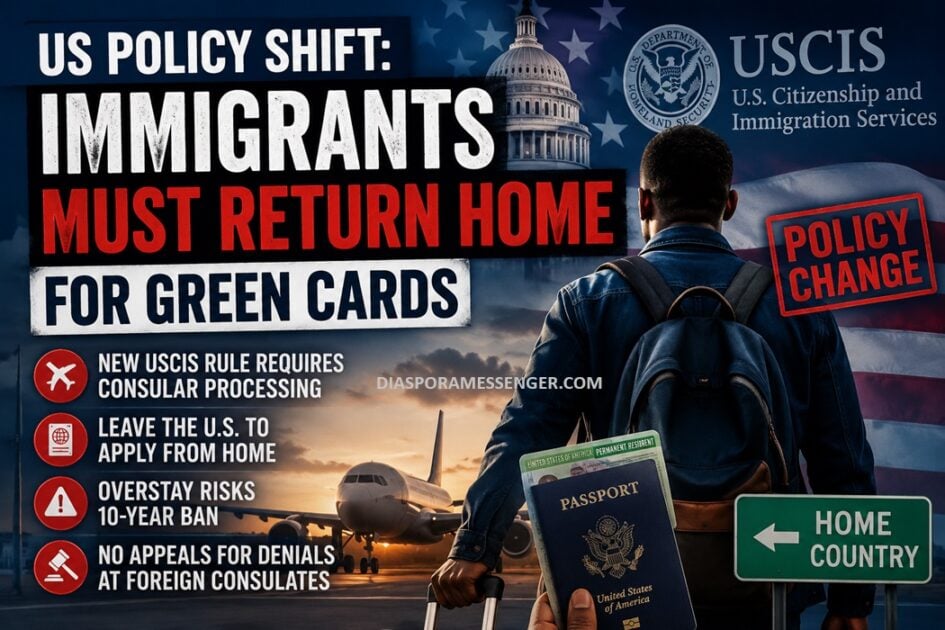
Under the new directive, most immigrants seeking green cards will now be required to leave the U.S. and complete the process through American embassies or consulates in their home countries.
The move is already generating widespread concern across immigrant communities, including the Kenyan diaspora in America, where thousands rely on employment visas, student visas, and family sponsorship pathways to build long-term futures in the United States.
What Has Changed?
For decades, Adjustment of Status allowed immigrants already inside the United States to transition from temporary visas to lawful permanent residency without international travel.
However, the new USCIS guidance now describes Adjustment of Status as an “extraordinary form of relief” rather than a standard immigration process.
The policy introduces several major changes:
Mandatory Consular Processing
Most applicants must now return to their home countries to complete green card interviews and processing through U.S. consulates abroad.
Strictly Limited Exceptions
Only immigrants facing “extraordinary circumstances” will be permitted to remain in the U.S. while adjusting status domestically.
Dual Intent Visas No Longer Enough
Even immigrants holding visas traditionally associated with “dual intent” — such as H-1B work visas — may no longer automatically qualify to adjust status inside the country.
Who Will Be Affected?
The policy could impact hundreds of thousands of immigrants currently living legally in the United States.
High-Skilled Workers
Many professionals working in technology, healthcare, engineering, finance, and corporate America under H-1B visas may now face mandatory international travel before obtaining permanent residency.
For many Kenyan professionals employed in the U.S. tech and healthcare sectors, the rule creates uncertainty over employment continuity and family stability.
International Students
F-1 visa holders who transition from university programs into employment sponsorships may now be forced to leave the U.S. before completing the green card process.
Spouses and Families
Spouses and immediate relatives of U.S. citizens who entered legally on temporary visas may also be affected, especially those who overstayed after lawful entry.
Humanitarian Parolees
The policy may also affect Ukrainians, Afghans, and other humanitarian parole beneficiaries currently pursuing permanent residency pathways.
Why the Trump Administration Supports the Rule
According to USCIS Director Joseph Edlow and administration officials, the new policy is intended to restore what they describe as the “original intent” of immigration law.
The administration argues that temporary visas were designed for short-term stays rather than serving as a pathway to permanent residency.
Officials also claim the policy will:
- Reduce visa overstays
- Close perceived legal loopholes
- Strengthen immigration enforcement
- Free USCIS resources for citizenship and humanitarian cases
- Reinforce stricter compliance with federal immigration law
The administration maintains that green card processing should primarily occur outside the United States through consular channels managed by the U.S. Department of State.
Immigration Attorneys Warn of Major Risks
Immigration lawyers and legal experts across the United States are strongly criticizing the policy, warning that it could separate families and destabilize American businesses that depend on foreign talent.
One of the biggest fears involves immigrants who previously overstayed visas.
Under existing immigration law, individuals who accrued more than one year of unlawful presence may trigger an automatic 10-year re-entry ban once they leave the United States.
Legal experts warn that many immigrants could unknowingly place themselves at serious risk simply by departing for mandatory consular interviews.
Another major concern is the lack of legal recourse for denied applications overseas.
Unlike Adjustment of Status cases handled inside the United States, immigrants denied at consulates abroad generally have very limited options to appeal or challenge decisions.
Attorneys also argue the policy could violate provisions of the Immigration and Nationality Act established by Congress.
Multiple legal organizations are already preparing for federal court challenges aimed at blocking or overturning the directive.
Kenyan Diaspora Community Watching Closely
The policy has triggered anxiety among many Kenyans living in the United States, particularly students, nurses, tech workers, truck drivers, and families pursuing permanent residency.
For years, Adjustment of Status provided a relatively stable pathway for immigrants who entered legally and later qualified through employment or family sponsorship.
Now, many fear that international travel requirements could expose them to visa denials, lengthy delays, or bans preventing re-entry into the United States.
Diaspora advocates say the uncertainty is especially troubling for families with children born in America, individuals with mortgages and businesses, and workers whose employers depend on their continued presence.
What Happens Next?
Immigration experts expect immediate federal lawsuits challenging the legality of the policy memorandum.
Advocacy groups are also urging affected immigrants not to make travel decisions without consulting qualified immigration attorneys.
For now, uncertainty remains high as immigrants, employers, universities, and legal organizations wait to see whether federal courts will intervene.
The policy marks one of the most significant changes to legal immigration processing in recent years and could reshape how future immigrants pursue permanent residency in the United States.