

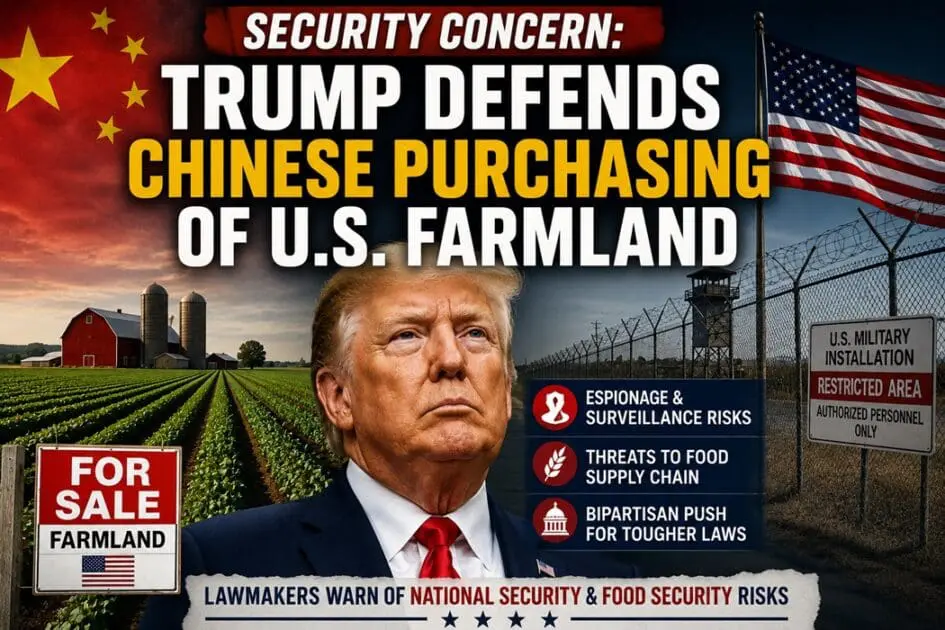
A major political and national security debate is unfolding in the United States after President Donald Trump defended Chinese nationals purchasing American farmland during his May 2026 state visit to China. The remarks have triggered backlash from lawmakers, security analysts, and critics who argue that foreign ownership of agricultural land near sensitive military installations could pose serious risks to America’s national security and food supply chain.
Trump’s comments mark a noticeable shift from his previous “America First” rhetoric, which often emphasized protecting American land, industries, and strategic resources from foreign influence. The issue has quickly become one of the most controversial discussions surrounding foreign investment, agricultural economics, and geopolitical competition between the United States and China.
For many in the Kenyan diaspora and African immigrant communities living in America, the debate highlights broader questions about economic globalization, national sovereignty, and the growing tension between free-market investment and security protection.
Trump Defends Chinese Farmland Purchases
Speaking during an interview on Fox News while visiting China, President Trump argued that banning Chinese buyers from purchasing U.S. farmland would financially hurt American farmers.
Trump acknowledged discomfort with the situation but emphasized the economic implications of removing Chinese capital from rural real estate markets.
According to Trump, restricting Chinese buyers would reduce demand for agricultural property and potentially cause American farmers to lose substantial income through declining land values.
The remarks surprised many observers because Trump’s earlier political campaigns strongly criticized foreign ownership of American assets under his “America First” platform. During previous campaigns, Trump frequently warned about economic dependence on China and pledged to strengthen protections against foreign influence.
His latest position, however, appears more transactional and economically focused, prioritizing market value and agricultural profitability over outright restrictions.
Growing National Security Concerns
Despite Trump’s economic argument, U.S. intelligence agencies and bipartisan lawmakers continue to raise alarms over the strategic implications of foreign ownership of agricultural land.
Military Proximity and Surveillance Risks
One of the biggest concerns involves foreign entities purchasing farmland near U.S. military bases and critical infrastructure.
Security experts fear these properties could potentially be used for:
- Electronic surveillance
- Intelligence gathering
- Monitoring military activity
- Strategic data collection
- Infrastructure mapping
Federal investigators have repeatedly warned that adversarial governments may exploit land ownership to establish covert observation points close to sensitive defense facilities.
Several controversial land purchases in states such as Texas and North Dakota previously sparked federal investigations due to their proximity to Air Force installations and missile facilities.
Food Supply Chain Vulnerability
Lawmakers from both political parties argue that foreign control of agricultural resources could eventually threaten America’s food security.
Critics warn that strategic adversaries controlling farmland, processing facilities, or agricultural logistics networks may gain leverage over domestic food production during geopolitical crises.
The concern extends beyond farming itself to include:
- Grain storage systems
- Water resources
- Livestock operations
- Agricultural technology
- Supply chain distribution networks
Some analysts compare the issue to energy security, arguing that food systems represent a critical national asset that should remain under domestic control.
Strategic Land Aggregation
Although Chinese investors reportedly control less than 1% of all foreign-owned farmland in the United States, security analysts note that the issue is less about total acreage and more about concentrated strategic locations.
Current scrutiny has intensified around farmland acquisitions in states including:
- Texas
- Missouri
- North Carolina
- Arkansas
- Oklahoma
Canadian investors still hold the largest share of foreign-owned U.S. agricultural land at approximately 34%, but lawmakers argue that geopolitical rivalry with China creates a fundamentally different security calculation.
Congress Pushes Back With New Legislation
Trump’s remarks come at a time when Congress is aggressively pursuing new restrictions on foreign farmland acquisitions.
Protecting U.S. Farmland and Sensitive Sites Act
In May 2026, the House Select Committee on China introduced the Protecting U.S. Farmland and Sensitive Sites from Foreign Adversaries Act.
The proposed legislation would:
- Presume denial for farmland purchases involving Chinese, Russian, Iranian, or North Korean entities
- Increase federal scrutiny of strategic land transactions
- Expand oversight around military-adjacent property purchases
- Strengthen national security reviews
Supporters of the bill argue that America must treat agricultural land as strategic infrastructure rather than merely a commercial asset.
Expanded CFIUS Authority
Lawmakers are also pushing to strengthen the powers of the Committee on Foreign Investment in the United States (CFIUS).
Proposed reforms would:
- Expand CFIUS jurisdiction over agricultural land
- Require mandatory reviews near military bases
- Add the Secretary of Agriculture as a permanent member
- Increase monitoring of foreign agricultural investments
The effort reflects growing bipartisan agreement that farmland transactions deserve the same scrutiny as technology and defense-related acquisitions.
State Governments Taking Independent Action
Several U.S. states are no longer waiting for federal action.
States such as:
- Utah
- New Hampshire
- Florida
- Texas
have introduced or signed laws restricting property acquisitions by entities linked to foreign adversaries.
These laws often target both:
- Land purchases
- Data infrastructure acquisitions
Supporters say states must act proactively to protect local communities and strategic resources from potential foreign influence.
Economic Debate Divides America
The controversy exposes a larger national debate balancing:
- Free-market capitalism
- National security protection
- Agricultural profitability
- Foreign investment policy
Supporters of Trump’s position argue that farmers depend on strong land demand and investment capital to sustain property values and rural economies.
Critics counter that certain strategic assets should never become vulnerable to geopolitical rivals regardless of economic gain.
The debate is expected to intensify as U.S.-China tensions continue shaping trade, technology, and security policies heading into the 2026 political season.
Why This Matters to the Diaspora Community
For diaspora communities living in America, including African immigrants and Kenyan-Americans, the farmland debate reflects broader concerns about:
- Economic nationalism
- Immigration politics
- Foreign investment rules
- National security policy
- Rising geopolitical tensions
Many immigrants working in agriculture, logistics, technology, and business sectors closely follow how U.S.-China relations affect markets, investment opportunities, and economic stability.
The issue also demonstrates how global politics increasingly influence local economies and everyday life in America.
Conclusion
President Donald Trump’s defense of Chinese purchases of U.S. farmland has reignited one of America’s most sensitive political and security debates. While Trump emphasizes economic realities facing farmers, critics warn that foreign ownership near military installations and strategic infrastructure could create long-term vulnerabilities.
As Congress advances bipartisan legislation and states impose independent restrictions, the battle over foreign farmland ownership is likely to remain a major national issue throughout 2026 and beyond.