


Canada Faces Critical Shortage of Early Childhood Educators: A Golden Opportunity for Foreign Teachers Seeking Permanent Residency
Canada is experiencing one of its most severe labor shortages in the education sector, with Early Childhood Educators (ECEs) and Assistants (NOC 42202) among the country’s most sought-after professionals.
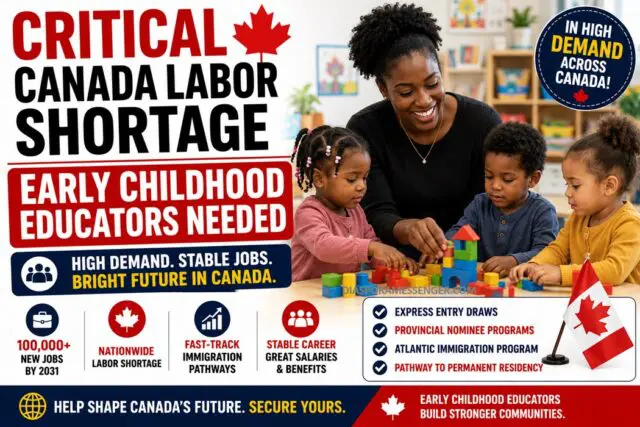
Driven by billions of dollars in federal investment to expand the national $10-a-day childcare program, Canada urgently needs thousands of qualified childcare professionals. Industry projections indicate that more than 100,000 job openings will become available by 2031, making early childhood education one of the strongest career pathways for skilled foreign workers hoping to build a future in Canada.
For many professionals living abroad—including teachers from Kenya, Nigeria, Ghana, South Africa, Zimbabwe, India, the Philippines, and other countries—this presents an exceptional opportunity to secure stable employment while pursuing Canadian Permanent Residency (PR).
Why Canada Needs So Many Early Childhood Educators
Canada’s childcare system is expanding rapidly as governments work toward making childcare more affordable for families.
The nationwide $10-a-day childcare initiative has dramatically increased demand for licensed childcare centers. However, the growth of these centers has far outpaced the available workforce.
Many provinces are struggling to recruit enough qualified Early Childhood Educators, creating significant employment opportunities for both Canadian graduates and internationally trained professionals.
Experts believe this shortage will continue well into 2033, making ECE one of Canada’s most future-proof careers.
More Than 100,000 New Jobs Expected
Employment forecasts indicate that Canada will require over 100,000 Early Childhood Educators and Assistants during the coming years.
Demand exists in:
- Childcare centres
- Nursery schools
- Kindergarten programs
- Preschool facilities
- Community organizations
- Indigenous education programs
- Private childcare providers
- Before- and after-school programs
Both urban and rural communities continue to report staffing shortages.
Fast-Track Immigration Pathways for Early Childhood Educators
Recognizing the urgent labor shortage, the Canadian government has created several immigration pathways that make it easier for qualified childcare professionals to become permanent residents.
1. Express Entry Category-Based Selection
Canada’s Express Entry system increasingly targets occupations experiencing labor shortages.
Education and childcare professionals have benefited from category-based draws that often invite candidates with lower Comprehensive Ranking System (CRS) scores than traditional Express Entry rounds.
This significantly improves the chances of receiving an Invitation to Apply (ITA) for Permanent Residency.
2. Provincial Nominee Programs (PNPs)
Nearly every Canadian province has developed immigration streams designed to attract Early Childhood Educators.
Popular provinces recruiting ECEs include:
- Ontario
- British Columbia
- Alberta
- Saskatchewan
- Manitoba
- Nova Scotia
- New Brunswick
- Prince Edward Island
Many Provincial Nominee Programs prioritize applicants who already have job offers from licensed childcare providers.
3. Atlantic Immigration Program (AIP)
Canada’s Atlantic provinces continue to experience severe workforce shortages.
Through the Atlantic Immigration Program (AIP), skilled foreign workers can relocate to:
- Nova Scotia
- New Brunswick
- Prince Edward Island
- Newfoundland and Labrador
Many childcare employers participate in the program, making it easier for international candidates to receive employer support for immigration.
Is Early Childhood Education a Regulated Profession?
Yes.
Early Childhood Education is a regulated profession across much of Canada.
To legally use the title Registered Early Childhood Educator (RECE), professionals must register with the regulatory authority in the province where they intend to work.
For example:
Ontario requires registration with the College of Early Childhood Educators (CECE).
Other provinces have their own licensing bodies and certification processes.
Licensing requirements vary slightly by province.
Qualifications Required
Foreign-trained educators generally need to meet several requirements before working in Canada.
Education
Applicants usually require:
A recognized one- or two-year diploma in Early Childhood Education, or
A university degree in Early Childhood Education or a closely related field.
Educational credentials earned outside Canada may need to be assessed to determine their Canadian equivalency.
Licensing
Before working independently, applicants may need to:
- Complete provincial registration
- Meet professional competency requirements
- Submit educational assessments
- Provide identity documentation
- Pass any required background or suitability checks
Language Requirements
Candidates must demonstrate proficiency in either:
English, or
French
Language ability is typically proven through approved language tests and is also an important factor in immigration applications.
Opportunities for Foreign-Trained Teachers
Many internationally educated teachers successfully transition into Canada’s childcare sector.
Applicants who obtained their qualifications outside Canada may need to complete:
- Credential assessments
- Additional coursework (if required)
- Provincial licensing procedures
Several provinces actively help internationally trained educators integrate into the workforce through bridging programs and employment support services.
Salary Expectations
Salaries vary depending on the province, employer, and level of experience.
Experienced Registered Early Childhood Educators often earn higher wages than assistants, while many provinces have introduced wage enhancement programs to improve recruitment and retention.
Additional benefits may include:
- Paid vacation
- Health benefits
- Pension contributions
- Professional development opportunities
- Stable full-time employment
Why This Matters for the Kenyan and African Diaspora
For qualified teachers across Africa and other parts of the world, Canada’s childcare shortage presents more than just a job opportunity—it offers a realistic pathway toward long-term settlement and career growth.
Many Kenyan teachers already possess strong educational backgrounds and English-language proficiency, making them competitive candidates for Canadian employers. With demand expected to remain high for years, those who meet licensing and immigration requirements may find a smoother route to employment and Permanent Residency than in many other occupations.
Individuals considering this pathway should research the licensing requirements of the province where they wish to work, prepare their educational credential assessments, and ensure they meet the language standards required for both employment and immigration.
Final Thoughts
Canada’s growing childcare sector has created one of the country’s strongest employment markets for Early Childhood Educators.
With more than 100,000 projected job openings, multiple immigration pathways, and continued government investment in affordable childcare, internationally trained educators have a unique opportunity to establish rewarding careers while working toward Permanent Residency.
For members of the diaspora seeking a stable future abroad, early childhood education could become one of the most reliable routes to building a new life in Canada.