


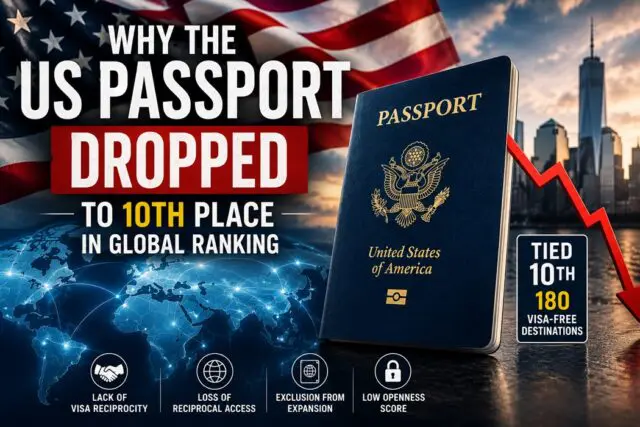
Why the US Passport Dropped to 10th Place in Global Ranking: What It Means for Americans and the Diaspora
For decades, the United States passport has been regarded as one of the world’s most powerful travel documents, offering American citizens access to hundreds of destinations with minimal visa restrictions.
However, the latest global passport rankings reveal a significant shift. The US passport is now tied for 10th place with Iceland, providing visa-free or visa-on-arrival access to 180 destinations.
While 180 destinations still represent substantial travel freedom, the decline reflects a broader change in international mobility and diplomatic reciprocity. Analysts say the biggest reason behind the drop is not that Americans have lost access to many countries, but that the United States has maintained relatively strict entry rules for foreign visitors.
For millions of Americans living overseas, including members of the Kenyan diaspora who have become US citizens, the change highlights how international visa policies increasingly depend on mutual cooperation between nations.
Current US Passport Ranking
According to the latest global mobility assessments, the United States now shares 10th position with Iceland.
Although American travelers can still visit most major tourism and business destinations without obtaining a visa beforehand, several countries have surpassed the US by negotiating stronger reciprocal travel agreements.
Leading passports now belong to countries whose governments have adopted more balanced visa policies that benefit both their own citizens and foreign travelers.
The Main Reason: Lack of Visa Reciprocity
The biggest factor behind the decline is visa reciprocity.
Visa reciprocity means two countries agree to offer similar travel privileges to each other’s citizens. If Country A allows visa-free travel for citizens of Country B, Country B often extends the same privilege in return.
The United States, however, offers visa-free entry to citizens of only about 42 countries, far fewer than the number of destinations Americans themselves can enter without visas.
This imbalance has increasingly affected America’s standing in international mobility rankings.
Many countries view reciprocal visa agreements as an important aspect of diplomatic relations. When reciprocity is lacking, governments may decide not to expand visa-free access for American travelers.
Countries Have Responded with Their Own Restrictions
One of the clearest examples is Brazil.
Brazil recently reinstated visa requirements for American citizens after years of allowing visa-free entry. Brazilian authorities cited the principle of reciprocity, arguing that since Brazilian citizens still require visas to visit the United States, Americans should face similar requirements.
This decision illustrates how visa policies have become increasingly linked to diplomatic fairness rather than tourism alone.
Other nations may adopt similar approaches if reciprocal agreements are not expanded.
America Missing Out on New Visa-Free Agreements
Another reason for the decline is that the United States has been excluded from several recent expansions of visa-free travel programs.
Countries seeking to strengthen tourism and international business have introduced new reciprocal travel arrangements with selected nations.
However, the US has not been included in some of these new agreements, including expanding travel access involving countries such as China and Vietnam.
As more bilateral agreements are signed around the world, countries that remain outside these arrangements gradually lose their competitive position in global passport rankings.
Low Score on Global Openness
Another important measurement affecting passport strength is the Henley Openness Index, which evaluates how welcoming countries are to international visitors.
The United States consistently ranks relatively low because it maintains strict visa requirements for most foreign nationals.
While American citizens enjoy broad international access, travelers seeking to enter the US often face:
- Lengthy visa application procedures
- In-person embassy interviews
- Extensive documentation requirements
- Long appointment waiting periods
- Higher refusal rates for certain nationalities
This limited openness reduces the overall global influence of the American passport compared to countries with more liberal entry policies.
What This Means for Americans Living Abroad
For millions of US citizens residing overseas, including naturalized Americans from Kenya and other African countries, the practical impact remains relatively small.
An American passport still provides access to most popular destinations for tourism, business, education, and family visits.
However, travelers should pay closer attention to changing visa policies before planning international trips.
Countries may increasingly review reciprocity when determining entry requirements for American visitors.
Implications for the Kenyan Diaspora
Many members of the Kenyan diaspora eventually become US citizens.
For these individuals, the American passport continues to offer significantly greater travel flexibility than many developing-world passports.
Nevertheless, the latest rankings demonstrate that even the world’s strongest passports are not guaranteed to remain at the top indefinitely.
International mobility increasingly depends on diplomatic cooperation, reciprocal visa arrangements, and evolving geopolitical relationships.
Why Passport Rankings Matter
Passport rankings influence more than tourism.
They affect:
- International business travel
- Global investment opportunities
- Student mobility
- Cross-border employment
- International conferences
- Family reunification
- Emergency travel flexibility
Governments therefore pay close attention to maintaining strong diplomatic relationships that preserve travel freedom for their citizens.
Could the US Passport Rise Again?
Experts believe the United States could regain higher rankings if it expands reciprocal visa-waiver agreements with more countries.
Improving international cooperation, modernizing visa policies, and simplifying entry procedures for visitors could strengthen America’s standing in future global mobility indexes.
As global travel continues to recover and diplomatic partnerships evolve, passport rankings are expected to remain highly dynamic.
Conclusion
Despite slipping to 10th place globally, the US passport remains one of the world’s strongest travel documents, offering visa-free or visa-on-arrival access to 180 destinations.
The decline is less about Americans losing travel privileges and more about the United States maintaining stricter entry requirements than many of its international partners. As countries increasingly emphasize reciprocity in visa policies, future passport rankings will depend not only on where citizens can travel but also on how open nations are to welcoming visitors from abroad.
For the diaspora community, the development serves as a reminder that international mobility is shaped by diplomacy, mutual agreements, and changing global relationships.