

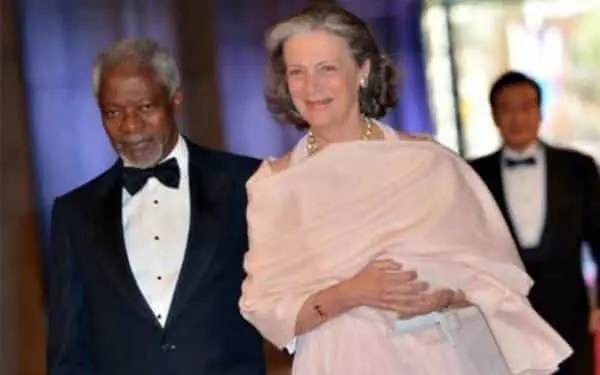
Photos of Nane Maria Annan: The Woman Who Stood Beside Kofi Annan
Following the passing of former United Nations Secretary-General Kofi Annan in 2018, many people around the world have remained curious about the remarkable woman he left behind—Nane Maria Annan.
More than simply being the widow of one of the world’s most respected diplomats, Nane Maria Annan has built an impressive career as a lawyer, humanitarian, refugee advocate, and champion for women’s and children’s rights.
Her lifelong dedication to humanitarian causes has earned her global respect and continues to inspire leaders, development organizations, and diaspora communities worldwide.
Who is Nane Maria Annan?
Nane Maria Annan (born Nane Lagergren) is a Swedish lawyer and humanitarian best known as the wife—and now widow—of former UN Secretary-General Kofi Annan.
Born in Stockholm, Sweden, she studied law and graduated in 1968 before beginning her legal career as an assistant judge in Sweden’s administrative and fiscal court of appeal.
Rather than remaining solely in the legal profession, she transitioned into public service and international humanitarian work, dedicating much of her life to defending vulnerable communities.
A Family Legacy of Courage
Nane Maria Annan comes from a family known for humanitarian service.
She is the niece of Raoul Wallenberg, the legendary Swedish diplomat credited with saving tens of thousands of Hungarian Jews during the Holocaust before mysteriously disappearing in Budapest in 1945.
In 2001, Nane and Kofi Annan jointly unveiled a monument honoring Wallenberg in Stockholm, celebrating his extraordinary courage and commitment to protecting human life.
Career with the United Nations
In 1981, Nane Maria Annan joined the United Nations High Commissioner for Refugees (UNHCR) as a legal officer in Geneva.
Her work centered on:
- Refugee protection
- Human rights
- Women’s empowerment
- Children’s welfare
- Combating ethnic discrimination
- Disability inclusion
- Poverty reduction
Over several decades, she became widely respected for advocating on behalf of displaced people affected by war, persecution, and humanitarian crises.
Marriage to Kofi Annan
Nane and Kofi Annan met while both were working within the United Nations system.
The couple married in 1984 in New York, beginning a partnership that lasted until Kofi Annan’s death in 2018.
Before marrying Nane, Kofi Annan had been married to Titi Alakija, a Nigerian woman, with whom he had two children:
- Ama Annan
- Kojo Annan
Their marriage ended before Annan married Nane.
Throughout Kofi Annan’s tenure as the seventh Secretary-General of the United Nations (1997–2006), Nane became an influential advocate for humanitarian initiatives worldwide.
Champion for Women and Children
Rather than occupying a ceremonial role, Nane Maria Annan used her international platform to advance meaningful social causes.
Her advocacy has included:
- Improving maternal and child health
- Expanding educational opportunities for girls
- Fighting poverty
- Supporting refugees
- Promoting gender equality
- Protecting vulnerable communities
She also supported initiatives connected to the Kofi Annan Foundation, which continues promoting peace, democracy, and sustainable development.
Continuing Kofi Annan’s Legacy
Following Kofi Annan’s passing in August 2018, Nane Maria Annan continued supporting humanitarian causes while preserving the legacy of her late husband.
She remains active in global conversations surrounding:
- Peacebuilding
- Human rights
- International cooperation
- Sustainable development
- Refugee protection
Her work reflects the values that defined Kofi Annan’s distinguished diplomatic career.
Why Her Story Matters to the Kenyan Diaspora
Nane Maria Annan’s work resonates strongly with Kenyan communities living abroad.
Thousands of Kenyans reside in countries that host refugees, immigrants, and asylum seekers, including the United States, Canada, the United Kingdom, Australia, and across Europe. Her decades of advocacy underscore the importance of protecting displaced populations and promoting inclusive societies.
For Kenyan professionals working in international organizations, humanitarian agencies, immigration law, and global development, her career serves as an example of how legal expertise can be used to advance social justice on a global scale. It also highlights the growing role of Africans and their partners in shaping international diplomacy and humanitarian policy.
Immigration Implications
Nane Maria Annan’s work with UNHCR highlights the increasing importance of international refugee protection and migration governance.
According to the United Nations High Commissioner for Refugees, more than 120 million people worldwide have been forcibly displaced due to conflict, persecution, and violence in recent years. This includes refugees, asylum seekers, and internally displaced persons, making refugee protection one of the world’s most pressing humanitarian challenges.
For Kenyan migrants and diaspora communities, these developments reinforce the need to understand international immigration systems, refugee rights, and the legal frameworks that protect vulnerable populations across borders.
Expert Opinion
Humanitarian experts emphasize that individuals like Nane Maria Annan demonstrate how diplomacy extends beyond political negotiations. Effective humanitarian leadership often involves long-term investments in education, legal protection, women’s empowerment, and refugee assistance.
Experts also note that partnerships between governments, international organizations, civil society, and diaspora communities are increasingly essential in addressing global displacement, poverty, and social inequality.
Global Statistics
Several global indicators highlight the significance of the issues championed by Nane Maria Annan:
- Over 120 million people are currently forcibly displaced worldwide.
- Women and children account for the majority of the global refugee population.
- Millions of refugees remain displaced for more than a decade before achieving permanent solutions.
- International organizations continue to rely heavily on humanitarian partnerships and diaspora engagement to support vulnerable communities.
These figures illustrate why continued advocacy for refugee protection and social justice remains critical.
Conclusion
Although widely recognized as the widow of former UN Secretary-General Kofi Annan, Nane Maria Annan has established her own distinguished legacy through decades of legal service, humanitarian leadership, and advocacy for vulnerable populations.
Her commitment to refugees, women, children, and marginalized communities continues to inspire global humanitarian efforts and offers valuable lessons for the Kenyan diaspora, whose members increasingly contribute to international development, diplomacy, and social justice initiatives around the world.